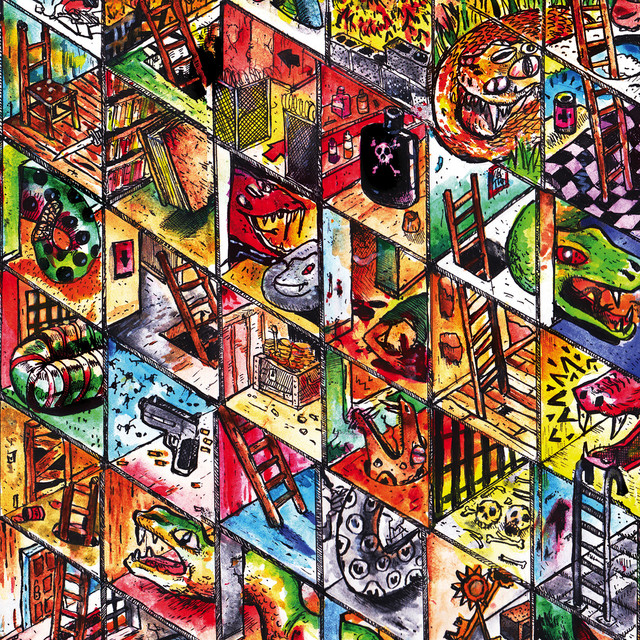
Long before it became a children's board game, Snakes and Ladders was a moral instrument known as Moksha Patam in India. Painted cloth boards carried players through squares named for virtues and vices: faith, reliability, generosity, anger, theft, dishonesty. Ladders lifted a player at one square, snakes pulled them down at another, and the whole design made the architecture of consequence visible. The goal was understanding the path itself; liberation from the board meant liberation from the cycle of rebirth. I have always been drawn to that older version because it treats a game as a ledger of cause and effect, where every roll lands you on a square with a name and a moral. The board could be folded and stored, but its lessons stayed in the room.
That ledger is the right frame for Armand Hammer's Snakes & Ladders. The Queens duo of billy woods and Elucid formed in 2013 and have made music together across two decades. Snakes & Ladders arrived on Backwoodz Studioz without advance notice, begun soon after they finished Mercy, their second album with the Alchemist. The production comes from a large roster: clipping., Kenny Segal, Sebb Bash, Preservation, Steel Tipped Dove, all shaped by longtime engineer Willie Green's dry, close-mic discipline. That many hands should have produced a patchwork, yet the record feels like one long, anxious breath. Both woods and Elucid have young children, and fatherhood sits in the lyrics as a reason to keep climbing, without sentiment. I hear the record as their most present-tense work: a map of how to survive a rigged board when you are responsible for other players.
The album's opening track, Deadbolts, is the clearest ladder on the old Moksha Patam board. Elucid's verse follows a drive through a post-snowstorm Brooklyn, past Con Ed trucks and cop cars, before he makes it inside to "Thyme, rosemary and sage, butter baste." His son asks whether he is happy. The kitchen is a square you reach and still have to defend. That same indoor relief returns on Vespers, where words from Jayne Cortez's There It Is open the song and a voice describes a dismal tide outside while the room stays dry. The album's power is in refusing to pretend the dry room is permanent. Send for Me strips the drums away to a beatless paranoia, Lock Out/Tag Out mutters about redacted paperwork and watchers watching watchers, and Nightswim reduces state terror to a torturer's routine: "The king's torturer eat slow, then wipes his lips." I find that image more frightening than any shouted threat, because it makes violence as ordinary as supper.
The historical snakes on the old board coil hardest on Dragon Teeth, where a verse names the Interahamwe and machete season, then answers mass atrocity with a strawberry: "a strawberry plucked as you fall." On the Moksha Patam board, that strawberry is the square marked generosity, a ladder reached only after the snake. Jet Magazine lands on a loss square: the beat snarls, a laugh stutters, and the rapping turns a padlocked game into blacktop and have-nots. I keep returning to TimesTables, where a father drives himself to hospital with a fishbone crosswise in his throat, a stubborn, solitary image and a square you land on and must mark. Dogville appears later in the tracklist, and I would queue it after Jet Magazine, a player checking the next ladder.
Some squares are warm on the Moksha Patam board. don't say it if it isn't true carries a warm soul loop and a rare romantic candour: fitted sheets pop off corners, and the narrator admits he might not be being truthful. Gravity floats on a dusted vocal sample and delivers the album's thesis without flinching: some debt is owed, everything else is borrowed. Assembly Lines turns that debt into a job application handled by ChatGPT and an interview conducted by AI, a bar that made me pause because it is both funny and completely plausible. Risk, the only track with a featured rapper, brings in $ilkmoney of Richmond. These songs offer the small victories of staying dry, staying employed, staying present, the tiny ladders you can still climb.
My one reservation is that the album's final stretch leans on texture over verse in places. Incidentals builds its whole hook from two scratched phrases, one dry voice saying for incidentals and another crooning about keeping the key to a heart; it is clever but slight next to the dense writing around it, a blank square on the board. Graveside repeats "I see you in the grave, I see you in the dirt" until the words sink under a wailing soul sample, and while the mood is suffocating, the repetition does less than the album's better songs. The closing track is called if we must die, and I wish the record had ended with one of its sharper lines. Dogville, Assembly Lines, Risk, and if we must die round out the tracklist, and the few moments that lean on sample manipulation do not undo the album's grip.
This record is for the listener who wants rap to work as moral philosophy, the kind who would study a Moksha Patam board before rolling, without losing the grit of a Queens winter. Put it on after dark, on headphones, when the news has already done its worst. If you love billy woods's solo records, ELUCID's own work, or Navy Blue's grim patience, start with Deadbolts, Jet Magazine, and Dragon Teeth. Leave it alone if you need hooks, choruses, or comfort: Snakes & Ladders offers none of the first two and only a rationed, hard-won version of the third. I would play it for someone who thinks rap cannot handle fatherhood and historical violence in the same breath.
The original game ended when a player reached the final square, but the board always stayed folded in a drawer, ready for another round. Armand Hammer's Snakes & Ladders never folds away. The ladders are real but short, the snakes are patient, and the dice are loaded by forces you can name but rarely see. I keep thinking of the kitchen in Deadbolts: thyme, rosemary, sage, butter basting, and a child's question waiting at the table. That is the whole game in one square.