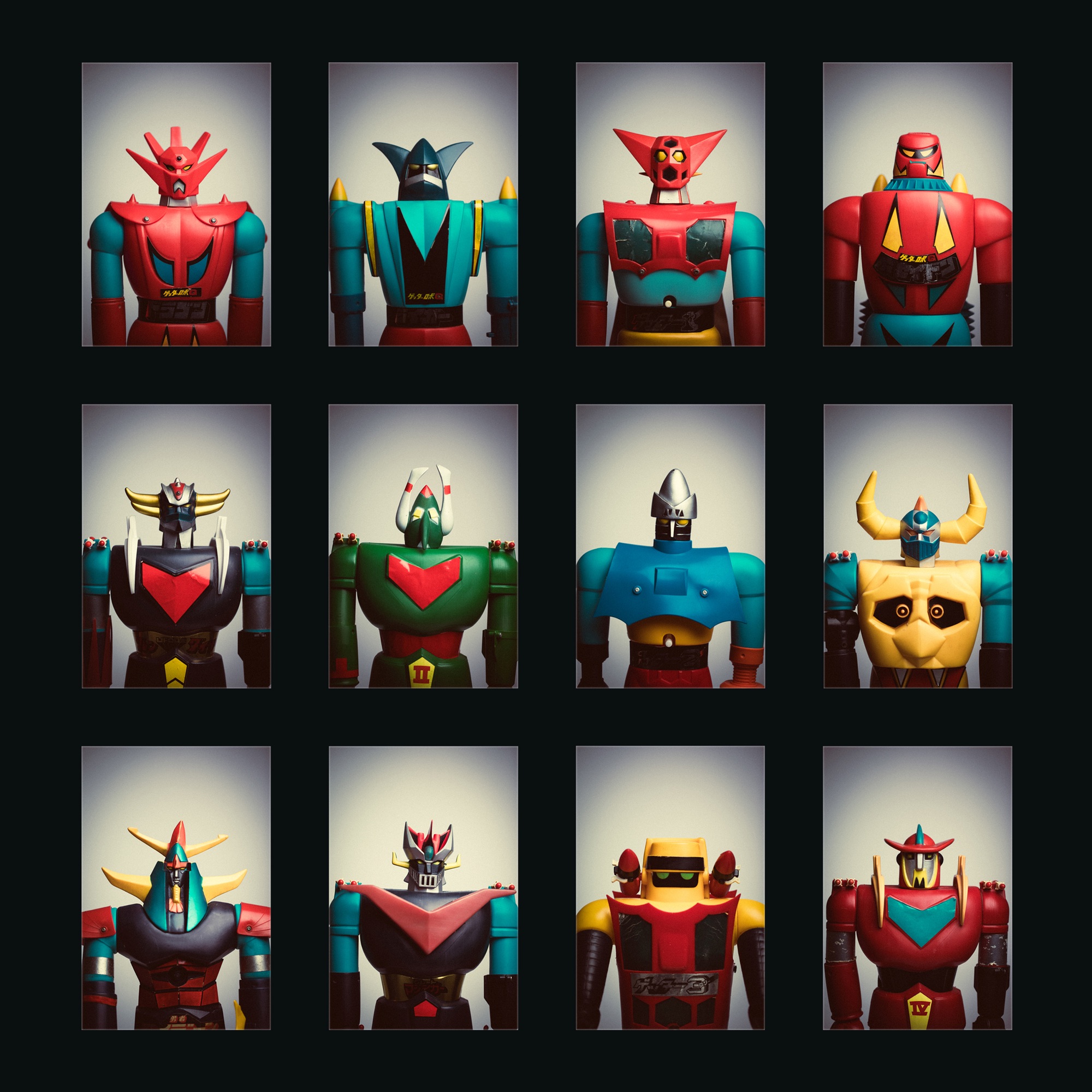
In any old toy box, a wind-up robot walks in a straight line until its spring runs down. Its arms swing in a fixed arc, its eyes light up or don't, and its feet click against the floor. What fascinates me about these toys is that they never pretend to be alive. Their mechanism is visible in the slow turn of a key, the pause before the first step, the way they stop exactly where you left them. They are built to repeat a single human gesture with perfect, pointless fidelity. I keep thinking of them while listening to Donato Dozzy's Astro.
Dozzy, born Donato Scaramuzzi in Rome, spent his boyhood collecting robot toys and 7-inch records. Those two shelves, the mechanical and the musical, sat side by side. Astro is the record where they finally shake hands. Out now on Tresor, the album's title track borrows its drum part from a theme song he loved as a kid. The result is a polished, immersive record that feels both retro and futuristic, like a toy robot that has learned to play a slow, steady groove.
The album opens with Ryoma (Prologue), a piece that plants a melody like a spring being wound. That melody returns in Ryoma (Lò Song), the closing track, which lasts eight minutes, as if the whole record is a mechanism that completes one cycle and resets. Between those two points, Dozzy keeps a steady beat under the synth textures of Astro, Raydeen, Himika (M Song) and Pegasu. The synth textures are wordless and polished, the production immersive. I hear a loop that never tires, a gesture repeated until it becomes a kind of stillness.
The title track is the record's centre and its clearest autobiographical gesture. Its drum part comes straight from a theme song Dozzy loved as a kid, and he lets that source hover just out of recognition. The beat is a toy's heartbeat, steady. I think this is the album's best move: it turns nostalgia into structure. Jumbo Crack pulls the opposite way. It is abstract and beatless, a texture that hangs in place. Some listeners will hear it as filler, and I understand that reservation. To my ear it works as the necessary pause, the moment the wind-up toy pauses to show its works. Without that exposed mechanism, the rest of the record would be too smooth.
Raydeen and Himika (M Song) follow with more of the album's synth-heavy drive, their wordless textures keeping the record's polished immersion intact. Then Pegasu arrives like a highlight: its steady beat and retro-futuristic sheen feel like the album's smile, the boy with his robot toys now letting the machine sing. I keep going back to this track because it makes that loop of childhood feel earned. The closing Ryoma (Lò Song) stretches that opening melody across eight minutes, unhurried and immersive. By the end, the eight minutes feel warm and steady. The melody completes its cycle, and I am left with the same satisfaction as watching a wind-up toy finish its walk.
What Astro represents in Dozzy's path is a homecoming without a museum label. The toy robots and 7-inch records of his Rome boyhood are the motor here, keeping the gears turning. The songs work like wind-up toys: each one winds the same spring, plays the same phrase, and then resets. I love how the album balances polished production with a mechanical edge. Both are present, and both are honest.
This record is for the listener who likes their techno with a soft, nostalgic edge, the kind of person who keeps an old toy on a shelf and a 7-inch on the turntable. If you love deep, droning techno or precise sound design, Astro will fit your evenings. For something smaller, try the slow-burning end of electronic music. Play it late, on headphones or in a car on a long night drive, and start with the title track or Pegasu. Leave it alone if you need vocals or immediate hooks; this is machine music for patient ears.
A wind-up robot toy plays the same walk for as long as its spring holds. Its gears still turn, its steps still click. Astro leaves me with the same feeling: a machine built from a boy's two collections, robot toys and 7-inch singles, still playing after decades. I am happy to keep listening.