Yeat’s New York Times announcement for ‘ADL’ is less a traditional rollout and more a statement on the new geography of musical prestige.
The most revealing artifact in the lead-up to Yeat’s double album ‘ADL’ is not a single, nor a cryptic social media post. It is a full-page advertisement in the New York Times. In stark black and white, the ad lists an improbable roster of collaborators: Elton John sits beside Lil Wayne; Kid Cudi shares space with the electronic producer Mura Masa; Drake and Young Thug are aligned with the indie rock band Unknown Mortal Orchestra. This is not a simple tracklist reveal. It is a cultural map, drawn in the bold typography of a legacy newspaper, plotting the coordinates of a new musical landscape where genre and generation are no longer meaningful borders.
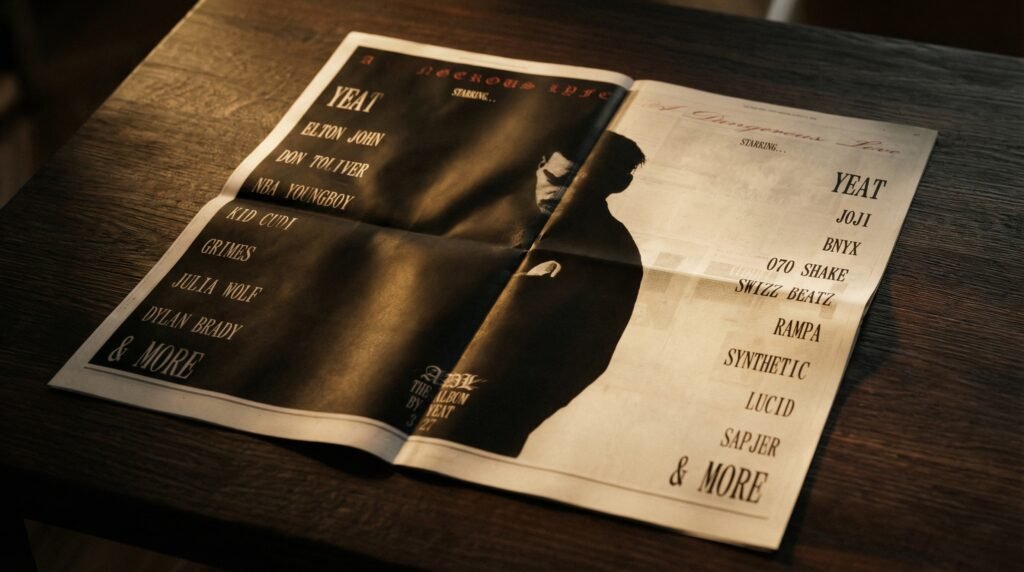
The gesture itself is a calculated anachronism. In an era defined by algorithmic discovery and vertical video snippets, buying space in the Times is an act of deliberate, almost confrontational, physicality. It asserts permanence in a flow of digital ephemera. It borrows the institutional gravity of the “paper of record” to legitimize a project that, by its featured list, deliberately destabilizes traditional hierarchies of taste. The ad does not just announce an album; it performs a cultural reset, using the ultimate establishment platform to frame a post-establishment vision of music.
The collaborator list is the core of this statement. It reads less like a musical credits sheet and more like a meticulously curated moodboard for a specific, digitally-native sensibility. The through-line is not genre, but a kind of textured affect. Yeat’s own sound—a slurry, synth-drenched take on rap obsessed with wealth, alienation, and pharmaceutical haze—acts as a gravitational field. It pulls in Elton John’s melancholic piano grandeur and Unknown Mortal Orchestra’s warped psychedelia, not for classicist cred, but because they share a tonal resonance, a particular shade of opulent unease. The inclusion of figures like Mura Masa or the electronic artist Vegyn suggests a producer’s mindset, where voice and texture are components in a wider sonic design.
This move reflects a broader shift in how prestige and influence are constructed. The old model involved clear lineages and guarded scenes. The new model, exemplified here, is networked and associative. It treats the entire history of recorded sound as a sample bank, where credibility is built not by allegiance to a single genre, but by the intelligence of one’s connections. The Times ad makes these connections literal and public, transforming what could be a streaming service metadata list into a cultural event. It is a bid to frame Yeat not merely as a rap phenomenon, but as a central node in a vast and eclectic web of sound.
Ultimately, the ‘ADL’ announcement is a powerful piece of image-making. It understands that an album’s context is now inseparable from its content. By choosing the newspaper page over the Instagram story, and a sprawling, genre-oblivious list over a tight, scene-specific one, Yeat is crafting a narrative of ambition that transcends music. He is staging a collision of formats and eras, using the weight of old media to launch a vision of a borderless musical future. The success of the album will be judged on its sounds, but the success of this gesture is already evident. It has turned an album announcement into a concise, compelling argument about how music now claims its place in the world.