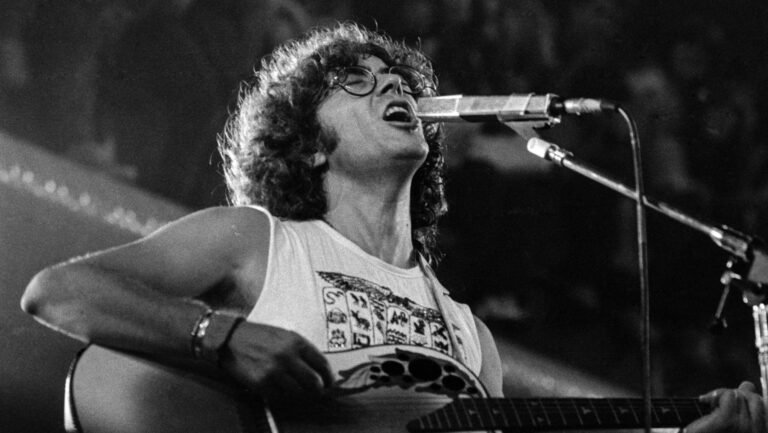
The author of “Mi Viejo” and “Soy Pan, Soy Paz, Soy Más” died on Oct. 7 in Buenos Aires, leaving behind a catalog that tied Latin American songwriting to social protest and cost him years of exile.
Piero died on Oct. 7 at Hospital Italiano in Buenos Aires. He was 81. His family confirmed the news on Instagram, writing that his voice, his songs and his message of peace would stay with those who heard them.
Born Piero Antonio Franco De Benedictis in Gallipoli, in Italy’s Apulia region, in 1945, he arrived in Argentina at the age of three. By the early 1970s he was a household name, co-starring with Luis Sandrini in Fernando Ayala’s film El Profesor Patagónico. The albums that followed, Pedro Nadie (1970), Coplas De Mi País (1972) and Para El Pueblo Lo Que Es Del Pueblo (1974), turned him into a political figure as much as a musical one.
His partnership with the Argentine journalist and poet José Tcherkasky gave that work its shape. Together they built social portraits and short stories with a wide reach, often carried by Jorge López Ruiz’s orchestrations, in songs such as “Valdemar, El Brasilero” and “Los Americanos,” recorded with Cuarteto Zupay. The Panamanian salsa singer Rubén Blades has cited that repertoire as an influence.
Para El Pueblo Lo Que Es Del Pueblo included “Así Es La Ciudad,” a collaboration with Marilina Ross, and a version of Víctor Jara’s “Te Recuerdo, Amanda,” released the year after Jara was assassinated under Augusto Pinochet.
After the March 1976 coup, Piero went into exile, living in Italy and Spain and settling near Madrid, where he worked on a farm. He maintained strong ties to Colombia, where his children’s album Sinfonía Inconclusa En La Mar (1975) remains a reference point for several generations. In 1981, with the civil-military dictatorship nearing its end, he planned his return to Argentina, stopping first in Uruguay and assembling a new band, Prema, with guitarists Amadeo Álvarez and Daniel Manzini. Its shifting lineup would include pianist Babu Cerviño and drummer Juan Carlos “El Negro” Tordó.
Join the Club
Like this story? You’ll love our monthly newsletter.
Thank you for subscribing to the newsletter.
Oops. Something went wrong. Please try again later.

ROMBO Editorial Staff
The collective voice behind ROMBO Magazine’s news, reviews, features, and cultural coverage.