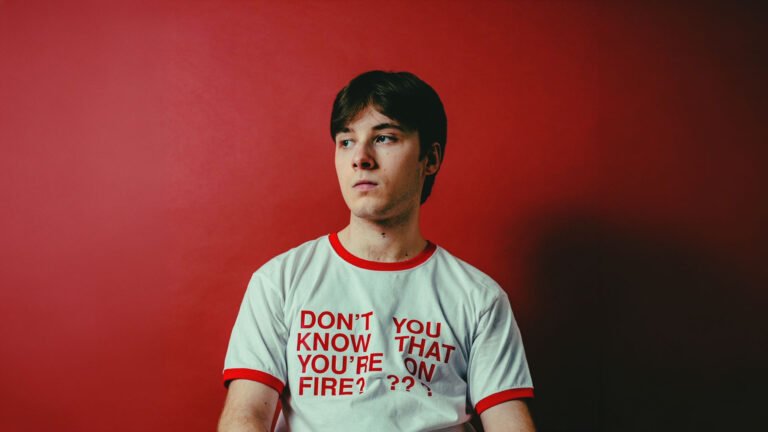
After Find Your Footing, the East Midlands artist steps into a slower room where the night stays inside the sleeping bag and a voice still carries through the trees.
Oliver Paul, born Oliver James Newton, is twenty-one and based between Derby and Leicester. He came through BIMM Birmingham and has already moved through bands including Yakov McIntosh and Dorset Caravan. In a recent conversation he described the work as messy melodic art punk for the kids who got picked last in PE, and named desert-island records by David Bowie, Television and Nas. We already wrote about his debut single on these pages. Find Your Footing arrived with a clearer outdoor edge. Fear Of Bears stays closer to the house.
There is a particular habit of leaving the porch light on when the conversation inside is still unfinished. The light does not invite the dark in. It marks the exact line where the room ends and the night begins. Children used to treat that line as a boundary against whatever might be moving past the garden. Adults keep the same light on for shorter reasons: late returns, one more sentence, the simple fact that someone is still awake. Fear Of Bears works inside that narrow band. The title names an old fear, yet the song never stages a chase. It stays with the person already inside the bag.
The track opens with a suspended, ethereal atmosphere shaped by a dirty guitar riff and soft pad carpets that keep the space floating. The energy stays controlled and hypnotic, moving on a discreet rhythmic pulse that holds a slow, meditative pace. The voice enters slowly. “Trapped inside my sleeping bag / Shadows roam under the porch light.” A sleeping bag is a temporary den. The line turns it into a held space. Later lines move further out: her voice that echoes through the forest into my cabin, and the image of floating on the lake with teeth bearing. The video keeps the same restraint, placing the singer directly to camera on a patio dressed with string lights and flowers, then cutting to the limited artificial light of the street beyond.
We spoke with Oliver Paul about the porch light that holds the boundary, the sleeping bag that becomes a temporary den, and how the track lets the night remain outside without forcing it into a story.
In Conversation with Oliver Paul
1. Find Your Footing felt more open and outdoor. Fear Of Bears stays closer to the house and the light that marks the edge of the night. What changed in the writing when the room became the main setting?
I suppose what changed with “Fear Of Bears” was the subject matter, as well as what I was listening to at the time. The first single was much more upbeat and hopeful, whereas this track is much more closed and intimate. At the time I wrote this song, it was towards the end of my second year at university, and I’d really gotten into slowcore music, namely Duster and Sign Crushes Motorist. Many of these tracks had minimal lyrics and I hoped to replicate this kind of structure and atmosphere.
2. The opening image places someone trapped inside a sleeping bag while shadows crawl under the porch light. How did that particular pair of pictures arrive, and what does the bag hold that the light outside cannot?
The track was inspired by an early childhood memory of reading the horror story “1999” about a serial killer who wears a bear costume. I then had recurring nightmares of being in a lone cabin with no furniture at all besides the sleeping bag I was in and the fear that I wasn’t alone. The sleeping bag holds a shed of hope that it is big enough to hide me from whatever lurks outside.
3. A voice echoes through the forest to the cabin. How far is that voice meant to travel, and does the cabin function as a fixed point or as something still being reached?
Often, if you’ve ever been outside late at night, you’ll hear many sounds. Whether it be crickets chirping, the wail of a late night freight train or maybe something more ethereal. The “voice” here is meant to represent these sounds, and the unsettled atmosphere they can sometimes bring, unsure if it’s just the natural breath of the evening or something more sinister. The true horror of the story being told in the song comes from the uncertainty if there is a real danger or not.
4. The line about floating on the lake with teeth bearing sits in the middle of the track like a sharper turn. What does that image open up once the porch and the sleeping bag have already been established?
Oliver: This line creates a real sense of urgency, but somewhat leaves the listener hanging as the song plays out almost like an unfinished story, this lyric being the last in the song. The listener knows that whatever’s out there is approaching… with its teeth showing. It makes the listener wonder if the sleeping bag will be enough to protect the protagonist from incoming danger.
5. The track opens with a dirty guitar riff and soft pad carpets, then holds a discreet rhythmic pulse. How did you decide on that balance between the guitar and the floating pads, and what did you want the pulse to do without breaking the suspended temperature?
Oliver: The synth pads were kind of a last minute addition, but proved to be really effective. They sound a bit amateurish, like a toy instrument, which really adds to the themes of childhood nostalgia, mixed with the somewhat harsh guitar tone, I guess hinting at something more sinister. I wanted the pulse to feel steady but nervous, creating a warm but uncomfortable feeling, a bit like being a kid in your room late at night, scared of what might be hidden in the shadows.
6. The video places you directly to camera on a patio with string lights, flowers and pale curtains, then cuts to the limited light of the street and the houses beyond. What made that particular contrast feel right for the song, and how much of the performance was shaped by the space itself?
I was really looking for the right atmosphere, something familiar and inviting, like warm string lights in a garden, but pairing it with the nighttime setting, it gave it a bit of a spookier vibe. I’d managed to convince my sister and her boyfriend to help me film the video, but on the condition that we stayed in the garden, so I really had to make do with what I had. Luckily my mum is obsessed with decorating, so the patio was well dressed for the occasion. We also recorded the video with the song played at 2x speed, the slow-motion effect attempting to create an unsettling viewing experience.
7. You have described the work as loose, imperfect and sentimental, and named records by David Bowie, Television and Nas as desert-island choices. How do those listening habits sit alongside a track that holds its tension this quietly?
I definitely create art through the lens of sentimentality and imperfection. I grew up really enjoying the human aspects of music, I find myself listening to a lot of outtakes for this very reason. I really enjoy seeing the effort and expression that goes into something. It’s also the reason I despise generative AI so much, the best art comes from true and unadulterated human expression. “Fear Of Bears” is a testament to this belief, it drowns in imperfections. I’m not the best singer in the world, or the best instrumentalist, but I put my all into everything that I do. I never create anything half-heartedly.
8. The title names a fear without turning the song into a chase. Once the light is on and the bag is zipped, what remains of that fear, and what does the track choose to keep rather than resolve?
The song is left on an intentional cliff hanger. It lets the listener interpret what happens next. Maybe the threat is miles away, bearing its teeth at another, separate prey altogether. Or maybe it really is mere feet away from the cabin, ready to strike. Either way, that fear won’t go away until the threat does first.
Follow Oliver Paul
Fear Of Bears is out now.
Listen: Spotify
Join the Club
Like this story? You’ll love our monthly newsletter.
Thank you for subscribing to the newsletter.
Oops. Something went wrong. Please try again later.

ROMBO Editorial Staff
The collective voice behind ROMBO Magazine’s news, reviews, features, and cultural coverage.