Ship-in-a-bottle builders work inside a glass prison by choice. The hull goes through the neck in pieces or with its masts hinged flat, and the rigging threads trail out like invisible tendons; once the ship sits on its painted putty sea, the builder pulls those threads to raise the masts and tighten the lines. Every knot tied inside is tied through the narrow opening with long tweezers, every glue dab gets pressed down with a wire hook. If a halyard snaps or the hull lists, the whole miniature world has to come out or stay crooked forever. I have always loved how much of the craft is hidden: the finished bottle shows a perfect ship, but the builder's work was a series of blind corrections in a space too small for a hand.
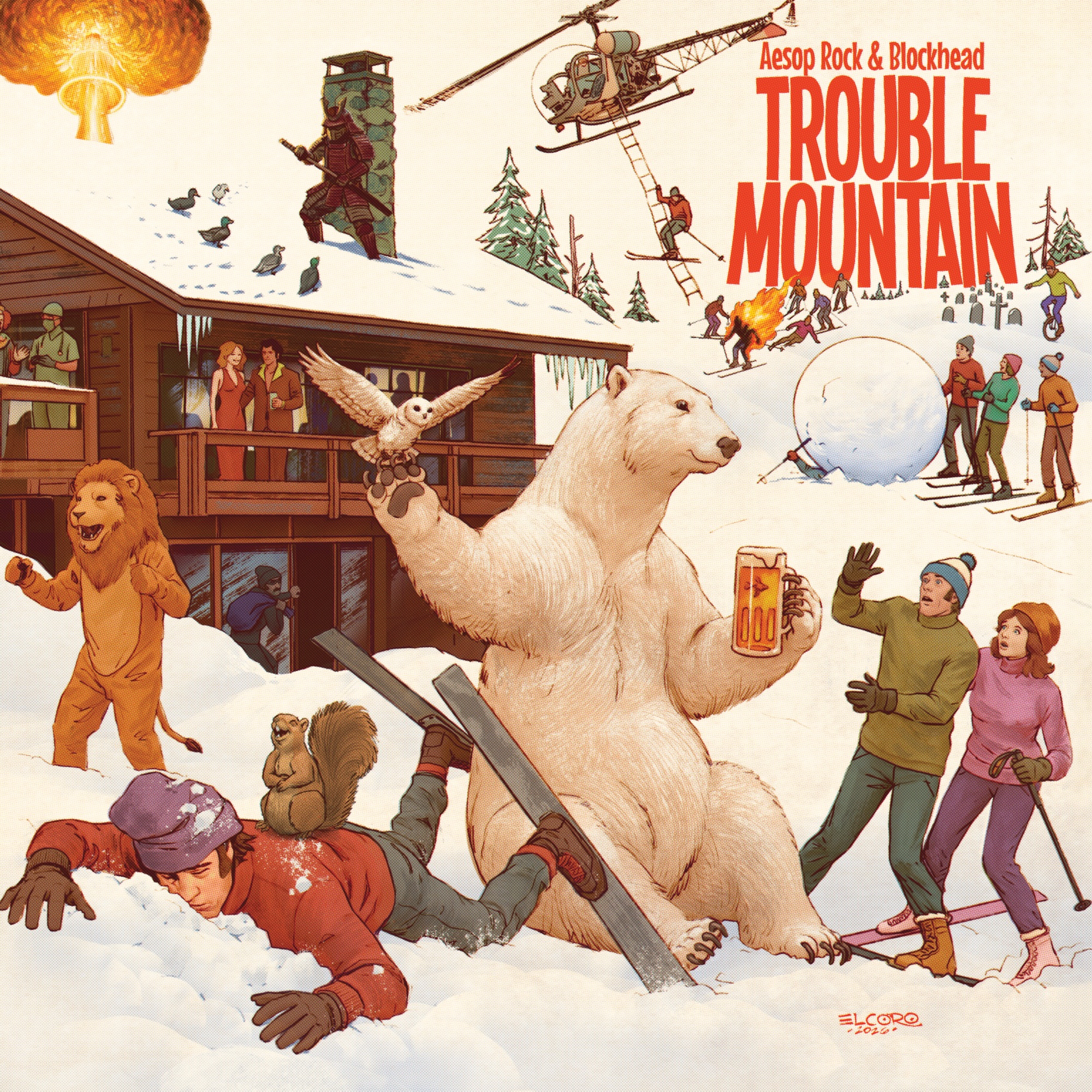
Aesop Rock and Blockhead do something similar on Trouble Mountain, their second full joint album after 2021's Garbology. Aesop Rock raps here with dense internal rhymes, and Blockhead, who handled production for the bulk of Labor Days, builds those spaces from samples that sound like they were slipped through a narrow neck and then raised into place. On this album, the two construct an invented ski lodge where local ski gangs may need fighting, a concept that comes from television commercials the two heard growing up. That far-off, slightly dangerous resort becomes a miniature world inside the record's glass, complete with a synthwave-style commercial that advertises Trouble Mountain partway through the album.
Aesop Rock's 13th album sits inside the sample-heavy underground hip-hop that both men have made their own: mid-tempo boom-bap, deep basslines, humming organ chords, melancholic horns, and a vocal that stays dry and upfront, packed with syllables. Yet there is a stubborn vitality in how the record keeps returning to the idea of a private world you build and defend. The ski lodge works like the bottle on a shelf, a thing you polish and occasionally shake. The first single, Trouble Trouble, frames the mountain as baggage, trauma, and life's indignities, and the rest of the record moves between that claustrophobia and the small rituals that make it survivable.
I keep going back to the way Swedish Death Cleaning opens the record. He works like a shipwright inside the bottle: the fingerpicked loop is the glass, and the rhymes are the rigging pulled through the neck. Aesop Rock's baritone moves through a fingerpicked acoustic loop and a crisp snare, and the line "The smarter I get, the dumber I give" lands with the flat exhaustion of someone who has studied himself into a dungeon. Vocal doubling reinforces the dark subterranean imagery on the line "This is under the dungeon where nothing lovable lives." That song sets the interior weather for the whole album: a mind that lives in tunnels and still insists on writing them down. Coyote Summer (feat. Hanni El Khatib) then steps outside, as if a window had been filed into the bottle, where a raspy sung hook and a deadpan rap exchange paint the night as a place to breathe, and Church Key carries the same urge to tag an expressway off-ramp even when feeling burnt.
The comic heart of the album is Hound Selector, and it solves the bottle problem by letting the miniature world contain a giant dog. The wolfhound puppy becomes a friend and a howling session turns into "all-out dog pound jazz." That line, delivered over lush orchestral strings and a warm bassline, is exactly the kind of domestic surrealism I want from Aesop Rock: the dog's big paws are war drums, the narrator starfishes in the dog's bed, and the whole gloomy mood gets howled out of the room. Mom One is almost as good, a straight-faced tribute to a mother's handwriting imagined as graffiti, built on the repeated boast "My mother could have been the illest graff writer ever." The beat is bright and nostalgic, with a call-and-response hook that keeps the joke grounded in genuine affection. One Thing (feat. Open Mike Eagle) changes register, a litany of fatalistic lessons that resolves in a chant of what it is, before Open Mike Eagle's verse brings a lighter, quicker cadence.
The album's best uptempo swings come on Easter, where a warped soul sample warns outsiders while a prowling bassline locks the territorial threat into place, and on Trouble Trouble, where the narrator rehearses a conqueror's speech before deflating it with a shrug. Ants breaks into a jam-session energy with a studio voice calling out Blockhead at the keys before the verse drops into a sled dog-led dreadnought, and No Interviews turns refusal into a manifesto of self-containment. TM Tours (feat. Baby Dayliner) is a useful palate cleanser, a synthwave commercial for the fictional lodge, though it feels slight beside the richer boom-bap cuts. To my ear, the production on Oatmeal feels murky and spacious, which suits the song, but Ewok feels like a sketch. Eat And Grow (feat. Cavalier & 4ize) brings in Cavalier and 4-IZE. The album then moves through The Bag and High and Outside to close with Buffering.
The listener who will love Trouble Mountain already knows the pleasure of stacking dense syllables against a sample loop until the room disappears. Start with Trouble Trouble and Hound Selector, then go to Easter and Eat And Grow (feat. Cavalier & 4ize). Play it on a night walk through an empty city, or in headphones while doing the dishes and burning sage. Neighbours: Homeboy Sandman's small-room absurdism, MF DOOM's masked verbal contortionism, and the blocky loops of early Blockhead solo records. Anyone who needs wide dynamic shifts or varied tempos should leave it alone; the whole album moves at the pace of a man counting his steps in a tunnel.
Shipwrights tie off the final threads through the bottleneck, then push the model into place on its sea of putty. The glass goes on the shelf and the miniature world stays fixed, a whole mountain inside a curve no hand can enter. Trouble Mountain works that way: a private lodge with its own commercial, its own dangers, and its own dog howling on the floor. By the time the record ends, I picture the bottle corked, the masts raised, and Aesop Rock still rapping inside the glass.