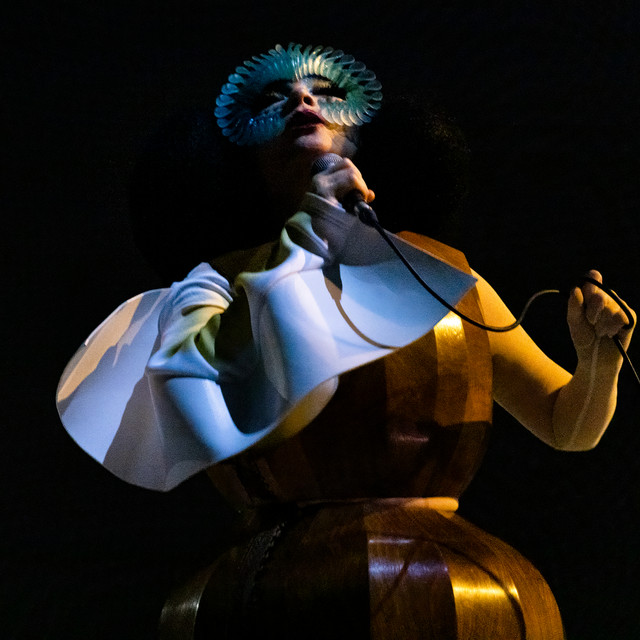
If you walked into the Venice Biennale this week expecting hushed gallery conversations, you walked into the wrong room. Björk turned the opening of the international art and cultural exhibition into a rave, playing a surprise DJ set that she dedicated to the artist chosen to represent Iceland, Ásta Fanney Sigurðardóttir.
She performed in a dress made from recycled fiberglass, drawn from Louise Trotter’s fall 2026 Bottega Veneta collection. It was a fitting look for an artist who has spent decades dissolving boundaries between sound, technology and textile work. The set came unannounced and felt like a gesture of solidarity rather than a promotional moment. Björk wrote on X that the performance was for Sigurðardóttir, rooting the music in the context of national representation rather than personal spotlight.
Amid the news from Venice, a quieter detail resurfaced. Last month, Björk casually mentioned “the new album in 2027” while giving updates on her work. She framed it without ceremony, just a practical note about timing. For an artist whose last full-length release was 2022’s Fossora, the timeline suggests a deliberate pace, one that matches the complexity of her recent projects. She also announced a solar eclipse rave planned for August, continuing a pattern of site-specific, environmentally aware gatherings.
What matters here is the way Björk moves between large-scale spectacle and intimate communication. A DJ set at one of the art world’s most prestigious events, a three-word phrase about her next album, and a planned natural phenomenon gathering all coexist without one overshadowing the others. She does not build hype. She places information where it belongs and trusts people to find it. In a season of carefully managed rollouts, watching a fiberglass-clad Björk turn a biennial into a dance floor while quietly resetting the clock on her recorded output feels like a complete statement in itself.