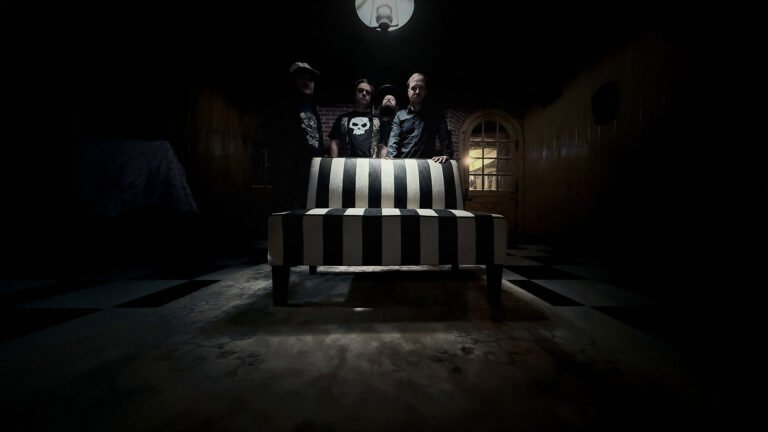
Thirteen years on, Block’s sixth album maps personal wreckage through ten sharply observed songs. Produced by Chris Kuffner and mixed by Blake Morgan, Love Crash refines the New York anti-folk voice into something quieter, more urgent, and unflinchingly present.
On his first album in thirteen years, the New York songwriter returns with ten tracks that treat personal wreckage as a site for meticulous excavation rather than dramatic reconstruction.
Block emerged in the late 1990s from New York’s East Village anti-folk scene with a debut that carried the grain of Beat-influenced storytelling and urban detail. A subsequent major-label album produced by Glen Ballard expanded the reach without softening the voice. Then came a long withdrawal into other work, followed by a gradual re-entry through catalog reissues and a new association with Meridian. Love Crash, released May 15 on that label, arrives as the sixth album and the first collection of new songs in over a decade.
The gap is audible in the songs themselves. These are not exercises in reclaimed youth or nostalgic revival. They carry the specific gravity of time passed and structures that did not hold. The anti-folk impulse toward direct address and narrative economy remains, now tempered by a refusal to resolve cleanly or perform recovery for an audience.

Produced by Chris Kuffner (Ingrid Michaelson, Regina Spektor) and mixed and mastered by Blake Morgan (ECR President, Lenny Kravitz, Lesley Gore), Love Crash presents a clear, present recording that foregrounds Block’s voice and acoustic guitar while allowing rhythmic undercurrents and textural restraint to do the emotional work. The arrangements never overwhelm the lyric; instead they create space around the storytelling, giving each song the feeling of a late-night confession captured in real time.
Where earlier work leaned into the loose, genre-bending energy of the anti-folk scene, this record sharpens the focus. Tracks such as “Over And Over” are built around a primal drum loop, captured live from a soundcheck and dropped into the session in one feverish Brooklyn day, mirroring the obsessive mental loop described in the lyric. The result is restless propulsion rather than polished groove. “Firefly,” by contrast, achieves a quieter, almost memorial stillness, its intimate production letting the memory of fireflies on a lawn and ashes in a mailbox sit unadorned. Across the ten songs the sound stays consistent: warm yet unsentimental, detailed without clutter, the kind of recording that rewards repeated listening by revealing new layers of vocal phrasing and subtle instrumental conversation rather than big dynamic shifts.
This is anti-folk matured—still story-driven and conversational, but now carried by a production sensibility that trusts the material to carry its own weight.
The album opens with “I Thought I Won The War,” a track that immediately undercuts any notion of victory. Strange events accumulate, white flags, air-raid sirens, a figure described as a “Punk rock Aphrodite” with a “tongue so sharp and wicked”, until the repeated refrain lands less as triumph than as bewilderment. The song treats romantic collision as a form of urban combat, complete with flares and no-man’s-land. It sets the tone: whatever has happened, the speaker is still inside the debris field, trying to read the signals.
“Over And Over” makes the mechanism explicit. The title phrase functions less as chorus than as symptom. The narrator describes fear of looking, breathing, knowing the extent of need; the mind skitters “like Anthony Bourdain” while dust floats “like little stars above the dusk.” Repetition here is not propulsion but entrapment. The song maps the interior weather of attachment that will not release its grip.
Grief arrives in starker form on “Firefly.” The details are domestic and final: ashes left in a mailbox, a body returned on a Sunday, the memory of someone dancing with fireflies on a lawn while stars blinked out. The song does not reach for consolation. It registers absence through the objects and rituals that remain. “Firefly” is one of the album’s quietest and most devastating tracks precisely because it refuses to turn loss into lesson.
Other songs extend the same unsentimental gaze. “Song To Jamie” offers counsel that feels earned rather than imposed, advice on misbehavior, time, and the world’s capacity to twist a person from the inside. “No One Ever Taught Me How” moves through a lifetime’s unlearned lessons: marriage, fatherhood, departure, the view of a child’s face in a window. The imagery is cinematic yet grounded: flying breaststroke over the Chrysler Building, packing bags while a daughter watches. These are not abstract emotions. They are sequences of events and their residue.
Block’s language favors precision over effusion. Even in tracks that circle obsession or regret, the writing stays close to observable detail and conversational cadence. “The Heartbreak Song” leans into a kind of deadpan inventory of coping strategies—borrow a dog, write a sestina, watch Tosh.0—without tipping into shtick. The humor functions as pressure valve rather than deflection.
The production gives the voice room and the arrangements clarity without crowding the songs. The architecture remains song-first: verses that accumulate evidence, choruses that sometimes function more as returns to a fixed point than as releases. This is consistent with a songwriter who has always treated the lyric as the primary instrument.
Geography recurs as material rather than postcard. The Chrysler Building appears in one song as something flown over in a dream of competence. Montauk, Long Island, SoHo, and the rain-slicked return to the city in “Still Life” all register as lived coordinates. The urban environment does not offer redemption; it simply continues, indifferent and therefore oddly stabilizing. Block has long written inside this continuum. On Love Crash the city functions as a quiet constant against which personal disarray is measured.
The closing track, “Still Life,” lingers in an installation space among lampshade cords and figurines. Someone asks if the stillness can be felt. The narrator rides the train back to the city and watches himself walk in the rain. The song acknowledges the temptation to remain suspended and the knowledge that motion will resume. It is a fitting endpoint for an album that documents the slow, uneven labor of remaining present after impact.
Love Crash does not frame survival as triumph or offer the consolations of narrative closure. It offers something more useful: a set of songs that treat heartbreak as a condition to be examined rather than performed. In doing so, Block continues a line of New York songwriting that values specificity, intelligence, and the refusal to look away. The work feels necessary because it remains exact.
Follow Block
Love Crash is out now via Meridian (ECR Music Group). Stream the album and explore more music below.
Listen: Spotify
Official: Meridian / ECR Music Group