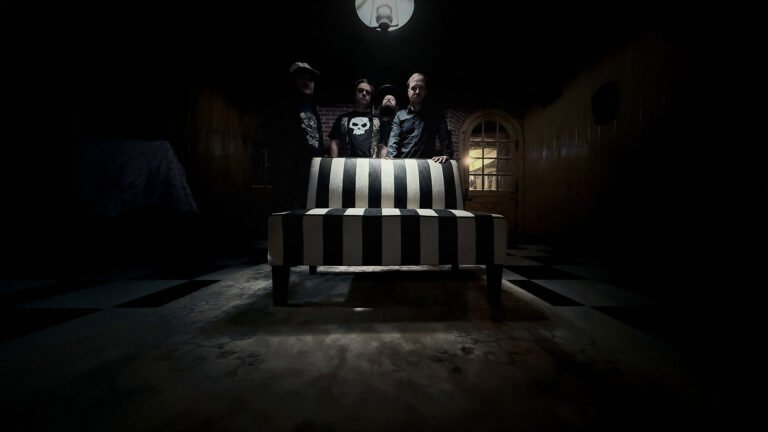
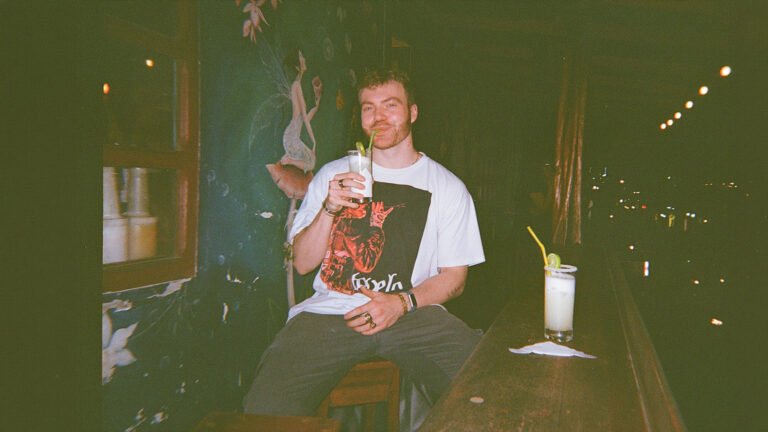
The Galway-born, Manchester-honed songwriter steps forward with a debut album that treats folk not as inheritance but as live material—intimate, oblique and built to last.
Thomas O’Donoghue, recording as Dove Ellis, was born in April 2003 in Galway on Ireland’s west coast. He spent his early years writing songs in relative solitude before moving to Manchester, where the city’s live circuit and shared rooms began to reshape his instincts. By late 2025 the 22-year-old had already opened for Geese on the American leg of their Getting Killed tour and released his debut album Blizzard through Black Butter and AMF Records. The record did not arrive as a calculated launch. It landed as the first clear transmission from a voice that had spent years learning how to carry weight without ornament.
Raised in Galway, O’Donoghue picked up the guitar at thirteen and began shaping songs almost immediately. Music at home was constant yet unforced; his mother had encouraged piano, but the six-string became the real catalyst. For years the process remained private—solitary recordings on a four-track, occasional teenage band attempts quickly abandoned. When he relocated to Manchester the insulation cracked. He describes those early Manchester months as humbling: he felt immature, unsure of his own voice, forced to test material in front of strangers rather than in his own head. The shift proved decisive. Informal sessions in London with friends sharpened his ear for collaboration, and by 2024 the first proper studio track, “To the Sandals,” emerged in Liverpool with engineer Sophie Ellis. That song became the hinge on which the album turned.
Blizzard is available to stream in full on Soundcloud and other platforms.
Blizzard was recorded across London and Liverpool in 2025, with mixing handled by Sophie Ellis and Andrew Sarlo. O’Donoghue self-produced the bulk of it, drawing on a small, consistent core of musicians: Fred Donlon-Mansbridge on saxophone, bass, clarinet and vocals, Matthew Deakin on drums and percussion, plus rotating contributors. The process was deliberately unhurried. Tracks were captured, set aside, revisited. The finished album—ten songs, thirty-four minutes—carries the trace of that patience. It feels assembled rather than performed, each layer tested until it either held or was discarded. The result is a record that resists both the acoustic-folk template and the polished indie-pop default. Instead it occupies a shifting middle ground where chamber arrangements meet oblique song structures and a voice that moves fluidly between exposed falsetto and fuller, more grounded projection.
What distinguishes Blizzard is the way Ellis treats sound as mutable architecture. The opening “Little Left Hope” begins with cello and saxophone entwined in a spare, almost classical figure before the song opens into something warmer and more folk-rooted. “Pale Song” drifts with a slow-motion jangle that recalls certain Radiohead ballads yet stays tethered to fingerpicked guitar and a vocal line that refuses to resolve neatly. On “Love Is” the arrangement surges with an Irish-folk pulse—accordion-like textures and driving rhythm—while the vocal sits right at the edge of breaking. Later tracks such as “Feathers, Cash” settle into a Tom Waits-tinged waltz, all smoke and minor-key melancholy, while “When You Tie Your Hair Up” builds through a bluesy crescendo that feels earned rather than imposed. Throughout, the saxophone of Donlon-Mansbridge acts as a second voice—sometimes harmonic shadow, sometimes disruptive colour—preventing the music from settling into easy pastoralism. Ellis has cited Prince’s self-reliant process as an early ideal, yet Blizzard is the work of someone who has learned the value of trusted collaborators without surrendering control. The songs feel personal without becoming confessional; they map emotional weather rather than narrate it.
“Pale Song” exemplifies the slow-motion jangle and vocal restraint that run through much of Blizzard.
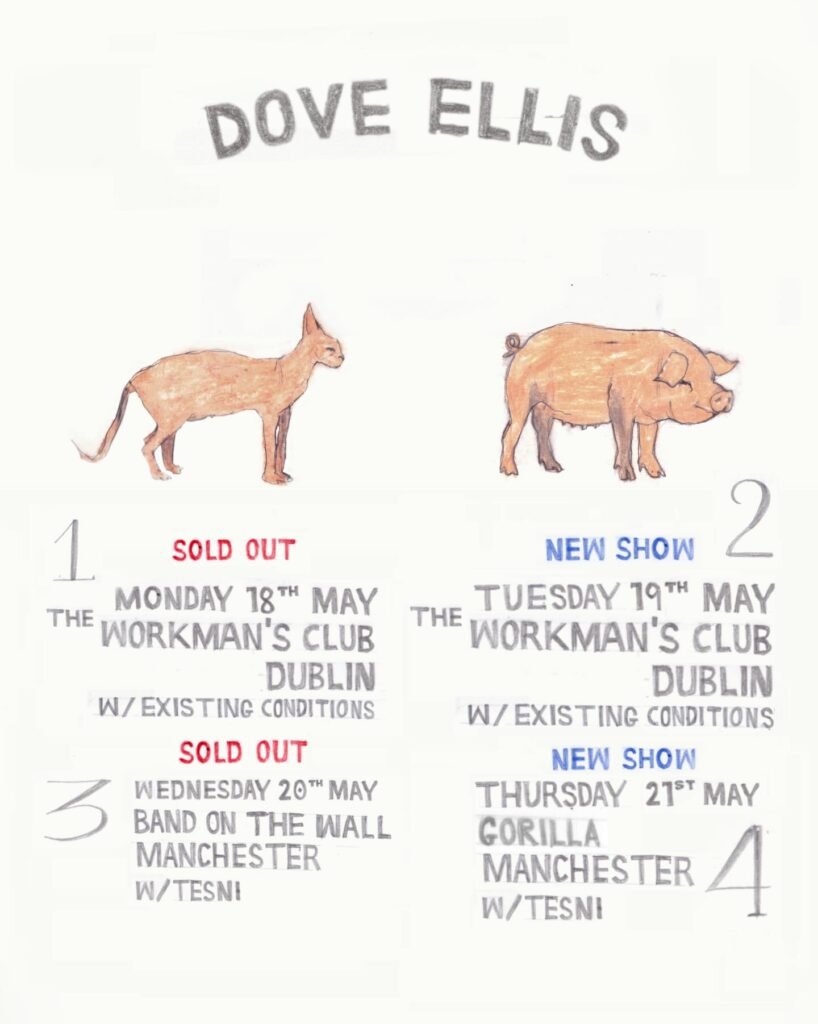
Live, Ellis has already demonstrated the same precision. The Geese support slots in late 2025 exposed his set to larger American audiences accustomed to more extroverted rock, yet the quiet intensity of his delivery held rooms. Headline dates followed at London’s ICA and in Dublin and Manchester, with physical copies of Blizzard appearing in May 2026. What the stage confirms is that these songs are not fragile in the pejorative sense; they are tensile. The same voice that can hover in falsetto on record cuts through a full band without strain. The arrangements, once layered in the studio, translate to a leaner but no less detailed live configuration built around the core of Donlon-Mansbridge and Deakin. Ellis has spoken of writing as a discipline rather than a series of lightning strikes—putting lines down even when inspiration feels distant. That discipline shows in performance: the set moves with purpose, never coasting on atmosphere alone.
In a landscape still dominated by rapid release cycles and algorithmic visibility, Dove Ellis has taken the slower route and arrived with a record that feels complete on first hearing yet rewards repeated attention. Blizzard does not announce a new star so much as introduce a songwriter who has already developed a distinctive grammar—one that bends folk tradition toward something more urban, more oblique and more emotionally exact. The Galway-to-Manchester axis matters here: it places Ellis within a lineage of Irish artists who have used distance from the capital to develop unhurried, personal voices, while Manchester’s current crop of inventive live acts provided the friction needed to sharpen the work. What remains compelling is the refusal of easy categorisation. This is not revivalist folk, nor is it chamber-pop pastiche. It is songwriting that understands atmosphere as structure and treats the first album not as a calling card but as the opening chapter of a longer conversation. In that sense Blizzard carries genuine weight—not the weight of hype, but the quieter, more durable weight of intention.