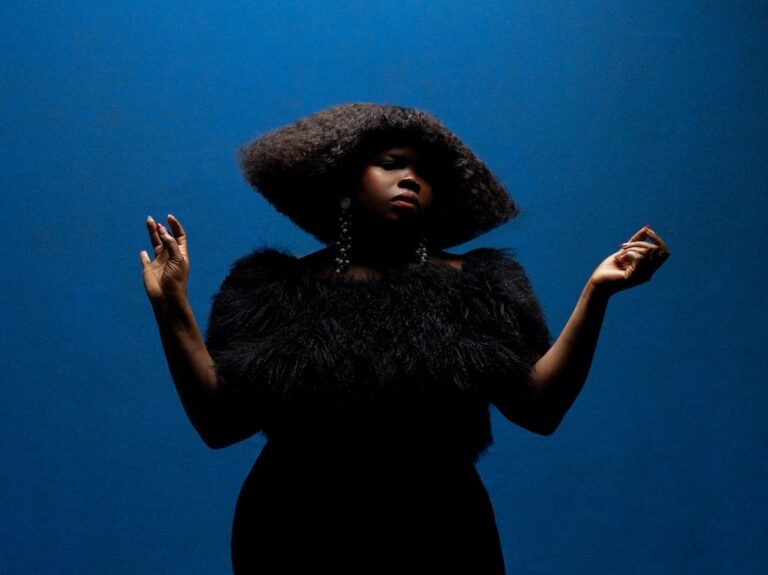
Kae Sera returns with The Moon (Sommernacht Remix), a late-night house reworking of her most streamed and most covered track to date. Liverpool-born and London-based, she has built her audience entirely independently, finding listeners across the UK, the US and mainland Europe through quiet, consistent accumulation rather than campaigns or playlists.
Kae Sera is a Liverpool-born, London-based independent artist making atmospheric electro-pop with a moody, sultry vocal. She blends modern electronic production with echoes of 50s and 60s retro soul. She debuted in 2021 with the singles “Dames Jean” and “The Moon”. The latter, written after a late-night message from an ex, quickly became her most streamed and most covered track, reaching listeners across the UK, the US and mainland Europe through quiet, organic accumulation.
With the Sommernacht Remix she returns to that song and gives it a new temperature. The original was intimate and cinematic. This version keeps the emotional honesty but opens the track up to movement. It does not erase what the song was. It simply lets the feeling exist in a different setting, warm nights, city lights, a dancefloor that feels like it exists slightly outside ordinary time. The ache remains audible. The beat gives it somewhere to land.
What matters here is not the transformation itself, but what survives it. Kae Sera has never been interested in sanding down the emotional core of her work to make it more club-ready. This remix tests that principle in public. It asks whether a song born in private disorientation can still speak clearly once the lights are low and the floor is moving.
In conversation with Kae Sera
We spoke with Kae Sera about revisiting her signature track, the emotional logic of summer nights, and what it means to let a song move while still protecting its honesty.
1. The Moon was already your most streamed and most covered track before this summer. What made you decide to go back to it for this remix rather than leading with new original material right now? Was there something about the song that still felt unfinished, or did the moment simply ask for it?
The Moon has always been the track people come back to me about privately, messages from people saying it captured something they couldn’t quite articulate themselves. That kind of personal connection always stayed with me.
And then there’s something about a European summer that brings the song’s energy back to life. It was always a late night, unanswered feeling, something nostalgic and unresolved, and putting it in that space, in the world where those feelings actually live, felt completely right.
It wasn’t so much that the song felt unfinished. More that it felt like it belonged somewhere it hadn’t quite arrived yet. The remix was a way of delivering it there.
2. You’ve spoken about the remix capturing a particular kind of wistfulness. How did that feeling guide the production choices? Was there a specific atmosphere or tension you were trying to protect while moving the track into house territory?
The wistfulness was always the non-negotiable aspect of it all. Whatever else changed sonically, that had to remain the emotional centre of the track. The feeling of something beautiful and temporary, of being fully present in a moment while already sensing it slipping away.
The tension I wanted to protect was exactly that paradox. Something that makes you want to move but also makes you feel something. Too far into pure dancefloor energy and you lose the ache and then too far into atmosphere felt like you lose the momentum. The house production had to hold both simultaneously.
There’s something about the sea that captures this perfectly. Summer gives you these seemingly perfect moments, but the sea has a stillness and a vastness to it that pulls you inward. You’re surrounded by beauty and yet you find yourself reflecting. That quiet underneath the joy is exactly the emotional space the remix lives in.
Part of the original track was actually written in the Balearics, so there was something poetic about returning to that world sonically. When I have been there the landscape has always understood the tension between euphoria and something quite melancholy better than anywhere else.
3. The original track is quite intimate, a quiet meditation on late-night messages from an ex. The Sommernacht Remix adds euphoria, movement and a late-night house pulse. How did you approach keeping the emotional honesty intact while giving the song this new energy and space to move on a dancefloor?
The emotional honesty was always in the vocal, and that was the one thing that couldn’t change. Whatever the production did around it, my voice had to carry the vulnerability of the original.
What I realised was that euphoria and heartache aren’t really opposites. There’s a very specific feeling of dancing when you’re carrying something heavy. The original was about sitting alone with an unanswered message. The remix takes that same feeling somewhere with more of a pulse, without pretending the feeling isn’t still there.
I guess we’re all guilty of suppressing what we feel. But I find that music is one of the few places where you don’t have to.
4. You’ve built your entire audience independently across the UK, US and mainland Europe. Did that independence make the decision to rework one of your most personal songs feel more natural, or did it bring its own kind of pressure around how the track might be received?
Independence tends to mean you answer the song first. I love that there is no one telling me what’s commercial or what fits the moment. The decision to revisit The Moon came purely from instinct, from feeling like there was more life in it than people had heard yet.
But it doesn’t remove the vulnerability. If anything it makes that far louder, because every decision is entirely mine.
What keeps me going is knowing that people in places I’ve never been across the US or Asia, found this music completely on their own. That tells me emotional honesty travels further than any music strategy. That’s what I keep coming back to whenever I write music and lyrics.
5. This remix is described as the beginning of a new chapter, with new original material planned for later in 2026. How does reimagining The Moon in this way help set the tone for what comes next?
Yes and it has been a bit of a journey of clarification.The Moon in this form feels like a statement of where I’m heading sonically, the atmospheric, late night, emotionally charged space that a lot of my unreleased material already lives in. In some ways the remix is introducing people to a world they’re about to hear a lot more of.
There’s material I’ve been sitting on for a while that feels like it belongs in exactly this space. The remix felt like the right way to open that door before walking through it properly with new originals later this year.
6. When you listen back to the finished remix now, what feels most true to the original spirit, even with the new house framework? And what, if anything, surprised you about how the song has evolved?
100% the vocal. That’s the thing that still sounds most like the original intention, it still feels raw and has an unguarded quality in how the words sit. The house production can do whatever it wants around it but the voice is still asking the same unanswered question.
What surprised me was how the space in the production actually made the vulnerability more audible rather than less.
I expected the energy to dilute something but it all feels like it has been amplified somehow. The moments where the track opens up and breathes, those feel more exposed than anything in the original.
And I was so impressed that the sense of wistfulness survived. That was the thing I was most protective of and it’s still completely intact. If anything the contrast between the euphoria of the house pulse and the ache in the vocal makes the wistfulness more present.
Follow Kae Sera
The Moon (Sommernacht Remix) is out now.
Listen: Spotify
Follow: Instagram · Facebook · SoundCloud
Join the Club
Like this story? You’ll love our monthly newsletter.
Thank you for subscribing to the newsletter.
Oops. Something went wrong. Please try again later.

ROMBO Editorial Staff
The collective voice behind ROMBO Magazine’s news, reviews, features, and cultural coverage.