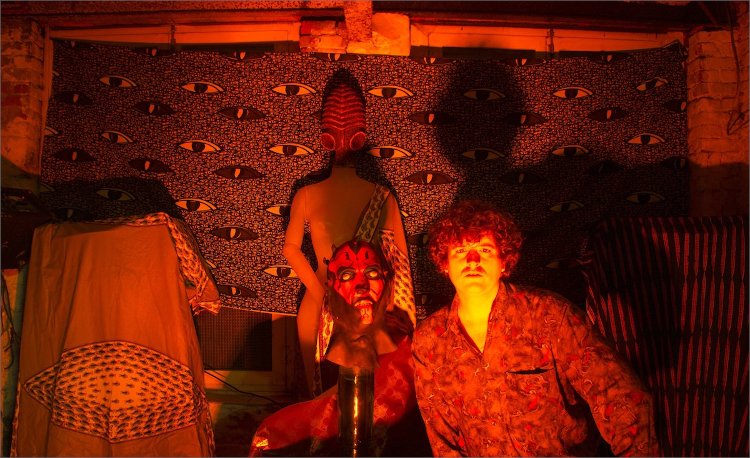
The duo treat roots as material that must be lifted and set alight. Across nine tracks they build a sound in which voices, percussion and electronics transform each other without losing their distinct character.
Racines treat their debut album as an act of transformation rather than preservation. Arilos Mennar takes its name from the seeds of the pomegranate and an Algerian Arabic term that speaks of fire as a primal, generative force. The nine tracks do not simply place ancestral sounds alongside electronic production. They allow each element to work on the other until new textures and new meanings emerge. The result is a record of clear intention and genuine depth, where cultural plurality is not performed but lived through sound.
The opening track, Market Miracolo, sets the terms. Ceremonial percussion from Taha Ennouri and Ali Belazi lays down a pulse that feels steady and ritual without ever becoming static. Layered voices move across Arabic, Italian, Spanish, French and Ladino with a natural fluency that turns the market of the title into an audible space of encounter. Electronics wrap around these elements rather than dominate them, gathering voices and textures until the track feels immersive and alive. The metaphor extends beyond the lyrics. The music itself operates as a crossing point where stories and timbres meet and reform.
This approach continues across the album with notable control. Nari, featuring production from Borda, shifts toward a more hypnotic and explicitly electronic register, yet the core remains grounded in voice and percussion. The track builds tension through repetition and release rather than sheer force. Fluir lets a lighter, more fluid quality come forward, while Meken Merteh and Taqfiz open darker emotional registers. Here the wind instruments played by Carmelo Colajanni, spanning duduk, zampogna, bansuri, arghul and overtone flute, create wide atmospheric spaces. Simone Santarelli’s oud adds timbral warmth and depth in the lower registers. These acoustic elements do not sit in the background. They shape the emotional temperature of the music and give the electronics something real to push against or inhabit.
The use of multiple languages throughout is particularly striking. Rather than treating each tongue as a separate colour to be displayed, Racines let them braid at the level of sound. The ear catches rhythm, cadence and emotional weight before any single phrase resolves into literal meaning. This is not music that translates its cultural references for the listener. It enacts a form of belonging that refuses to choose between one tradition and another. The feminine perspective that runs through the work functions as a shaping intelligence. It gives the voices their clarity and the arrangements their sense of direction, turning what might have remained a collection of interesting crossings into a coherent and living world.
Buttana di to mà brings an ululation that cuts through with traditional power, adding a raw, communal edge to the track’s celebration of freedom across borders. Taqfiz turns nostalgia into forward motion, while Aman holds a fragile persistence that resurfaces even in difficult passages. The album maintains its balance between pulse and reflection without losing momentum. The percussion remains the constant thread, sometimes pounding with ritual weight, sometimes fizzing in multiple directions to keep the body engaged and the mind alert.
The closing track, Rumman, strips back to voice and oud in a more intimate dialogue. It reflects on roots, distance and memory without sentimentality. After the journey through shifting languages and rhythmic intensities, this final piece feels earned. It acknowledges the persistence of what has come before rather than offering easy resolution. The seeds have been carried and ignited. What remains is the trace of their scattering.

What gives Arilos Mennar its particular weight is the maturity with which it handles experimentation. Racines do not use electronics to modernise tradition or tradition to authenticate electronics. They let both elements change through contact. The music moves with pacing and restraint, balancing moments that invite physical response with passages that reward close listening. The emotional range is real, moving from lighter, more open textures to darker, more subterranean ones without ever losing its centre. This is a debut that understands identity as something made through movement and relation rather than something fixed and possessed.
The visual language that accompanies the release, particularly the artwork by Marie Cécile, mirrors this concern with bodies, nature and transformation. Figures entwined with red branches heavy with fire and fruit suggest the same generative tension that runs through the sound. Yet the music stands fully on its own terms. It creates its own symbols from the meeting of percussion, voice, wind, string and electronic signal. In doing so it offers a model of cross-cultural work that feels both specific and open, rooted and nomadic at once.
Racines have made an album that earns its place through detail, intention and control. It treats the meeting of sounds and cultures as an ongoing process rather than a statement to be made once. The fire in the title is not destructive. It is the force that allows seeds to open and new growth to begin.
Follow Racines
Arilos Mennar is out now.
Listen: Spotify