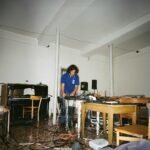
During a residency at IRCAM, the ensemble found itself between a space of innovation and striking workers outside. Their album doesn’t romanticize struggle — it lets field recordings, strings, and fragmented poetry hold the tension.
In November 2023, the experimental ensemble tellKujira began a residency at IRCAM, inside the Centre Pompidou. Outside, hundreds of the museum’s workers were protesting the potential loss of their jobs. The dissonance between institutional access and collective precarity became the immediate scaffolding for La lucha es un poema colectivo.
The album doesn’t report on the events. It absorbs them. Opener “En grève” layers field recordings with a looped, cut-up speech in Castilian about solidarity, then pushes strings toward an abrupt collapse that gives way to something softer — not resolution, but a shift in pressure. The group treats the encounter as a compositional problem: how to hold contradiction without flattening it into a single message.
Throughout, tellKujira resists easy symbolism. “¡Que viva México!” uses Mexican field recordings not to represent a nation but to capture a specific density of human presence. “Tarantella” sidesteps any folkloric quotation, building instead on cyclical arpeggios and a hypnotic mood. The closing track threads plucked strings, a child’s giggle, and fragmented poetry — “to be 16, 14, 15, 40, 100…” — into a textured field where meaning stays unassigned.
There’s no sloganeering, no claim that listening is itself political action. But by assembling these traces of protest, memory, and daily life, La lucha es un poema colectivo quietly insists that no listening position is neutral, and that collective experience can be held in sound without being reduced to a lecture.
Join the Club
Like this story? You’ll love our monthly newsletter.
Thank you for subscribing to the newsletter.
Oops. Something went wrong. Please try again later.

ROMBO Editorial Staff
The collective voice behind ROMBO Magazine’s news, reviews, features, and cultural coverage.