Budapest electronic artist Zságer Balázs turns Buddhist impermanence and Alan Watts philosophy into glitch-driven electronica that refuses closure. His second solo album on Free Sequence is precise, immersive and quietly radical.
Two weeks after its release, the Budapest producer’s second solo album treats the self as code that never stops rewriting itself. Rooted in Buddhist notions of emptiness and impermanence, Eternal Beta Mode translates philosophical flux into a concise, shape-shifting electronic work on Free Sequence.
Listen to the full album while you read.
The record opens with a spoken excerpt from László Krasznahorkai contemplating infinite emptiness. A narrow beam of synthetic light cuts through and the system boots. From there the nine tracks move like shifting states rather than finished compositions. Glitch is not an effect but the governing principle. Structures appear, rewire themselves, dissolve. Weightless textures drift across fragmented rhythms. Fluid compositions mirror the central idea borrowed from Alan Watts: you are under no obligation to be the same person you were five minutes ago. Zságer Balázs turns that provocation into sound design. Identity becomes an operating system constantly updating, never locked.
The opener “Végtelen Üresség” sets the tone with a low, simmering drone that feels almost vocal in its solemn weight. It carves out a vast empty space, foreboding yet strangely inviting, as if the music itself is breathing slowly in the dark. Then “Etűd” pivots sharply. Twinkling synth lines rise with buoyant clarity, laced with effervescent electronic flourishes that bring a sudden sense of lightness. In the space of just five minutes the album has already demonstrated its range, moving from nocturnal murk to bright, approachable atmospheres without forcing a transition. “Fényrés” widens the aperture further. A thin beam of light seems to slice through layered pads that build intensity step by step, while subtle rhythmic passages begin to surface, adding dynamic contrast to the otherwise drifting textures.
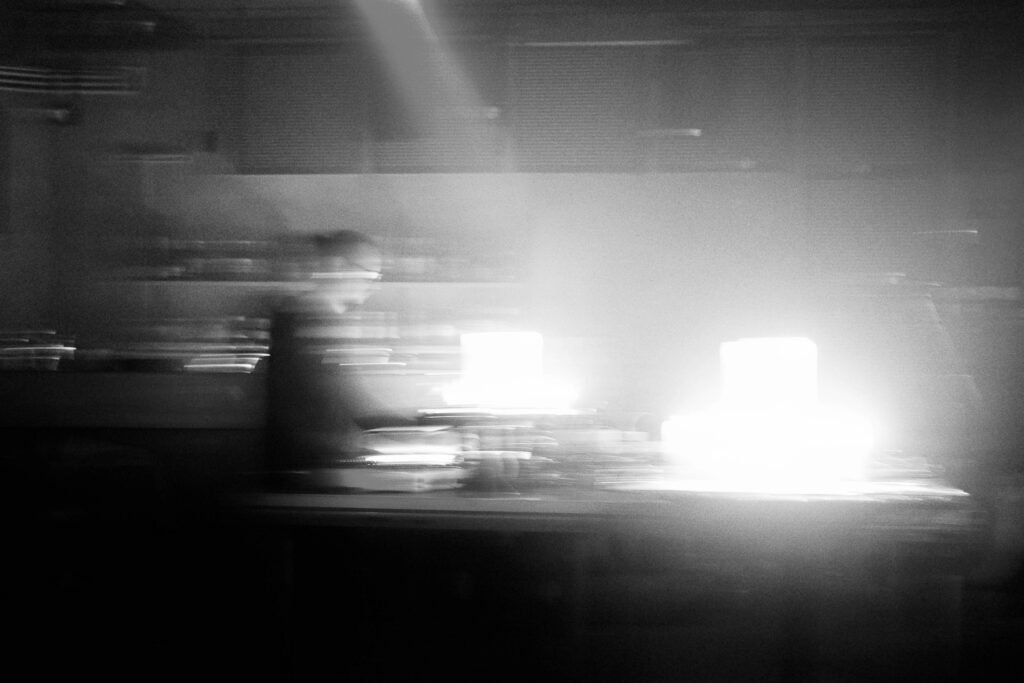
“Repatched” occupies the middle ground where the record feels most alive in its contradictions. Vague, warbly layers slowly assemble into airy washes of synth. Around the two-minute mark a luminescent glow emerges, swelling toward something almost daytime in its allure before retreating again into crackling nighttime flair. The movement never feels arbitrary. Every shift reflects the album’s core logic: nothing is fixed, everything is in the process of becoming something else. “Lebeg” and “Ghost Frames” deepen this suspension. Ethereal layers hover above more complex percussion patterns and sophisticated arpeggios that flicker in and out of focus. The music acquires a psychedelic, almost surreal quality here, as if the listener has stepped into an environment where time itself has been gently unmoored.
One piece that captures the album’s method in miniature is “Alaktalan”. Whirring synth pulsations hold steady against elegant, understated doses of tonal serenity. Nothing dominates. Everything coexists in controlled instability. The track arrives at the right moment in the sequence, proving how fluently the record can move between nocturnal depth and luminous detail without ever settling.
By the time “Sodródás” drifts into view, the album has already established its refusal of conventional arcs. Rhythmic elements and melodic fragments continue to surface and recede, never locking into place. The closer maintains the same suspended logic. It does not deliver resolution. It simply stops updating, leaving the system still running in the background. In just over thirty-five minutes the entire work achieves a rare economy. It does not deliver meaning. It generates the conditions in which meaning might continue to appear.
Zságer Balázs has been a fixture in Hungarian electronic music since the early 2000s, first as the driving force behind Žagar and co-writer of Yonderboi’s Shallow and Profound. His tracks have been remixed by Deadbeat, Minilogue, Vakula and others. In recent years he has performed at festivals including Inota, Synästhesie and Vision of Sound, and he curates the Budapest series Transcendent Waves. His live sets, built around multiple electronic instruments, create immersive, narrative-driven environments. After the 2024 solo debut Aqua Obscura and the noisier Sacral Design EP, Eternal Beta Mode sharpens the focus. The Buddhist and metaphysical threads that have long run through his work are now fully integrated into a cybernetic framework. The result feels both deeply personal and quietly radical: a meditation that treats impermanence not as metaphor but as operating system.
In an era when much electronic music offers either maximal spectacle or ambient drift, Zságer Balázs offers something rarer: music that thinks. Stability, the album quietly insists, may be the real illusion. The beta mode is eternal because it has to be.
Follow Zságer Balázs
Eternal Beta Mode is out now via Free Sequence.
Listen: Spotify
Follow: Instagram · YouTube · Facebook · SoundCloud · TikTok