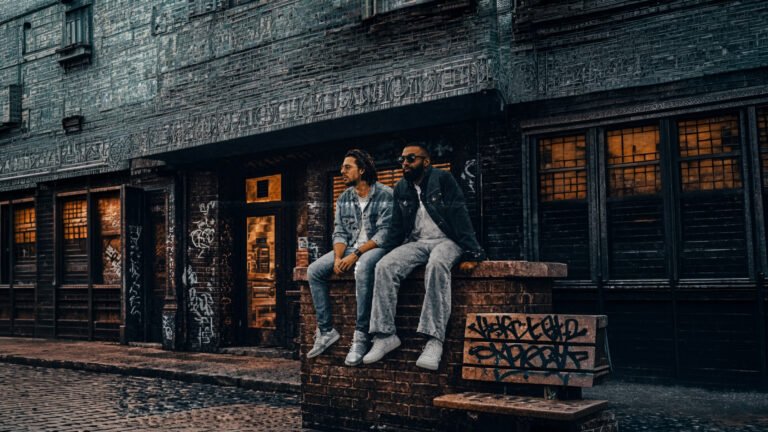
From East Village anti-folk rooms to a Capitol imprint deal, film soundtracks, a Wall Street detour, and a catalog reclaimed on Meridian, Jamie Block has never stopped writing with the same unsentimental clarity. A career-spanning look at the songwriter behind Love Crash.
Jamie Block emerged from the East Village anti-folk scene in the 1990s with a voice shaped by narrative sharpness, dry humor, and an unwillingness to romanticize damage. Thirty years later, the same instincts drive his work, now sharpened by time, absence, and a catalog that refuses to stay buried.
East Village Roots and the Anti-Folk Impulse
Block arrived in New York’s anti-folk circles in the mid-1990s, when the scene still operated in the shadow of the folk revival and the louder downtown noise. His songs arrived fully formed: story-driven, conversational, laced with Beat cadences and street-level detail. The self-released debut Lead Me Not Into Penn Station (1996) established the tone, rough-edged acoustic arrangements that never sacrificed lyric precision for prettiness. “Rhinoceros,” one of its standout tracks, already carried the mixture of wry observation and emotional bluntness that would become his signature.
The Major-Label Window and Soundtrack Footprint
In 1998 Glen Ballard signed Block as the first artist to his Java Records imprint at Capitol. The resulting album, Timing Is Everything, widened the reach without diluting the voice. Its most visible moment came when Block’s cover of Perry Como’s “Catch a Falling Star” was placed in the opening credits of the 1999 Drew Barrymore film Never Been Kissed. The placement gave the song a brief but genuine mainstream life, yet it never defined Block; it simply sat alongside other soundtrack credits, “Rhinoceros” in Blast from the Past and “I Used to Manage PM Dawn” in Clubland, evidence that his songs had always traveled through film rather than radio cycles.
After the major-label chapter closed, Block stepped away from music entirely. He spent years working in finance on Wall Street, a detour that, in retrospect, sharpened the observational distance already present in his writing. When he resurfaced with The Last Single Guy (2006) and later Whitecaps on the Hudson (2013), the voice had not softened; it had simply acquired the weight of lived time. These records reinforced his reputation as a literate, unsentimental chronicler of New York life rather than a nostalgia act. The anti-folk DNA, direct address, narrative economy, refusal of easy resolution, remained intact.
The current chapter began with a series of 2025 deluxe-edition reissues that brought the early catalog back into circulation. Those reissues, paired with renewed press attention and a new home at Meridian (ECR Music Group), set the stage for Love Crash, Block’s sixth album and first full-length of new material in thirteen years. Released May 15, 2026, the record distills three decades of craft into ten tracks that treat heartbreak as material to be examined rather than performed. Produced by Chris Kuffner and mixed/mastered by Blake Morgan, it maintains the intimate, lyric-forward production that has always been central to his work while allowing the songs a new clarity and urgency.
In our full review of Love Crash, we noted how the album maps the residue of impact with anti-folk precision: “a set of songs that treat heartbreak as a condition to be examined rather than performed.” The new work does not attempt to revive the 1990s scene; it simply continues the same line of inquiry on its own terms.
What has held Block’s work together across three decades is not stylistic consistency alone but a consistent refusal to look away or tidy up the mess. The songs remain grounded in observable detail—Chrysler Building flyovers, Montauk train platforms, ashes in mailboxes, daughters’ faces in windows—while the voice stays conversational, intelligent, and unsparing. In an era when many songwriters chase immediacy or algorithmic shareability, Block continues to write as if the only audience that matters is the one willing to sit with the full weight of the story.
That quality is why the catalog keeps resurfacing and why Love Crash feels less like a comeback than the logical next step in a career that has never really paused. The anti-folk voice that first cut through East Village rooms in the 1990s has simply grown more exact with time. It remains necessary for the same reason it always was: it tells the truth without asking for applause.
Follow Block
Love Crash is out now via Meridian (ECR Music Group). Stream the album and explore the full catalog below.
Listen: Spotify
Official: Meridian / ECR Music Group
Join the Club
Like this story? You’ll love our monthly newsletter.
Thank you for subscribing to the newsletter.
Oops. Something went wrong. Please try again later.

ROMBO Editorial Staff
The collective voice behind ROMBO Magazine’s news, reviews, features, and cultural coverage.