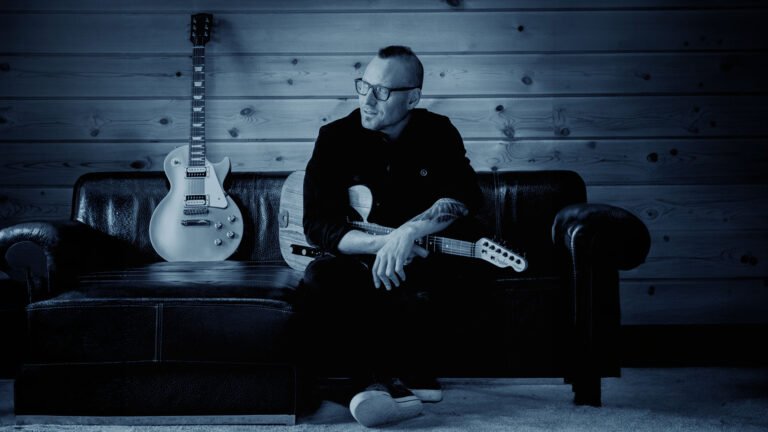
Faroese composer and producer Benjamin Djurhuus spent a long stretch of his working life just off camera. He mixed, wrote, arranged, and helped other records find their shape. He grew up around church music, then moved through folk, pop, rock and jazz until production became the job. By 2019 that work had a public edge. Nominations followed at home, and in 2024 he was part of a Faroese Music Awards Album of the Year as co-producer and co-writer. On the side he writes trailer music for Trucks Music Publishing in Aarhus, the kind of cues built to move a picture in a hurry. öð [øh], released on 24 July 2026, is the first time that whole craft sits under his own name.
Trailer music is a strange apprenticeship for a quiet record. A good cue has a few seconds to announce weather, threat, tenderness, victory. It has to arrive already knowing what it is. Then it has to get out of the way. That economy lives in Djurhuus’s hands. You can hear it in the way a string line lifts, in how a banjo click can stand in for a cut, in the clean contour of a melody that would survive under dialogue. The surprise of öð is what he does with that skill once nobody is selling a film. He keeps the colour and throws away the countdown. The album wants the minute after the preview ends, when the lights are still down and nobody has stood up.
The title is almost a breath. öð, spoken as [øh], sits in the mouth like the start of a word you decide not to finish. Around it Djurhuus gathers eight players and a small forest of wood and wire: his own guitar and banjo, Jacob Kaaberbøl’s Spanish guitar, Mathis Emil Jønsson P. on mandolin and banjo, David M. Orłowicz on resonator, and a quartet of Søren G. H. Mortensen and Halfdan Asmild on violin, Misha Kucherov on viola, Kamill Bendo on cello. He produces and mixes. Óli Poulsen masters. The session was taken live in the studio, which matters more than the credit line suggests. Fingers scrape. Chairs settle. A pause keeps its air. The record sounds like people occupying the same few square metres.
That occupancy is the album’s real form. Ávegis, framvegis opens on the move, the Faroese sense of being on the road and still going forward. Guitar, dobro sheen, banjo push and strings arrive in overlapping falls rather than in a stack. Nothing in the first three minutes is trying to impress the front row. The instruments keep handing the phrase along, as if the point were to stay in step. Badihu tightens the weave. Four guitar voices lock into a bright, restless cloth, banjo adding a percussive spark, strings swelling underneath like weather coming in off the water. Midway the voices enter on the title itself, syllables used as another plucked part. The choir does not explain the piece. It thickens the room.
Dorian Waltz turns the floor. Guitar and mandolin walk a circular figure while the quartet gives the dance its longer breath. The dobro leans in with a rusted glint, then steps back. The waltz never stamps. It turns, which is harder. Søgade is the album’s most watchful stretch, named like a Danish lakeside street and paced like fog over still water. Long, slightly unsettled string tones open the cut. A dry plucked pattern keeps time at the centre. Around it the guitars pick up a leaner, almost western shade, and the strings hold a pathos that never quite resolves. The track lives in that withheld landing. You wait, and the waiting becomes the content.
Stúkukvartett gives the strings the floor. Guitar, mandolin and banjo shrink to occasional punctures. The quartet moves in slow circles, melancholy without collapse, the kind of writing that comes from someone who has spent time placing emotion under picture and now lets the picture go blank. Glintan answers with bounce, guitar and bass-like low strings in a compact skip, the quartet running alongside instead of above. Sært meg so væl is the comfort the title promises, a slower rocking motion where cello takes the sung line the record otherwise refuses. Acoustic guitars answer it the way a second person answers from across a table. The arrangement is rounded, unforced, sure of its temperature.
Then the house empties. Harrans varðveitsla, the Lord’s keeping, is one guitar, close-miked, fingerpicked with a patience that borders on prayer. After the choir, the quartet, the four-guitar braid, the reduction is not a stunt. It is the argument stated without company. You hear the wood. You hear the gap between notes. The church rooms of Djurhuus’s childhood are in that last two minutes, not as doctrine, as hush.
Live, the same idea becomes architecture. For the Acoustic Surround Experience the eight players stand in a circle around the listeners, a formation he brought to rooms in Norðagøta and Tórshavn when the album arrived. The Faroe Islands already know what a circle can do. The old chain dance puts the community in a ring and makes the song a shared step. Djurhuus inverts the traffic. The musicians close around you. On record the stereo image works toward the same placement. You are not seated in front of a band. You are inside the arrangement, which is why the quieter passages feel occupied rather than empty.
The Faroes are usually sold as fog, wind, black rock, the North Atlantic performing its reputation. öð declines the postcard. Art Lasovsky’s cover photograph is a garden, instruments left on the grass as if a session had paused for air, Djurhuus in a knit jumper with a guitar in his lap. That picture is closer to the music than any cliff. Warmth here is practical. It is the decision not to clear the table. It is the extra minute a player stays on a chord because the room still needs it.
What gives the debut weight is the control of that minute. Djurhuus knows how to swell a string line and how to cut one. He knows when banjo should drive and when it should only click. He knows that a choir can be rhythm, that a cello can speak without words, that a last solo guitar will carry more meaning if everything else has already been heard. öð is chamber folk with a producer’s ear and a parish sense of time. It does not ask to be the loudest object in the week. It asks whether you can sit still long enough for the temperature to become yours.
The record is short enough to finish and open again. That is part of its intelligence. Presence, in this music, is a repeatable act. You stay. Then you stay a little longer.
Follow Benjamin Djurhuus
öð [øh] is out now.
Follow: Instagram · Official Site