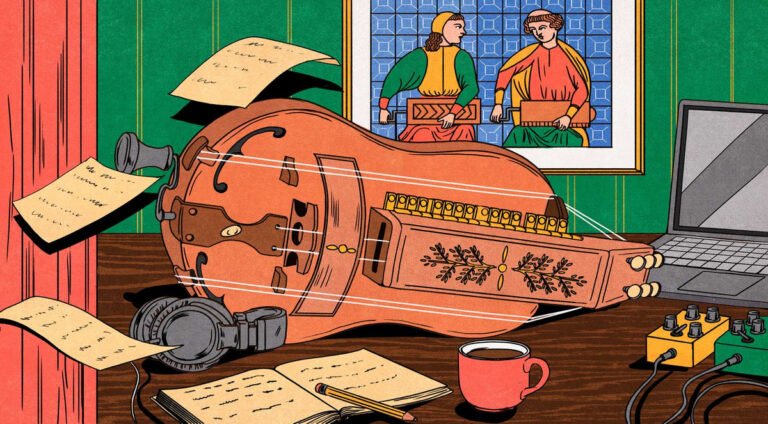
The medieval wheeled fiddle largely vanished from European music, survived in France, and has spent six decades being pulled into rock, folk and experimental work. A quartet from Auvergne is one of its newest handlers.
The hurdy-gurdy is a wheeled-bow string instrument. A crank turns a rosined wheel against the strings; drones run underneath, and a moving bridge the French call the chien, or dog, produces its characteristic buzz. Built in the Middle Ages to accompany liturgical chant, its earliest form, the organistrum, required two players. It sounds like a hybrid of violin and bagpipes, which is part of why polyphony pushed it out of religious music.
The tradition stayed alive mainly in France and, to some extent, Hungary. From the 1960s folk revival onward, French musicians began treating their own traditions as source material, and Emmanuelle Parrenin’s Maison Rose became that moment’s fixed point, elegant and psychedelic. The revival has now run for more than fifty years and has spread well beyond the countries where the instrument was once local.
Among the newest acts in it is Brama, a quartet from Auvergne. Their second album, with Amandine Pauverton on hurdy-gurdy, places the instrument inside kraut-inspired psych rock and Occitan folk. “We wanted to include something from our everyday environment,” says guitarist and singer Simon Guy. Pauverton, who also performs traditional music, resists the museum framing: “Even my traditional practice is contemporary. We live in the 21st century, I never wanted to pretend it’s still Middle Ages.” Guy adds that the guitar is just as old.
Outside folk, the drone draws experimental players, among them Keiji Haino and Animal Collective’s Geologist. Paweł Płoskoń, a Polish musician and academic teacher, calls it an instrument for telling stories. That is the useful way to hear it: not heritage for its own sake, but a sound still doing work.
Join the Club
Like this story? You’ll love our monthly newsletter.
Thank you for subscribing to the newsletter.
Oops. Something went wrong. Please try again later.

ROMBO Editorial Staff
The collective voice behind ROMBO Magazine’s news, reviews, features, and cultural coverage.