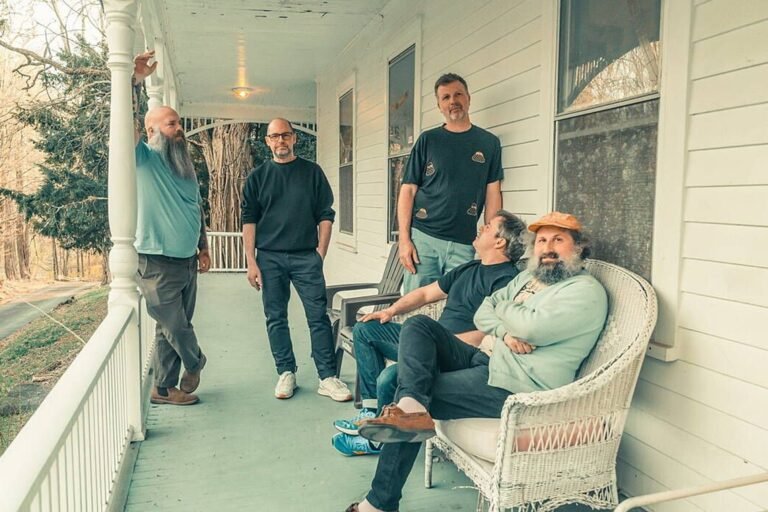
After years on bass in surf and stoner bands, the Piacenza musician steps into jazz funk with organist Paolo Apollo Negri and treats the signals of 1970s Italian crime cinema as living architecture.
Marek De Vann is the electronic project of Marco Sarracino, a musician from Piacenza, a city in Emilia-Romagna in northern Italy, roughly an hour southeast of Milan along the Po. He spent more than two decades as a bassist in instrumental surf and punk outfits such as Liquid Germs and in stoner rock with Oak’s Mary. He launched the solo name around 2022, releasing Sounds in Headphones, Interstellar Radio and Toy Factory while drawing on Boards of Canada, Kraftwerk and Devo alongside the crime-film scores he first heard as a teenager when a neighbour handed him the Beretta 70 compilation. Stereotyping, out now on IRMA Records, is his first full collaboration with Paolo Apollo Negri, the Hammond specialist long associated with The Link Quartet and Wicked Minds, and his first sustained move into jazz funk. IRMA, founded in Bologna in 1988, has long been a central Italian home for dance, jazz-inflected electronics, lounge and funk-adjacent work, with a catalogue that stretches from early house experiments to contemporary instrumental projects. The two composed and arranged the material over eighteen months in Sarracino’s home studio. Sarracino handled Moog, drum machines and bass. Negri supplied Hammond, Rhodes, Clavinet, Mellotron and other organs. Mastering came from Alberto Callegari at Elfo Studio in Tavernago. Guests include Maddalena Conni on wordless vocals, Federico Rivoli on drums, Andrea Cravedi and Dario Cabisto on guitar, and Gianni Satta on trumpet. The album closes with the only cover, Nucleo Antirapina by Bixio, Frizzi and Tempera. Artwork is by Gut Feeling.
In the printing trade a stereotype was once a solid metal plate cast from a mould so the same text or image could be reproduced at volume without resetting every letter. The plate fixed the outline. The ink and paper could still change. Sarracino and Negri treat the sonic grammar of 1970s Italian poliziottesco cinema the same way. Each track carries one deliberate stereotype of the genre, a police siren, a Clavinet figure, bongos, a thumb dragged across a conga skin, a classic funk bass line, wordless female vocals. These are not period costumes. They function as the fixed plates. The arrangements around them are contemporary, built on Moog lines, dry electronic drums and airy mixes that keep the low end springy and the high end bright. The result feels like new documents printed from old forms, each one still carrying the stamp of its origin while the content moves forward.
The album’s architecture is clear from the first bar of When a Plan Comes Together. Bright arpeggiators and a precise electronic pulse set a lively temperature. Maddalena Conni’s short vocal colourings act as rhythmic punctuation rather than lyric. The production stays open, low frequencies deep but quick, synth phrases taking the role a sung chorus would usually hold. Fourteen Trains follows with slap bass, stop-time guitar chords and brass stabs that keep the energy high without crowding the mix. The sequence then tilts. Gioco Sporco tightens the pulse into something more urgent, its compressed synth bass and sharp arpeggios sketching a nocturnal chase. Via Po Explosion opens the window again, a straight four-on-the-floor kick and agile synth bass carrying a bright, danceable line that still reads as city traffic rather than pure club track.
True Crime Love supplies the first real breath. Slow arpeggios and wide pads stretch the space. The rhythm continues underneath, but the temperature drops. The track holds a suspended quality, less a song than a corridor between rooms. Il Fuggiasco, the earlier single now placed sixth, restores forward motion with a dense electronic undercurrent and long synth lines that feel like headlights cutting fog. Downtown Drift is the album’s most elegant balance. Gianni Satta’s trumpet phrases sit cleanly over a rounded bass and tight rhythm guitar. The brass carries the melodic hook the way a vocal would, and the whole arrangement moves with a light, continuous sway. A Mano Armata returns to darker ground, its dry drum machine and filtered synths building a sense of pursuit without breaking into full aggression. Ghetto Funk loosens the tension again with elastic bass and short vocal samples used as percussion. Nucleo Antirapina closes the record with the heaviest percussive weight, the cover treated so the original theme sits inside a contemporary electronic frame that still feels rigorous rather than decorative.
What holds the ten tracks together is the decision to let melody live in the instruments. Synth lines and brass stabs function as refrains. The mixes leave room for each element to arrive on its own terms. Low end stays physical, whether electric slap or synthesised, while the upper register stays crisp. The pacing moves between bright openings and darker mid-section stretches without forcing a single dramatic arc. By the time Nucleo Antirapina arrives, the earlier stereotypes have already done their work. The listener knows the frame. The music can therefore keep changing the picture inside it.
Stereotyping understands atmosphere as structure. The signals of an older cinema are present, yet they never freeze the arrangements into quotation. The record earns its weight through the precision of its pacing and the clarity of its instrumental voices.
Follow Marek De Vann
Stereotyping is out now.
Follow: Instagram · YouTube · Official Site · Facebook
Join the Club
Like this story? You’ll love our monthly newsletter.
Thank you for subscribing to the newsletter.
Oops. Something went wrong. Please try again later.

ROMBO Editorial Staff
The collective voice behind ROMBO Magazine’s news, reviews, features, and cultural coverage.