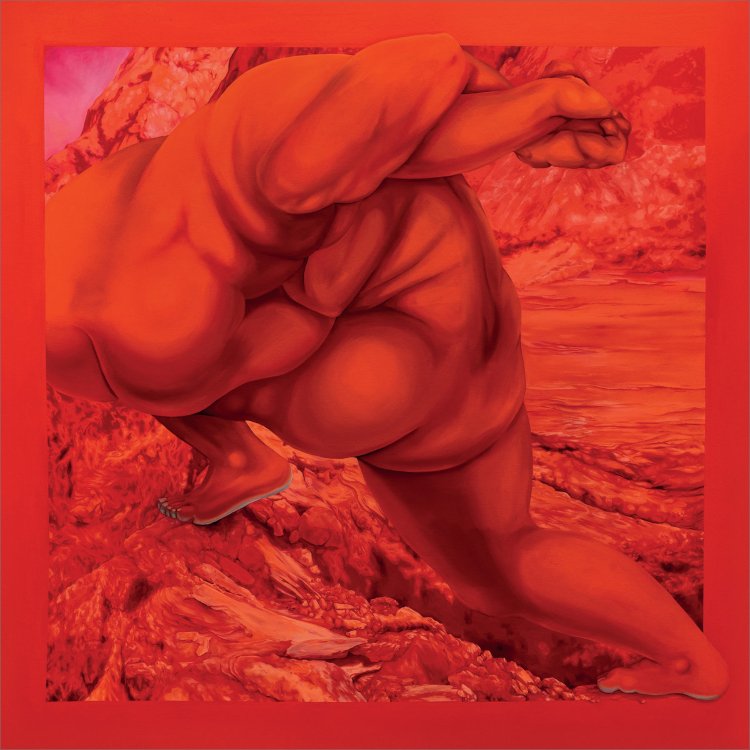
After two records for PAN, Marina Herlop releases Dja Dja on her own and scales her music up into a long-form work structured by the monomyth.
Marina Herlop’s first self-released album follows two records for PAN, Pripyat in 2022 and Nekkuja in 2023. Dja Dja does not abandon the language she built across those releases. It expands it. The album runs nearly twice as long as its predecessors, and that extra room is deliberate: the record is built as an epic, with the hero’s journey serving as its scaffold.
Herlop’s music tends to overwhelm by accumulation rather than by austerity. Rhythm and polyrhythm pull attention one way, a melody or a vocal run pulls it another, and the baroque arrangement of the instruments holds it in place. On Dja Dja those layers are organized into a system. The opener, “Flor,” lays out the material: quintuplets that become one of the album’s central meters, dyads descending in parallel by a semitone, and the theme from “Vas volant,” which resurfaces later in “Los dos lobos” and, more quietly, in “Average Evil.” The lead single “Jaque” shares some of that harmonic DNA.
The record’s narrative is carried by sound rather than by atmosphere borrowed from elsewhere. “ツラ” sets chirps, whistles, vocals, and birds in counterpoint; the close of “Los dos lobos” drops into a filtered abyss. These are diegetic gestures, but they never turn Dja Dja into a soundtrack. The storytelling is done by the music alone.
Join the Club
Like this story? You’ll love our monthly newsletter.
Thank you for subscribing to the newsletter.
Oops. Something went wrong. Please try again later.

ROMBO Editorial Staff
The collective voice behind ROMBO Magazine’s news, reviews, features, and cultural coverage.