On the day her debut single arrives, the songwriter who splits her time between El Paso and Burgundy turns a 3:35 AM moment of honesty into a public invitation. “I Want To See Your Fire” is out now and asks to be played loud.
Lauren DaCruz has spent a year writing in the spaces that remain when the noise falls away. At her grandmother’s 1925 Steinway baby grand, in the shower, or tapping rhythms on a desk through tears. The result is À Vous de Jouer, a debut EP shaped as an intentional time capsule. Every track lands on a note of hope. Today the first of those tracks leaves the private room and meets the world.
“I Want To See Your Fire” sparked at 3:35 AM after she sat with Ernest Hemingway’s advice to write one true sentence. What followed was a spiritual call to step into her fullest self. It opens with an intimate stomp-and-clap rhythm, then builds through memorable hooks, driving bass, soaring guitars and layered percussion before stripping back to a quieter coda. Produced by Jesse DeCarlo and Taylor Safina, the arrangement understands when to expand and when to hold still. This is music written for anyone moving out from under fear and perfectionism. It is designed to be played loud.
DaCruz’s path has never been linear. New Mexico mountains, Los Angeles, Big Sur, San Francisco, El Paso, and the hills of Southern Burgundy. She moves between Texas and France, carrying a calculated focus and an expansive creative vision that also includes screenplays and artisan wines. Behind the music is a Renaissance sensibility rooted in resilience, transformation and devotion. The EP captures a return to the childhood ease that existed before fear and perfectionism took root. “I Want To See Your Fire” is the boldest invitation in that process, and today it is available.
What gives the single its weight is the precision of its world. The track does not rush to explain itself. It builds its own temperature. The production leaves space for the feeling to arrive on its own terms. This is music with a clear sense of identity and purpose.
In Conversation with Lauren DaCruz
We spoke with Lauren DaCruz about the early-morning spark that became the song, the family piano that held the year, the quiet work of reclaiming creative freedom, and what it means to ask listeners to play the track loud on the day it arrives.
1. The song began at 3:35 AM after you sat with Hemingway’s advice to write one true sentence. What did that true sentence sound like in the moment, and how did the stomp-and-clap rhythm arrive from there?
I had written the sentence a few weeks prior in my journal as part of a daily practice. The moment it hit the page, I knew it carried weight—it was direct, personal, and a little terrifying. It lingered with me until that night, when I couldn’t sleep. I walked out to my studio/ office, intentionally leaving my phone behind mostly so I wouldn’t spend the next hour googling why I was awake at 3:30 AM, researching which organ was supposedly acting up, and obsessively cataloging myself.
When I opened my journal and read that line out loud, the rhythm hit me immediately. I started tapping the cadence directly onto the paper: “I want to see your fire”—tap, tap, tap, tap, tap. “I don’t want to see you break”—tap… “So what you gonna do now to make it go away?”
From there, the words started flowing out faster than I could write. I was in a place where I was tired of self-sabotaging—I just wanted to finally believe in myself and step into a lighter space.
“So what you gonna do now?” was me asking myself, in real time, if I had the courage to turn this raw, spirit-led conversation into a song. I sat at my desk and recorded myself on my laptop stomping my foot and tapping on the desk. Once it was captured, I finally went to sleep. The cover art for the single is actually a photo of me the very next day—things shift fast when you answer the call.
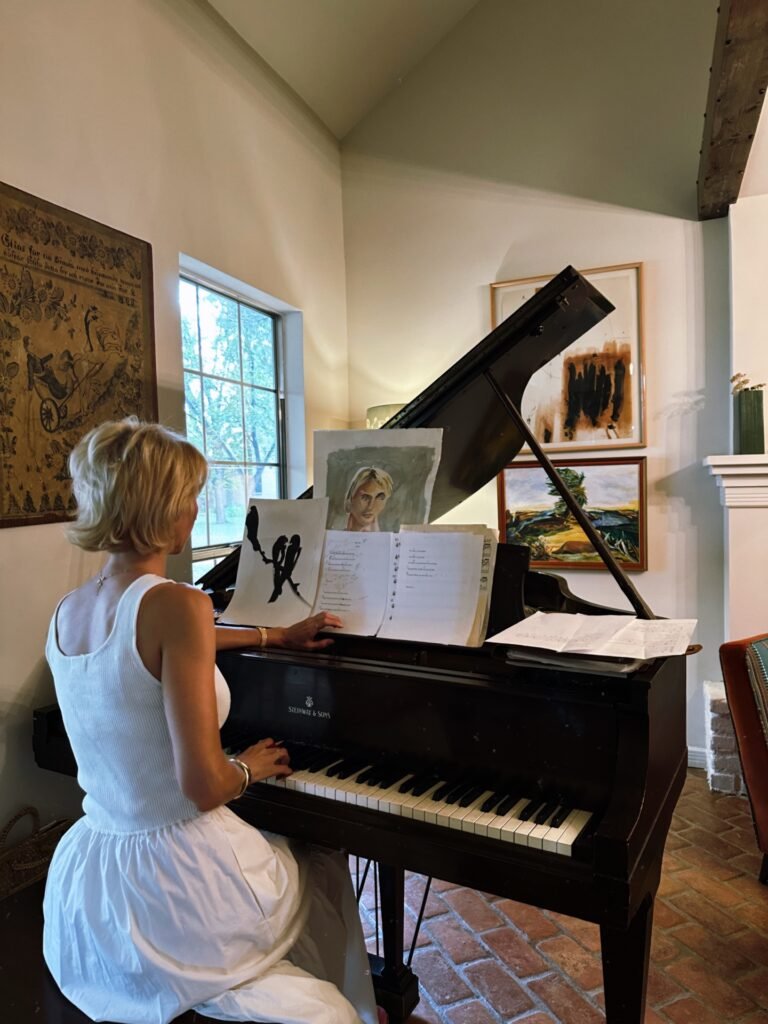
2. Much of this music was born on your grandmother’s 1925 Steinway. How does that instrument, and the family history it carries, shape the emotional temperature of the EP?
That piano is the heart of everything. It belonged to my grandmother, who was a concert pianist and very dear to me. When she moved into assisted living, the piano came to me. I’ve moved it from Big Sur, CA to Monterey, CA then to El Paso, TX and soon to Burgundy, France.
Taking traditional lessons as a kid felt stiff and uninspiring—it was all strict recitals, and sight-reading rules. I’d get frustrated by making mistakes, and my grandmother would say, “Playing the right notes isn’t the most important part—you have to play what the piece is asking for.” Years later in Monterey, she overheard me practicing and repeated the exact same thing, and I just went for it, “Now you’re playing. Keep doing that.”
The true turning point came years later, when my daughter, Estelle, asked me to learn Joni Mitchell’s “Both Sides Now” so she could sing it. That was the catalyst that made me prioritize learning to play again.
Receiving an instrument with that much history demands respect; it couldn’t just sit in my house as a piece of furniture. In a nutshell, this piano is deeply important to me—I don’t know if I ever would have started writing songs without it. It truly is my dream maker.
3. You describe the year behind À Vous de Jouer as one of deep introspection and a quiet return to self. What did reclaiming creative freedom look like in practice, away from fear and perfectionism?
It looked like giving myself permission to finally be myself again. For a long time, I revered music so deeply that I treated it like sacred ground reserved only for people far superior to me. Reclaiming my freedom meant showing up every day, taking myself seriously as an artist, and doing the quiet, unglamorous work.
A massive shift happened through my piano teacher in El Paso, Karla Prieto. She’s a talented artist herself who saw something in me. When I shared my poetry and essays with her, she simply said, “Write songs.” When I looked at her like she was crazy, she demystified music theory, taught me lead sheets, and showed me how to use the Circle of Fifths as a tool to write and create. She told me to “go home and play freely in C Major.” I did, and “Inside Her Castle”—which ended up on the EP—was born right then. I will be forever grateful to Karla for believing in me and opening that door.
From there, it was about taking bold steps—like sharing my early tracks with my producer and dear friend, Jesse DeCarlo. When I handed them over with my usual caveat, “This probably sucks,” Jesse stopped me right there and told me to quit speaking about myself that way. He said, “Let’s record this.”
In practice, reclaiming freedom meant stopping the habit of talking about creative ideas out loud to seek validation. It meant sitting down, being quiet, and listening. I’ve run hundreds of miles across mountain trails trying to outrun this work, but books like Steven Pressfield’s The War of Art and Rick Rubin’s The Creative Act, alongside my own faith, kept pointing me back to the same truth: stop running, step into the room, and do the work.
4. The song starts in a quieter place with piano and voice before the rhythm takes hold and the arrangement opens out, then returns to a more intimate close. How did you decide when to push the song outward and when to leave space?
I’ve always loved music that leaves you wanting more, like Cat Stevens’ “Tea for the Tillerman”—how it builds so beautifully, gets so good, and then stops, leaving you with that feeling of “Wait, it’s so good, let’s keep going, please!”
That feeling was on my mind when this song came to me—just a vocal and a stomp-clap rhythm. At first, I thought the whole track would be built around that stomp-clap, percussion and voices, growing into something massive purely through vocals. But working with musicians as incredible as Taylor and Jesse changed direction. They brought so much power to their instruments that building the swell instrumentally felt so much cooler and opened up the whole arrangement.
After we got that awesome rough track down, I sat with it for a few weeks, but I knew in my gut it wasn’t quite finished yet. I listened to my original track that I had recorded that night in my office, to see what the song was missing, and it hit me – that quiet beginning. So, I had the idea to record a final coda. Karla recorded me right here in my office studio to capture it. Ending the track back in the very room where it was born brings it full circle—a quiet, personal moment to ground all that energy.
5. You live between El Paso, Texas and Burgundy, France. How do those two landscapes, one desert frontier and one wine country, enter the writing and the sound?
Every place I’ve lived, with all their different extremes, shapes my writing. I’m deeply sensitive to my environment, and I naturally pick up on the heartbeat of wherever I am.
When my husband Dominique, and my daughter, and I moved to El Paso seven years ago, leaving behind the cool California fog, some people thought we were crazy. But El Paso is truly a gem. The people here are the nicest, warmest, and some of the most interesting people I’ve ever met. Between that incredible community and the wide desert skies—which quickly became my new ocean—it’s been completely life-giving. I thawed from the fog, stepped into myself, and found my own little nook under the sun to write freely.
At the same time, France has held a piece of my heart for nearly twenty years. “Inside Her Castle” was directly inspired by the history of the woman who lived in Château Cormatin, near our home in Burgundy.
Both landscapes feed different parts of my soul. El Paso gave me the expansive warmth and clarity to find my voice, while Burgundy grounds me in history, romance, and story. Though quiet and rural, this region has deep roots in art and music—a legacy I’m thrilled to be part of. The music lives in that interplay between the open desert frontier and the magic of the French countryside.
6. The EP is framed as a time capsule of a challenging, beautiful year, with every track landing on a note of hope. How does “I Want To See Your Fire” sit as the first statement of that larger story?
It’s intentional that “I Want To See Your Fire” acts as the first single introducing this era, while actually serving as the final track on the full EP, À Vous de Jouer.
As a first statement, it’s the most actionable and danceable song on the record. It carries an immediate, physical energy—it invites you to move, to feel something directly, and to step into your own strength. Placing it at the end of the EP allows the whole journey of a challenging, beautiful year to resolve on an undeniable surge of momentum.
It anchors that note of hope not as a quiet sentiment, but as a spark. My hope is that whether you hear it first as a single or at the end of the full project, it leaves you energized, wanting more, and ready for the rest of the album and the new music coming right behind it.
7. The single is written for anyone stepping out from under fear, and you ask that it be played loud. What does “seeing your fire” mean to you now, on the day the music leaves the private space of the piano and meets listeners?
First and foremost, it means it’s time to dance!
On a deeper level, it means staying dedicated—to keep practicing at the piano, to keep writing, and to keep choosing joy. My dad always called me Pollyanna, and today I feel called to step into that identity more than ever. People often mistake Pollyanna for being naive, but she saw the hard realities of the world clearly—she just made a conscious choice to lead with love, hold onto hope, and take real action to make things better.
To me, “seeing your fire” isn’t about passive optimism. It’s an active choice to step out from under fear, claim your light, and share it. As this song leaves the quiet, private space where it was born and goes out into the world, my hope is that it gives people permission to do the exact same thing: turn it up, dance, and step boldly into their own fire.
Follow Lauren DaCruz
“I Want To See Your Fire” is out now. The full EP À Vous de Jouer follows on October 14.
Follow: Instagram · Official Site
Cover Artwork © Dominique DaCruz