motko is the solo project of Shorty. After years inside shared band energies, he works alone. The nine-track record that follows treats atmosphere as structure and turns the idea of home into something that has to be earned.
motko is the solo project born when a musician who had spent years inside Millhouse, Symbiosis and the progressive metal outfit IONS chose to make something entirely on his own. The decision came from simple curiosity. The result is home, a nine-track alternative rock record out now. It moves slowly and on purpose. Layered, loosely conceptual, and closer to a film than a playlist: scenes rather than songs, mood rather than momentum. Somewhere between introspective and cinematic. The kind of record that gets described as movies for your ears.
The lowercase name is deliberate. So is the approach. The album revolves around emotional openness versus stagnation. Its lead single “old”, already covered by ROMBO earlier this summer, confronts the fear of becoming rigid and bitter. The rest of the tracks stay inside that inner landscape, exploring memory, distance and what still feels like home after you have left far enough to recognise it.
Alongside the record, Shorty has also released a small companion zine called Finding Your Way Back Home that expands on the themes and the world behind the album.
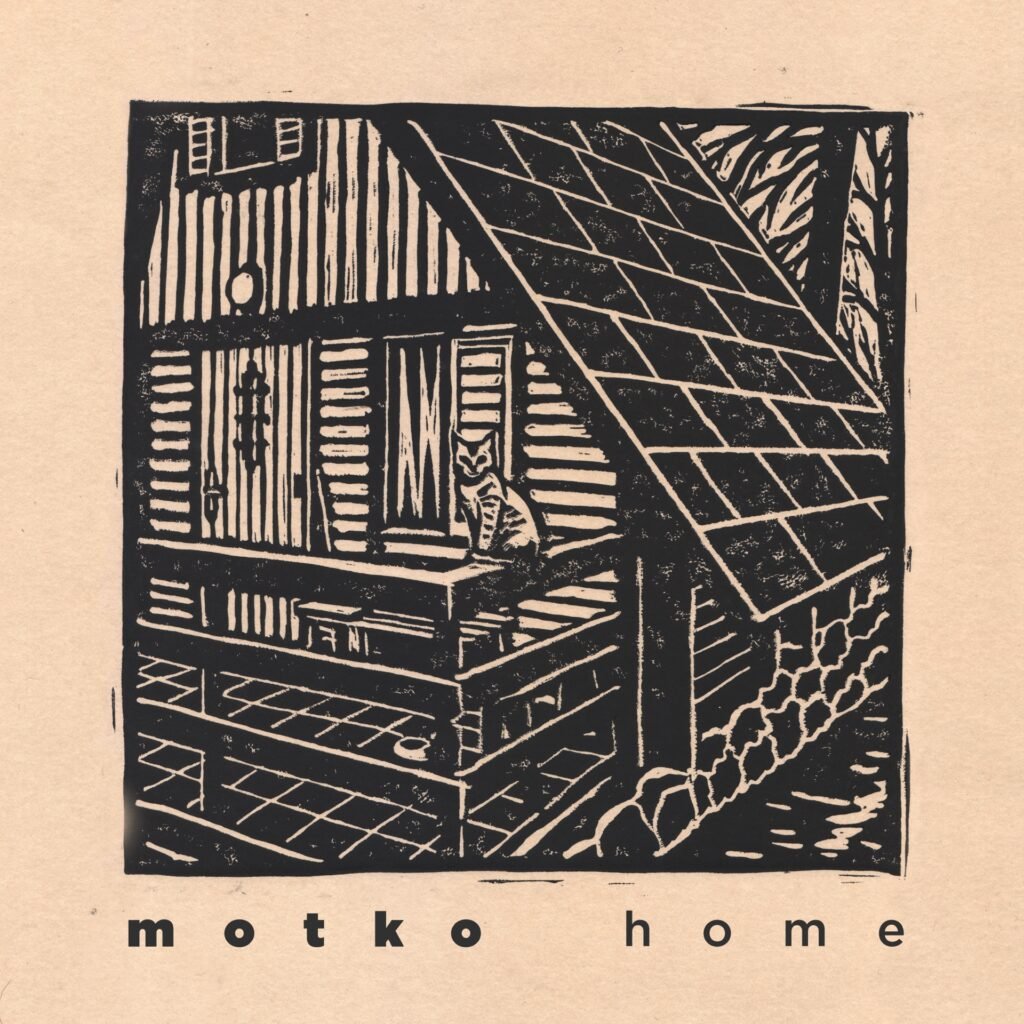
The artwork, a stark linocut of a wooden house with a cat on the porch, carries the same quiet weight. Domestic and slightly unsettled at once. The music does the same. It does not rush to explain itself. It builds its own temperature.
In Conversation with motko
We spoke with Shorty about the shift from band rooms to solo focus, the idea of leaving far enough to finally know how to stay, and the patience required to make a record that moves like a film.
1. After years inside the shared energy of bands such as Millhouse, Symbiosis and IONS, you chose to work entirely alone. What changed in the way you write and arrange once there was no one else in the room?
It was a journey. I realised there’s a huge difference between writing songs for a band and writing them just for myself. I tried a few times before, but it never quite felt right. The real shift came when I decided to write songs for my fiancée Lenka as a birthday present. Those first three tracks are about her, about us, and that was the moment I understood that if I’m writing songs for her, I’m also writing them for myself. Everything that followed was about figuring out how to finish a whole record in that same spirit. It was my first time doing all of it alone, including mixing, so every step felt like discovering something from scratch.
2. home is a record about leaving far enough to finally know how to stay. How did that idea shape the overall arc of the nine tracks, and when did it become clear that this was the centre of the album?
For me that idea arrived at the very end. I let the songs live and ferment on their own. After those first three, something broke open and I just kept writing; often I wasn’t even thinking much about it, and I don’t remember half of the processes in detail. I simply gave the whole thing space. Only when I stepped back at the end and looked at the tracks and lyrics from above, it became clear that they were all circling one emotion: searching for your core self, and home as a feeling rather than a place.
3. The project treats the songs more like scenes than discrete tracks. Atmosphere functions as structure rather than decoration. How conscious was the decision to prioritise mood and pacing over traditional song momentum?
Totally unconscious, in the same way the writing was. I think my love for cinema has a strong influence on what I do. I’ve always connected with the idea of albums as “movies for the ears”, and that’s really important to me. I almost never see songs in isolation; I feel them in the context of the whole record. Each track has its own story and works on its own, but once you set them next to each other they gain more weight and meaning as parts of one larger whole, rather than nine separate statements.
4. “old” confronts a specific fear: the slow hardening of the mind, the drift toward bitterness and certainty. How does that track sit inside the larger emotional landscape of the album, and what does it reveal about the rest of the material?
For me “old” is the lowest point in that journey. It’s the moment where, on the way toward self‑knowledge, you hit one of the biggest pitfalls: false certainty. That track is about seeing how easy it is to slip into rigid opinions and bitterness, and how necessary it is to admit that, face it, and walk through it. Only then can the path continue. If you skip that confrontation, the rest of the record doesn’t land in the same way.
5. The lowercase name and the linocut visual world feel carefully chosen. What do restraint and a certain visual quietness allow the music to do that a louder presentation would not?
I feel like it lets details, complexity and contrast stand out more, and it brings in a very tangible human touch. The lowercase name and the linocut artwork keep everything a bit raw and imperfect, which for me means more humanity and more room for connection. That’s where Adam Pizurny and I met creatively – the linocut idea came from the same need on both sides: to show the rough edges, not polish them away. We’ve worked together on several projects before, so he understood my intention quickly and also recognised himself in it. The result is a visual world that carries our shared preference for imperfection and makes it easier for the listener to feel a real person behind the record, not just a polished product.
6. Looking at the sequence from “wake up” through to “you better run,” the record seems to move through different temperatures of the same inner space. How do you see the relationship between the earlier tracks and the later ones?
From the first track the record is still full of a kind of enthusiasm – the energy of discovering that something in you needs to move. By the end you find out it’s not simple at all and that you have to start with yourself. Sometimes it’s necessary to leave, and to leave quite far, in order to actually be able to stay. It does sound a bit like a snake eating its own tail, because in its essence it’s an ongoing effort rather than a straight line. There isn’t a clean “before/after” split; it’s more a cycle of waking up, leaving, looking back and trying again.
7. What do you hope a listener carries away after spending time inside home, once the last track has finished?
I hope they leave with a bit more permission to be who they really are. The record is full of characters who feel like they don’t fit – people drowning in inherited patterns, expectations, shame, or false certainty, and still trying to reconnect with themselves and with others. If someone hears home and recognises pieces of their own story in songs, I’d like it to feel like a small safe harbour: a place where it’s okay to admit those contradictions, to see how far you’ve drifted from your own centre, and to start moving back without judging yourself or anyone else too quickly. If there’s one sentence underneath the whole record, it’s probably: it’s OK not to be OK, and it’s OK to stay with that for a while instead of fixing it on the surface.
Follow motko
home is out now.
Listen: Spotify · Apple Music · Bandcamp · YouTube
Follow: Official Site · Substack