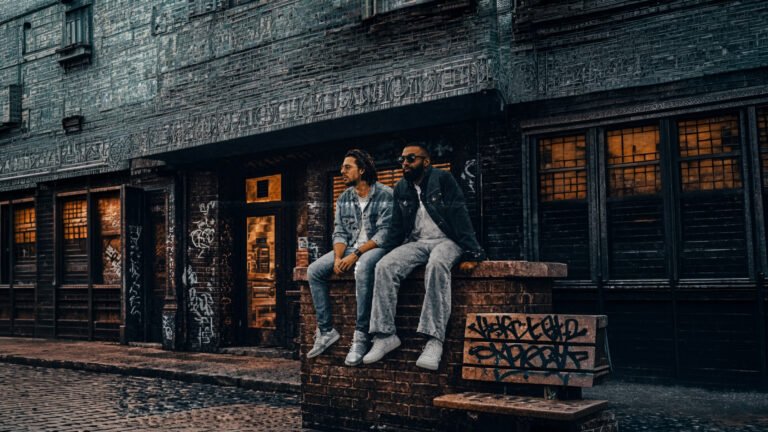
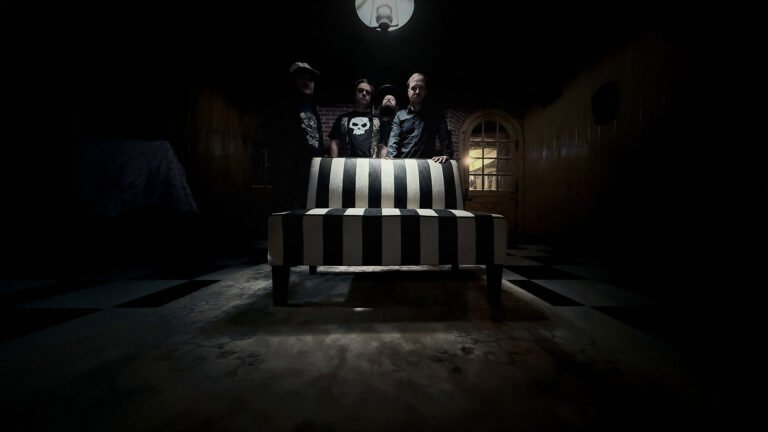
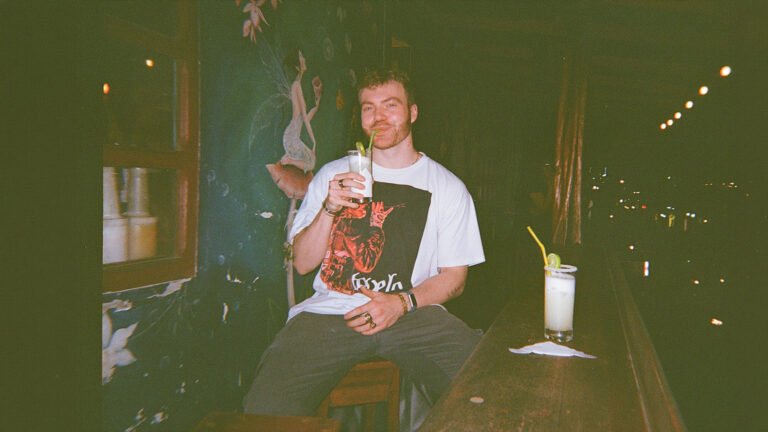
Summerhouse is the project of Conall Hill. After years in East London indie rooms, he arrives with a four-track debut that treats a flinch as a full night. The Pull Away, featuring blackbird, follows heat, relapse, and the morning that will not stay finished.
There is a moment on the last night bus through East London when a conversation is still open and a stop is already chosen. Nobody makes a speech. A hand leaves a pole. A body leans toward the doors. The other person stays seated and watches the street empty by one person. That gap is small. It decides the rest of the night.
The Pull Away lives in that gap. Conall Hill grew up in East London, Irish-English, and spent his teens and early twenties in indie bands, Crash Magnets among them, in the pubs and basements that teach you volume before they teach you space. When the rooms closed, he took the work downstairs. Synths. Drum machines. Guitars and vocals recorded on an iPhone in his parents’ basement. Those early takes are still inside the record. You can hear the grain under the gloss.
The project that came out of that room is Summerhouse. The debut EP is out now as an independent DistroKid release, four tracks written and recorded across a long stretch between London, Canada and Ireland. The voice belongs to blackbird, the name Angie Robba uses when the singing needs to feel like a second self. Robba, born in Lyon and raised inside a family of Italian circus artists, signed young with Playtwo, passed through The Voice France, and has spent years writing and singing across pop and electronic records. On this EP she is not a cameo. She is the temperature.
ROMBO first met the project on All I Know, the single that made an on-and-off affair feel like a room you keep walking back into. Burn All Night followed with more heat and less apology. The full sequence now sits in order. Intro names the flinch. Burn All Night asks for light in the dark. All I Know runs back because running back is the only habit that still works. Daisy wakes up and tries to fall out of love before the light in the room makes a liar of the night before.
The production keeps Hill’s old guitar language, the kind that comes from Peace and early Bombay Bicycle Club, inside synth pads and distorted breaks that lean toward Magdalena Bay and the brighter end of hyperpop. Desire, panic, lust, regret. The writing does not dress those words up. It lets them arrive in the order a night actually uses them.
The artwork repeats the title until the letters start to look like a reflex. Pixelated, stacked, hard to hold still. That is the right image for a record named after a hand leaving a hand.
In Conversation with Summerhouse
We spoke with Conall Hill about the basement years, the voice that carries the record, and how a four-song debut learned to start on the flinch rather than the kiss.
- After the shared noise of bands like Crash Magnets, Summerhouse is a room with one producer and an iPhone. What changed in the writing once there was no one else in that basement?
You gain things and lose things when you move into solo production. In a band you’re never short of someone to collaborate with and bounce ideas off. You can quickly hear how chords, a melody, and a beat sounds together. I’ve missed that for sure, and I try to actively seek out collaboration wherever I can. But producing alone gives you the chance to really focus in on what you can hear in your head, and try and replicate it perfectly – you can drive yourself crazy, but when you nail it, it’s a joy.
- blackbird is not a guest so much as the voice the EP thinks in. How did the work with Angie Robba start, and what did she bring that the production could not do alone?
I have a bad habit of getting so attached to my instrumentals that I pretend they don’t even need vocals. It takes a really good singer to break you out of that, with a voice that adds layers and depth instead of just sitting on top. I originally met Angie online, and from the first scratch demos she sent for Burn All Night I could tell it was going to work out. Once we had leads, doubles, harmonies and whisper tracks recorded, I stripped back a lot of the instrumental production. No instrument fills space as organically as good vocal layers.
- Intro takes the title phrase and turns “pull away” into a loop. Why open the record on the withdrawn hand rather than on the first good hour?
Intro was born out of the first verse of Burn All Night, where hands brushing and pulling away was an image of yearning, and the back-and-forth of making a move. I eventually shortened that verse and moved some of those lines to the darker Intro track, where we decided to emphasise the ‘pulling away’ as foreshadowing for the whole story. After that, it really felt like the image encapsulated the whole EP, hence it ended up as the name.
- Burn All Night wants the dark lit. All I Know keeps running back. How much of that sequence was written as one night, and how much arrived later as structure?
Originally they were independent songs. I thought they might fit together into an EP eventually, but when Angie wrote lyrics for those two tracks there wasn’t a clear structure yet. It was only when they were finished and we started working on Daisy that it became clear what the narrative arc of the EP would be, and what parts of the story we needed to fill.
- You kept years-old iPhone guitars inside new synths and distorted breaks. What does that older tape still do that a clean replacement would flatten?
I loved the tones of the shredded guitars in Daisy from the moment I produced a first demo in 2022. In the original recordings there’s interference, bits of background noise and missed notes. I wasn’t a great guitarist at the time! But after a healthy dose of reverb these imperfections gave it character: the loud and muted notes became smooth undulations and the interference got reflected around. You can do a lot with digital synths, but nothing beats stumbling into a great guitar tone.
- The writing moved between London, Canada and Ireland. Did place change the temperature of the songs, or did the same argument follow you from room to room?
I was taught that good songwriting is about creating moments of tension and release. I love London, but when you’re on a deadline, writing songs about anxiety, it can quickly start to feel oppressive, and it can be easy to focus on the tension part! Going back to Ireland always helps me to breathe, and it certainly switched the focus back onto the positive and cathartic moments of the songs. We’ve build up the tension, now how do we let it all out?
- Daisy ends on a winter image after a record that spends a lot of time asking to burn. What did you want left in the air when the last track finishes?
I really love the choice to invoke winter, and the idea of a relationship not making it past November; after a summer fling and an autumn of reckoning, November is surely the worst time to get dumped. The nights start drawing in and the draft through your windows gets icy, and you can feel in the air that it’s just downhill from here.
- The Pull Away already knows the morning after. Once this cycle is out of the room, where does Summerhouse go next?
I’ve already joked to a few people that I’ve just about run out of steam promoting this EP – 8 weeks of editing videos that are all pensive looks, smeared mascara and chain-smoking in the rain. For my sanity I’ll need to pivot to something a bit more optimistic – maybe a Christmas album?
Follow Summerhouse
The Pull Away is out now.
Listen: Spotify · SoundCloud
Follow: Instagram