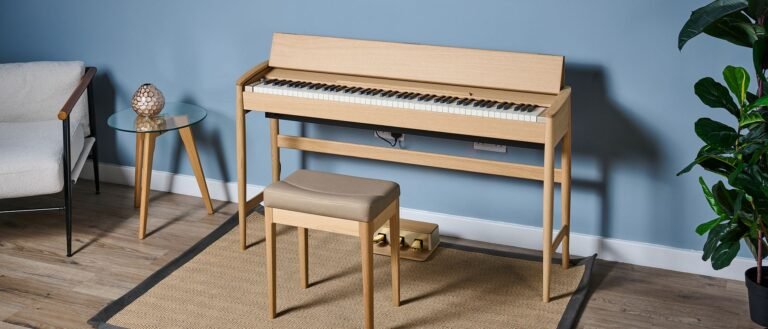
The 2026 evolution of Roland’s Kiyola line pairs handcrafted Karimoku cabinets with the Piano Reality Modelling engine from the LX and GP grand pianos, and trades a control panel for an app.
The Kiyola line has never been about the control panel. Roland’s series, begun in 2015 with the KF-10, continues a collaboration with Karimoku, one of Japan’s established wood furniture manufacturers, and the KF-20 is its 2026 iteration. Each cabinet carries its own grain pattern and will age differently, so no two instruments leave the workshop looking the same.
The design draws on Hikimono, a traditional Japanese method of preparing wood into smooth, organic forms, which is where the KF-20’s rounded edges come from. Roland describes the intent as ‘wa’, the Japanese idea of harmony in which appearance and function carry equal weight. A second model, the KF-25, takes the opposite route with sharper, angular lines informed by Japandi, the Japanese-Scandinavian fusion. The KF-20 is offered in Pure Oak, Walnut, Sheer White and Celadon Green; the KF-25 only in Smoked Oak.
Inside, the specification leans on Roland’s higher-end piano technology. The PHA-50 action combines wood and plastic across all 88 keys with escapement simulation, ivory and ebony touch surfaces, and sensors built to register fine gradations of touch. Sound comes from the same Piano Reality Modelling engine used in the LX and GP grand piano ranges, which generates tone in real time by recreating string vibration and soundboard resonance instead of playing back samples. Because it models rather than samples, it also escapes the polyphony limits that sampling engines can impose.
The compromise is access. Onboard there are a few buttons and six tones. The companion app supplies 48 more, along with Piano Designer. Restrained or under-equipped depends on how much you want within reach of the keys.
Join the Club
Like this story? You’ll love our monthly newsletter.
Thank you for subscribing to the newsletter.
Oops. Something went wrong. Please try again later.

ROMBO Editorial Staff
The collective voice behind ROMBO Magazine’s news, reviews, features, and cultural coverage.