Norwegian producer Fredrik Kristiansen stepped away from the noise of tech to rediscover music as a place of clarity. With his debut album Stillness Is A Sound set for release on June 15, he has created a quiet map of recovery drawn in cinematic indie folk and northern light.
Norwegian producer and songwriter Fredrik Kristiansen is The Quiet North. For years he moved inside the bright, relentless hum of digital products and startups. Then one day the noise became too loud. Music, once a private refuge, returned as the only space where breathing felt possible again. What began as a solitary outlet in the summer of 2025 has already become something larger and quieter at once: a project that reached more than 100,000 monthly listeners in roughly six months and earned early support from NRK Urørt, NRK P3 Musikk and Stjernepose.
Stillness Is A Sound, due for release on June 15 and available now for pre-save, gathers the first thirteen songs of that journey. Acoustic guitars drift against soft piano and warm synths; wide atmospheric layers open like northern skies after fog lifts. The record never raises its voice. Instead it invites the listener into the small, precise moments where uncertainty softens into memory, longing settles into light.
Across the tracks Kristiansen is joined by a carefully chosen circle of collaborators: Ukrainian arranger and multi-instrumentalist Vitaliy Kozubenko, Norwegian artist Thom Hell, California vocalist VÂN SCOTT, UK songwriter Ollie Wade and the Austrian duo Fitz Brothers. Their voices do not dilute the Nordic core; they deepen it, turning personal stillness into something that travels.
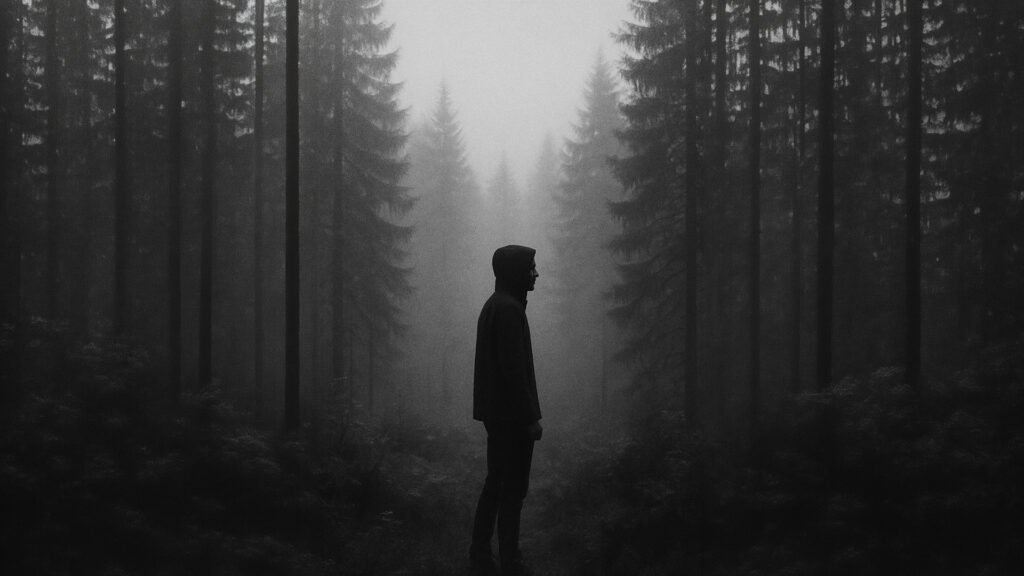
The visual language is inseparable from the music: a hooded figure in mist, black sand beaches, forests swallowed by fog. These images are not decoration. They are the landscape the songs inhabit.
In Conversation with Fredrik Kristiansen
The Quiet North was born after a long season of noise and overstimulation in the tech world. What made music the place where clarity and calm finally felt possible again?
I don’t think there was one single moment where I decided that music would become that place. It happened gradually.
For many years, I had been working with digital products, startups and constant decision-making. I loved building things, but over time there was a lot of noise around it, screens, pressure, responsibility, momentum, always thinking ahead. After a while I think I needed a creative space where nothing had to be optimized or explained.
Music became that space.
At first, The Quiet North was just a private outlet. I was not thinking about building an audience or making an album. I was simply trying to create something that felt honest and calm. But quite quickly I noticed that the songs helped me find my way back to something clearer in myself.
It became a way of moving from inner noise toward stillness, using music to create space, clarity and calm.
The album title Stillness Is A Sound captures a central paradox. How did this idea guide the songwriting and production across the thirteen tracks?
The title came from the feeling that stillness is not empty. It has a tone, a texture, almost a presence.
That idea guided a lot of the album. I wanted the songs to have space around them. I didn’t want everything to be too crowded or too loud. Even when the songs become bigger or more cinematic, I wanted them to keep a sense of restraint.
In the production, that meant allowing small details to matter, a soft piano, a distant guitar, a warm synth, a vocal that feels close but not over-polished. The spaces between the sounds became just as important as the sounds themselves.
For me, Stillness Is A Sound is about listening to what happens when things slow down. When you stop pushing for a moment, other emotions start to appear, memory, longing, light, recovery. That became the emotional world of the album.
Collaborators stretch from Ukraine to California, the UK and Austria. How did these international voices expand, rather than dilute, the distinctly Nordic core of the project?
The Nordic core was always there, because that is where the project comes from emotionally and visually. The light, the landscapes, the melancholy, the restraint, that is part of me and part of the sound.
But the collaborations opened the project up.
Vitaliy Kozubenko in Ukraine has been very important in shaping the musical language, especially through guitars, bass, arrangements and atmosphere. He added depth and movement to many of the songs. Thom Hell brought a strong Norwegian presence and a very natural musicality. VÂN SCOTT, Ollie Wade and Fitz Brothers each brought their own emotional color and identity.
What I like is that the collaborations did not make the project feel less Nordic. They made the world around it wider. It still feels rooted in the North, but there are voices and textures from other places moving through it.
That contrast feels right to me. The Quiet North is rooted in a specific emotional landscape, but it is not closed off from the world.
Tracks such as Southbound, Northbound and Fading Daylight seem to trace movement through uncertainty. What emotional or geographical terrain were you mapping?
A lot of those songs are about movement, both real and emotional.
Southbound has a warmer feeling to me. It carries something about leaving the North for a while, travelling, looking for light, maybe even searching for a more open version of yourself. Northbound feels like the return, not necessarily back to a place, but back to presence, family, clarity and the kind of light that belongs to the North.
Fading Daylight is more reflective. The original inspiration came from the way daylight slowly disappears here in the North as autumn turns into winter. There is a particular feeling in that transition, the light fading a little more each day, the landscape becoming quieter and darker. But the song is not really about darkness. There is also hope in it. The line “still I stay” became important because it speaks to resilience and presence. Even as things change, even as light fades, there is a decision to remain, to endure, and to trust what comes next.
I think many of the songs map the space between where you have been and where you are going. They are about uncertainty, but also about trust. About letting things move without needing to control everything.
Your influences range from the melodic melancholy of a-ha and Kent to the glacial atmospheres of Sigur Rós and the emotional scale of Arcade Fire and Band of Horses. How do you translate those references into your own northern aesthetic?
For me, influences are more about emotional direction than sound alone.
From a-ha and Kent, I connect with the melodic melancholy, that ability to make something feel both beautiful and a little painful at the same time. From Sigur Rós, there is the sense of atmosphere, space and something almost elemental. Arcade Fire and Band of Horses have that emotional scale, where the songs feel human but also wide open.
With The Quiet North, those references pass through my own landscape. I think about Nordic light, mist, forests, coastlines, long days, dark evenings, and the feeling of being alone in a big space without feeling lonely.
The songs are emotional, but they are not trying to shout. I like music that stays with you quietly. That is probably where The Quiet North finds its own identity, somewhere between intimacy and distance, melody and atmosphere, melancholy and light.
In roughly six months, the project grew from zero to more than 100,000 monthly listeners and earned early Norwegian radio support. What does this response suggest about the place of quiet, reflective music in a permanently stimulated world?
It tells me that there is still a real need for music that gives people space.
We live in a very stimulated world. Everything is fast, loud, optimized and constantly asking for attention. I think many people are tired of that, even if they don’t always say it out loud. They still want emotion, beauty and atmosphere, but maybe in a way that does not demand too much from them.
The response to The Quiet North has been very encouraging because the music is not made to chase trends. It is slower, more cinematic, more reflective. So when people connect with it, it feels meaningful.
Maybe quiet music has a different role now. It can become a place to breathe. Something you return to when the world feels full.
The visual identity, misty forests, black beaches, the hooded silhouette, feels inseparable from the sound. How do these images inform or reflect the themes of memory, longing and recovery on the album?
The visuals are very important to me. I don’t see them as separate from the music. They are part of the same world.
A lot of the imagery actually comes from photographs taken during our travels around the world. My wife is a visual designer and has captured most of these images, and in many ways we function as a creative design duo. Together, we are drawn to atmosphere, light and landscapes that evoke a certain feeling, and those photographs often become part of the visual language around the music.
The misty forests, black beaches and hooded figure all carry a feeling of distance and stillness. There is something hidden in them, but also something calm. They reflect the emotional space of the songs, memory, longing, recovery, and the feeling of moving through something slowly.
The hooded figure is not meant to be mysterious in a dramatic way. It is more like a person walking through a landscape, trying to find clarity. The figure could be me, but it could also be anyone.
Coming from a background in design and user experience, I naturally think about projects as complete experiences rather than separate elements. The music, photography, artwork and visual identity are all different ways of expressing the same emotional landscape.
That is why the visuals matter so much. They help create a sense of place before a single note is heard. At the same time, I like images that leave something unresolved. Not everything needs to be explained. Just like the songs, they leave room for people to bring their own memories, emotions and interpretations into the experience.
Stillness Is A Sound arrives on June 15 and is currently available for pre-save. What do you hope listeners carry with them once the final track fades?
I hope they carry a sense of space.
For me, this album is about finding calm again, but not in a perfect or polished way. It is about moving through uncertainty, allowing things to breathe, and discovering that quiet moments can hold a lot of emotion.
If someone listens to the album and feels a little more present, a little more open, or a little less alone in their own inner noise, that would mean a lot to me.
I hope Stillness Is A Sound becomes something people can return to, on a walk, in a car, late at night, or in a season of life where they need room.
Music that gives room and stays.
Follow The Quiet North
Stillness Is A Sound arrives June 15 and is available now for pre-save.
Listen: Spotify · SoundCloud
Follow: thequietnorth.no · Instagram