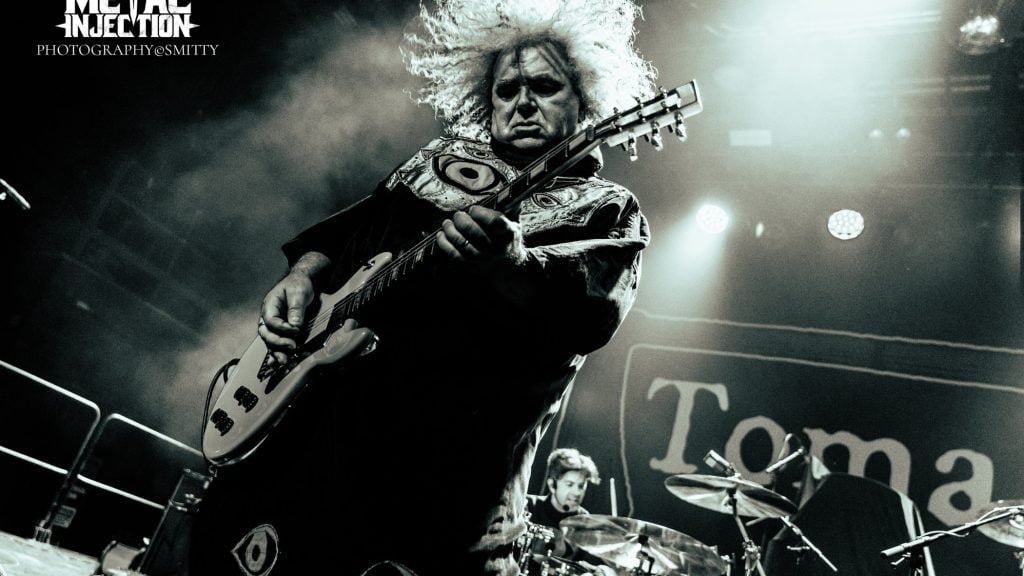
On a recent night in Brooklyn, two of heavy music’s most deliberately unconventional forces shared a stage. Tomahawk—the long-running project of Mike Patton, Duane Denison, John Stanier, and Trevor Dunn—met the Melvins, whose influence on sludge and slow-tempo extremity remains foundational. The pairing, documented by photographer Mark “Smitty” Neal, was less a clash of styles than a study in contrast.
Tomahawk’s set shifted through dissonant noise-rock and atmospheric detours, held together by the friction of Patton’s vocal control and Denison’s angular guitar. The Melvins answered with the slow-crush weight that has defined them since the 1980s, Buzz Osborne’s riffs dragging the room into a thicker, more patient kind of chaos. Neither act presented anything resembling nostalgia—their sets relied on tight musicianship and an enduring disregard for expectation.
The convergence offered a rare overlap of two paths that have shaped underground heaviness from parallel angles: one built around a frontman’s eclectic vision, the other around a drummer’s unyielding pulse. Together, they made a case that heaviness is a matter of tension, not volume alone.