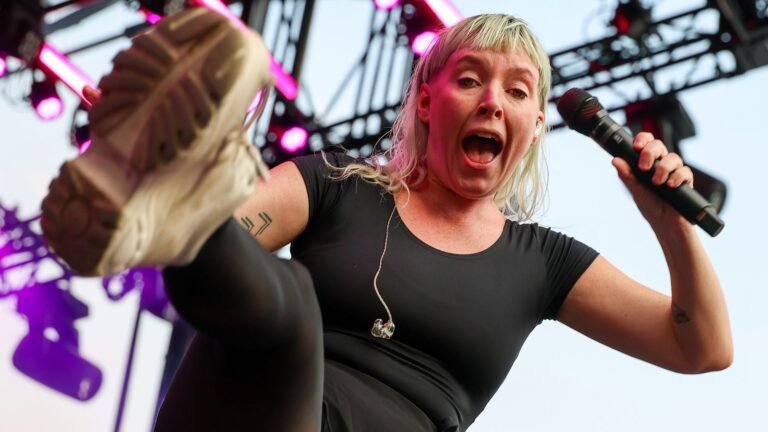
On her fourth album, the Australian songwriter’s signature style becomes a deliberate practice, moving beyond doubt into a settled craft.
Courtney Barnett’s artistic identity was cemented early by a specific tension: the sprawling, anxious detail of her observations delivered with a laconic, almost detached cool. This made her songs feel like real-time transmissions from a buzzing mind, charming in their vulnerability and sharp in their wit. As she prepares her fourth solo album, Creature of Habit, the narrative shifts from one of anxious discovery to one of accepted practice. The title itself signals a key evolution. Barnett is no longer merely diagnosing her own restlessness she is examining the structures she has built within it.
Her journey, as discussed in the context of the new record, is framed as a movement toward accepting life’s inherent uncertainties. This is not a dramatic reinvention but a subtle consolidation. The musical hallmarks the conversational vocal cadence, the grungy, melodic guitar work, the lyrical fixation on the mundane are no longer just stylistic fingerprints. They have become the reliable tools of a settled craft. Barnett’s earlier work often thrived on the energy of unresolved doubt, while her recent output suggests an artist making peace with the process itself, finding a different kind of clarity in repetition and refinement.
This progression mirrors a natural artistic maturation. Where once her songs captured the paralysis of choice, they now seem to document the rhythm of living with those choices. The “creature of habit” is an acknowledgment of the patterns we all form, for better or worse, and the creative potential within acknowledging them. It suggests Barnett is looking at her own songwriting not as a series of confessional outbursts, but as a disciplined space where life’s ambiguities can be held and examined with a steadier hand.
In the landscape of confessional indie rock, Barnett’s significance lies in her ability to render internal monologue as compelling narrative. With Creature of Habit, she appears to be refining that project, moving from a portrait of the artist as a young skeptic to a portrait of the artist as a working professional, for whom uncertainty is not an obstacle but a familiar part of the terrain. The doubt has not vanished, but it has found a home in her habitual, and increasingly assured, craft.
Join the Club
Like this story? You’ll love our monthly newsletter.
Thank you for subscribing to the newsletter.
Oops. Something went wrong. Please try again later.

ROMBO Editorial Staff
The collective voice behind ROMBO Magazine’s news, reviews, features, and cultural coverage.