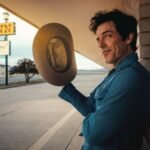
A young Nottinghamshire songwriter records a garage-born track that treats personal release and class frustration as the same temperature. The result carries more presence than most polished indie of the moment.
Daniel Troop is a young acoustic-indie songwriter from the Nottinghamshire countryside, specifically the Newark and Sherwood area just off the A60 toward Worksop. He grew up around his grandfather, a milkman who worked the farms, and his mother. When that grandfather died in 2018, Troop picked up his first guitar. He was already deep into Oasis. By the first lockdown he was writing. By 2021 he was playing those songs live, pushed by a sixth-form tutor who remains one of the strongest early influences he names. After leaving school in 2023 he kept the circuit of open mics and small gigs. In December 2025 he wrote “Wide Open Lies.” He has said this is the track that finally showed him what his sound could be.
He calls his work “Songs For The People.” The phrase is not branding. It is the intention. Troop comes from a working-class family and wants the music to reach people who feel the same pressures, the same small daily tightnesses, without closing the door on anyone else. He records at home in what he describes as a garage-come-studio and mixes the tracks himself. “Wide Open Lies” is the first piece that feels fully his.
Here is the part that lands harder than expected. In 2026, when most independent artists either chase hyper-clarity or lean into deliberate fracture, Troop has made a record that simply refuses both options. It sits inside an older British acoustic tradition and stays there without apology or irony. The track does not try to update the form. It trusts the form. That trust is what gives it weight.

The architecture is straightforward and effective. A driving acoustic guitar carries the whole piece with a fast, rhythmic strum that never loosens its grip. Bass and drums stay square and functional. The verses keep a steady narrative tension. Troop’s voice is slightly nasal, lightly dragged, marked by a clear northern English accent. He does not push for range or polish. He aims for attitude, the same mixture of arrogance and melancholy that once defined the best of that lineage. The references sit close: the acoustic b-sides Noel Gallagher used to leave on the table, the directness of The La’s, the early emotional economy of Arctic Monkeys, the open-sky melodrama of The Verve. Yet the track never feels like pastiche. It feels lived-in.
When the chorus arrives the song opens. A lightly distorted electric guitar enters, not with chords but with a clear melodic line that locks against the vocal. That line is the hook. It is simple, memorable, and perfectly placed. The outro does what the best songs in this tradition have always done. It refuses to fade. Instead it builds into a short instrumental swell where the electric riff takes the centre and the final repeated line, “I wish you all the best,” is delivered with the kind of resigned clarity that feels earned rather than written.
The lyric moves between two registers without losing temperature. The verses look outward: upper classes, economy games, the everyday pressure felt by working people. The chorus turns inward to a relationship that has reached its limit. The cynicism does not disappear. It is simply set beside a quieter acceptance. “I can’t turn away from the wide open skies.” The skies are both the place where the personal story ends and the only remaining horizon when the social picture closes in. Troop has said the song is not a direct protest piece, yet it carries his distaste for the recent state of the English economy and, in the second verse, a call for people to stick together. The two threads never feel forced into the same frame. They share the same emotional weather.
What holds the listener is the control of pacing and the refusal of excess. Nothing is overplayed. The production is intentionally rough in places, the kind of roughness that comes from recording and mixing alone in a garage rather than from a studio decision to sound authentic. That roughness becomes part of the identity. The song does not ask to be admired for its craft. It asks to be recognised. It takes the grey of routine, the friction of class, and the quiet end of something personal, then converts them into a melody that still wants to be sung out loud. The release is real. It does not pretend the world has improved. It simply refuses to stay closed.
Troop is still early. He is independent, still building the circuit, still writing from the same ground that produced the song. “Wide Open Lies” already shows a clear sense of identity and purpose. The music understands atmosphere as structure, not decoration. The detail is in the restraint, the movement of the guitar, the way the voice holds back until the chorus needs it. This is music with presence. It does not rush to explain itself. It builds its own temperature and then leaves the door open.
Follow Daniel Troop
Wide Open Lies is out now.
Listen: Spotify · Bandcamp · SoundCloud