A Dublin fiddle player steps out of the session chair and sequences her first album of songs like a season, from a corncrake air to a bluegrass calendar.
Jayne Pomplas has been in the room for a long time. Born in upstate New York, she started asking for Irish fiddle lessons at three, spent childhood summers at fleadhs and festivals, especially around County Clare, and moved to Ireland on her own at 17. The playing that followed sits in the New York to Sligo line she learned from Brian Conway and Tony DeMarco. Dublin knows her as a session musician and a featured hand, the sort of player who has sat in with The Chieftains, Frankie Gavin, Fin Furey, Francesco Turrisi, Liam Ó Maonlaí, John Francis Flynn and Ron Block. She already had traditional records to her name. This Is How The World Ends is the first album of her own songs.
The title sounds like a collapse. The sequence behaves more like a field. Track three is Farewell to the Corncrake, Connie O’Connell’s slow air set beside her own hop jig. The corncrake is a poor candidate for romance. Its call is a rasp, closer to a ratchet than a song, and for years it was the sound of an Irish summer being written out of the meadows. A few western pockets still keep it. Pomplas has talked about turning 27, deciding she had been playing it safe, and throwing everything at once, only to land on the plain fact that she knew nothing. “A world does end,” she has said, “but it always begins again.” A corncrake is that sentence with feathers. Something leaves. Something is heard again in the long grass. The apocalypse on this record is seasonal.
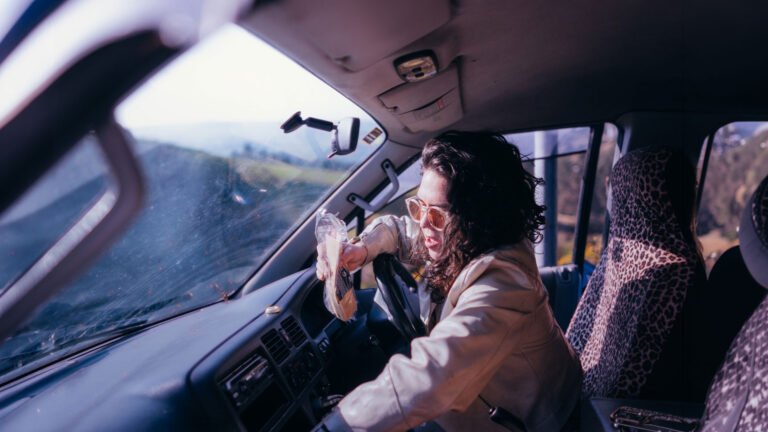
She recorded the spine of it from January at Sonic Studios in Stoneybatter, with Kilian O’Flanagan engineering and Ber Quinn mixing and mastering. John Francis Flynn was the first guest through the door. Other days pulled in Adrian Crowley, Patrick Stefan, Luke Coffey, Graham Heaney and Méabh McKenna. She took her own gear to a houseboat on the Thames to work with pianist Jaz Delorean, and went to Waterford for the art-folk duo Lunatraktors. The sleeve, shot by Steve O’Connor, puts her at the wheel of a van with a sandwich in one hand and a leopard-print seat beside her. She has lived in vans. Hit Single knows the fantasy and the correction in the same breath. California, a one-verse jingle, a deal. Then the dry landing: that does not happen anymore.
Sweeter Than Honey opens the album in a small, late room. Delorean’s piano gives the song its cabaret lean, and Pomplas sings the exit with a smile that does not forgive. “I blow you a kiss from the abyss” is a cruel little courtesy. Hit Single and Stars and Stripes carry the American grain, country manners with the romance scraped off. County fairs, candy floss, goldfish in plastic bags, then stars and stripes burning. The fiddle sets keep the other half of her life in the room. The Lonesome Boatman takes Finbar Furey’s melody and worries it with effect-soaked fiddle over guitar, less a postcard of the west than a signal heard through weather. Bending the Curtains is the keenest view of her as a tune writer, her own jig and reels running into the classic Wheels of the World. Speed here is not display. It is a body keeping time.

Mother Superior is the dark centre, recorded with Lunatraktors and framed by her as a conversation with the inner monologue. Fiddle and voice start close. Electric guitar, bassoon, choral stacks and Dublin church bells open the room out, a nod to The Chieftains and The Bells of Dublin that never turns into tribute-band manners. Whiskey Sours, cut with Delorean on the houseboat, holds the album’s question. She has called it a song about limerence, romantic or otherwise, the moment a person wakes inside the story they have been telling. “Is this how the world ends? At five in the morning?” The arrangement stays small enough for the line to land as speech, not slogan. Saint Francis, angry neighbours, limes and bitters, a body under covers. The ending, in her hands, has a postcode.
Blackwaterside arrives late and keeps the old room intact. The liner notes name Anne Briggs, and the vocal sits near that shadow, fingerpicked and circular, the false promise and the fishes that will have to fly. It does not reinvent the song. It holds it steady, which is its own kind of nerve on a record this restless. Ninety Nine is the one that tips. Parts of it were written on pandemic walks. In Istanbul, the call to prayer and the birds answering it shaped the melody. Crowley, Lunatraktors and McKenna crowd the track with duduk, accordion, harp and electric guitar. “Slipping sliding twisting turning falling through the looking glass” is the dizziness the arrangement has already built. The coda stops arguing. “Things are bad enough as they stand. Let’s dance.”
There Is a Time closes the record, learnt from The Dillards and played with distorted banjo and fiddle, a hopped-up Appalachian session that refuses to fall over. Love, frost, a fire against the cold, sleep when the day is done. Pomplas has said in her notes that it is the right ending, and the sequence agrees. The world on this album does not go out in a speech. It goes out the way a summer does, and the corncrake, the houseboat, the van and the five o’clock question all belong to the same weather. This is music with a clear sense of what has ended, and a sharper sense of what is still in the grass.
Follow Jayne Pomplas
This Is How The World Ends is out now.
Listen: Spotify · SoundCloud · Bandcamp
Follow: Instagram · YouTube · Official Site