With “Talisman”, the Athens-based songwriter leans fully into the contradiction that has come to define his music: bright, summery momentum wrapped around a core of quiet collapse. Released 22 May 2026, the track refuses easy catharsis. Instead it lets illusion fray slowly, one repeated reassurance at a time. Ahead of what appears to be his debut long-form project, we spoke about the deliberate tension between surface warmth and emotional restraint, the metaphors we carry for comfort, and the distances, geographic and internal, that keep returning in his songs.
Sotto James has never been interested in tidy emotional resolutions. On “Talisman”, the latest single in a run of releases that already includes the stark, nocturnal “Cold Fingers”, he doubles down on that instinct. The arrangement moves with an ease that feels almost summery, yet the lyrics drift through fragmented images and half-formed objections. Devotion and denial sit side by side. The narrator insists everything is fine while the song itself quietly suggests otherwise.
The title is no accident. A talisman is something carried for protection or hope even when its power is doubtful. In the track, that object becomes a stand-in for every comforting fiction we choose not to examine too closely. “You can have anything, anything you want” repeats not as promise but as surrender. The warmth of the music makes the unease more disorienting, not less.
To understand how this particular tension took shape, and how it connects to the wider world Sotto James has been building, we spoke about the deliberate balance between surface warmth and emotional restraint, the metaphors we carry for comfort, and the distances that keep returning in his songs.
The Conversation
You’ve moved from the stripped-back, nocturnal intimacy of “Cold Fingers”, written in the suspended hours before a long journey from Greece to Japan, toward the brighter, more propulsive palette of “Talisman”. What drew you to this shift in sonic temperature while keeping the emotional restraint so deliberately intact?
I suspect music is like food to me in that if I have too much of something I will get tired of it, so I stop frequenting the same places, so to speak. With Cold Fingers I was very much living out the top end of an emotional state that later culminated in Talisman. It was January, and I was keeping to myself, emotionally, socially, and creatively. Talisman is the visceral, outward reaction that followed a wallowing that had begun to stagnate. Summertime was around the bend, and this fact alone seemed more important than my poorly-made bed in all things sentimental.
The arrangement carries an unexpected warmth and forward momentum that sits in sharp contrast with the song’s themes of exhaustion and quiet surrender. How did you and your collaborators approach that disorienting balance in the studio, and what did the process reveal about the kind of world you want these songs to inhabit?
I worked with Dimitris Fragkoulis to record and produce Talisman in a tiny studio in downtown Athens. His band, Mavile, had put out what became perhaps my favorite-sounding rock album of any Greek band back in 2021. Being more of a musical artist as opposed to just a player himself, we spoke almost exclusively about how the song made us feel, only exchanging a couple references that came to mind for the song’s overall character. The process was almost entirely intuitive, and felt like just hanging out with your friend. I brought some pedals over, a harmonica, a small electric piano, and we plugged in and played. I remember forgetting my power supply so we could only use two or three pedals at a time, which was a delightful obstacle to work around. The biggest part is finding someone who, for whatever reason, clicks. The rest is allowing them to surprise you. There were many moments where either of us gladly gave into the other’s “Trust me man, this works.”
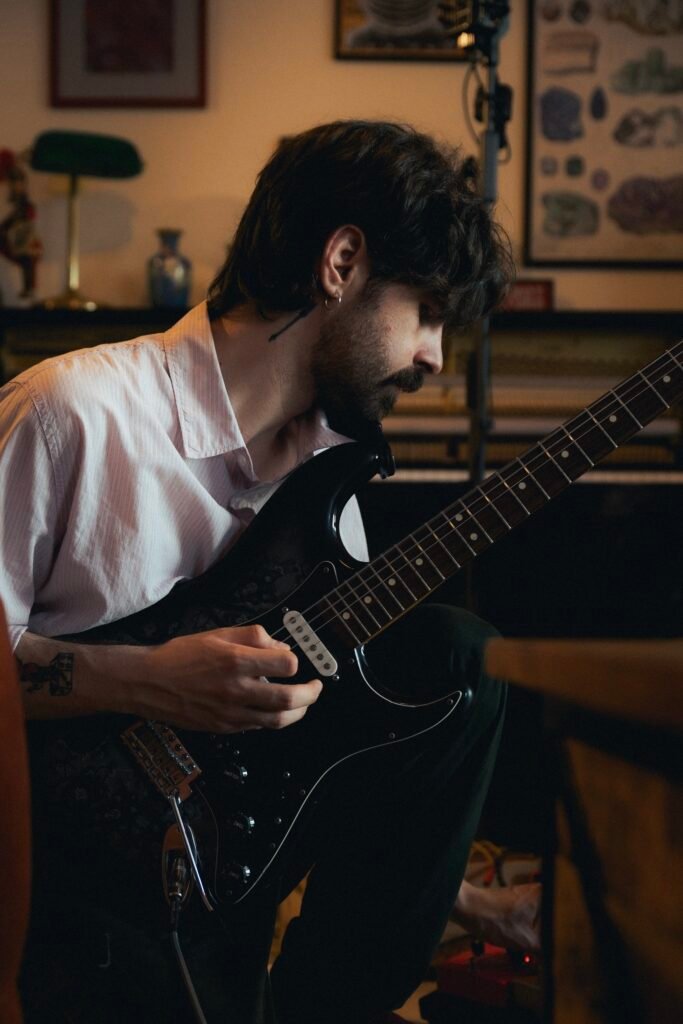
The refrain “You can have anything, anything you want” lands less like reassurance and more like a knowing, almost satirical calm. Where did that line begin for you, and what does it capture about the particular form of self-deception the song is circling?
The line, in my head, is saying “Fine. Have it your way.” It’s one of the first lyrics I found myself singing. People who struggle with setting boundaries may feel me on this one. You’ve tried everything, given it your all, but it’s just not happening. Maybe you’re too stubborn to let it go. One side is me dismantling my boundaries in front of someone else, the other is my conscience, which is tired of trying to knock sense into me. We all see the end, but no one is willing to budge.
The title itself has become the central metaphor: a talisman carried for comfort or protection regardless of whether it still works. Is this image rooted in something specific from your own life, or does it speak to a more universal pattern in the way we manage emotional misalignment?
I become superstitious usually when I don’t like what my gut has to say. I think that’s the main point of a talisman anyway: offloading denial, uncertainty, hopelessness. The working title for the song was “Anything” but it didn’t do it for me. While spitballing, my friend randomly blurted out “Talisman” and it hit me so hard I even had to go back and re-work some lyrics. The talisman is never of any significance. Your beliefs are. What you choose to hope for is. So is when you choose to stop hoping and face the facts. But what the talisman does not require of you is accountability. This is the pattern.
Your lyrics often arrive in fragments “coming up roads in droves of reasons to object”, “little blank spots appear”, “I’m getting so good at holding on with one hand”. How do you construct these incomplete, unresolved images, and what space do you intentionally leave for the listener to fill?
I spend most of the lyric-writing part of any song confused and restless. I mumble phrases I like the shape of and then fill in the gaps. It feels less like writing the song and more like it’s already out there and I’m trying to shape it. If I am lucky enough to find the pieces and patient enough to put them together, I’m just as surprised when I’m done as the listener is at what’s there. Most of life happens in the spaces in between, when there is no right answer, and you don’t need to be someone. The same fragments can reflect differently in any given circumstance, and I hope they do just that.
Distance, both physical and emotional, recurs throughout your work: the Athens–London axis that colours your perspective, the Greece-to-Japan transit that informed “Cold Fingers”. How does that permanent sense of in-betweenness shape the way you write about longing, denial and the quiet violence of holding on?
It’s funny and simultaneously a bit jarring to be associated with distance. I consider myself fairly open and at times even awkward. I think the distance occurs when I step back to analyze, and that’s what’s happening in my songs. It’s never automatic though. I dive headfirst and then come up for air. As far as the sense of in-betweenness, I feel I am constantly pulled by binaries, and they never settle in a middle point. But opposites are fated to connect exactly because of that binary quality, and this is what I cannot escape in my songwriting and indeed in my own life. How can I properly talk about love without also talking about the violence it must defy? How can I speak about hopelessness without mentioning how liberating it can be to sometimes give up?
Negative space, sonic and lyrical, has become one of your clearest signatures. You leave gaps where other songwriters might rush to resolution. Is this restraint a conscious discipline, or does it emerge more naturally from the way you process feeling and memory?
Definitely conscious, but less of a discipline and more of a takeaway I’d say. I used to approach a song thinking “how many cool things can I stuff inside?”. Having matured as a songwriter, I see that there is great potency in simple things. When I leave space in a song, it is me giving whatever image or sentiment the opportunity to resonate, and allowing the listener to reflect. It’s a sunset no matter who is looking at it, but it can mean something different to each of us.
The visual language around your releases, the talisman imagery, the atmospheric photographs, the figure singing in water at dusk, feels tightly woven with the music’s mood. How involved are you in shaping that visual world, and what role does it play in how you want a song like “Talisman” to land?
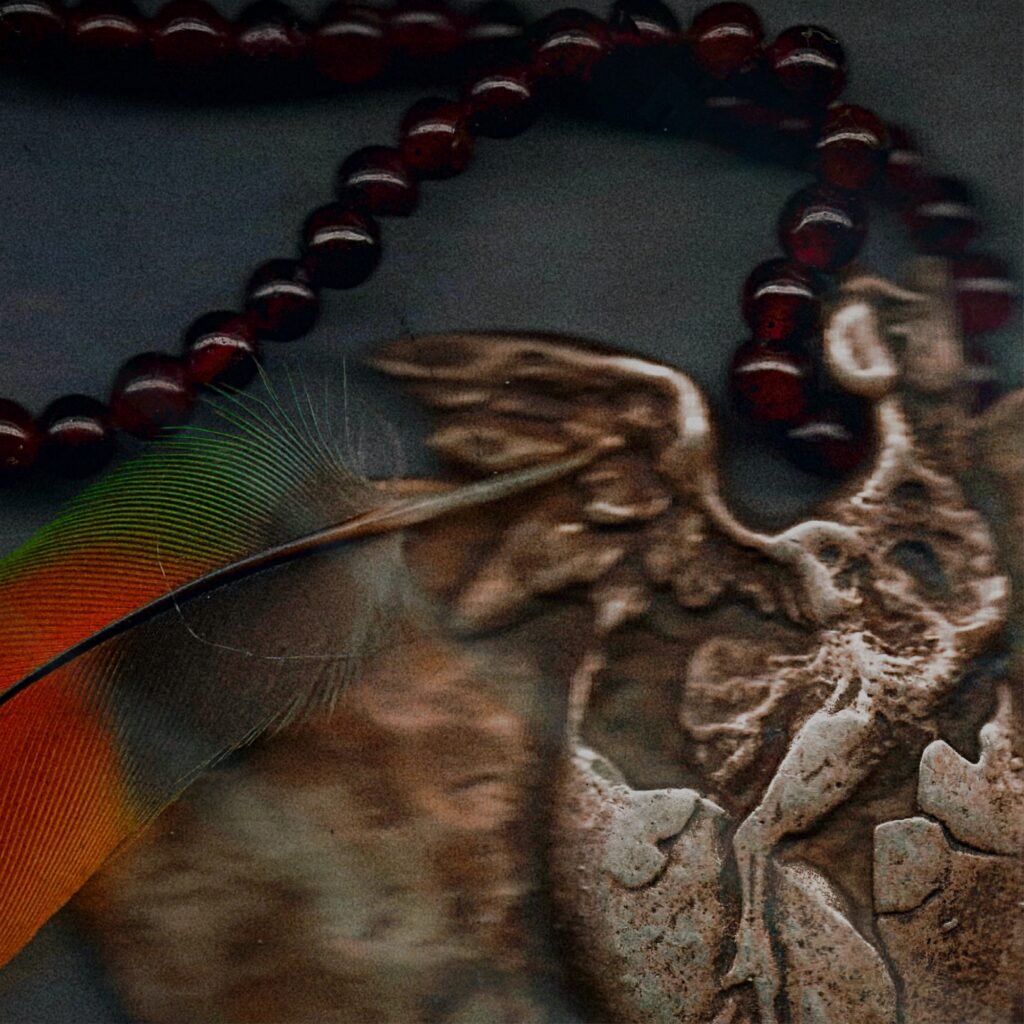
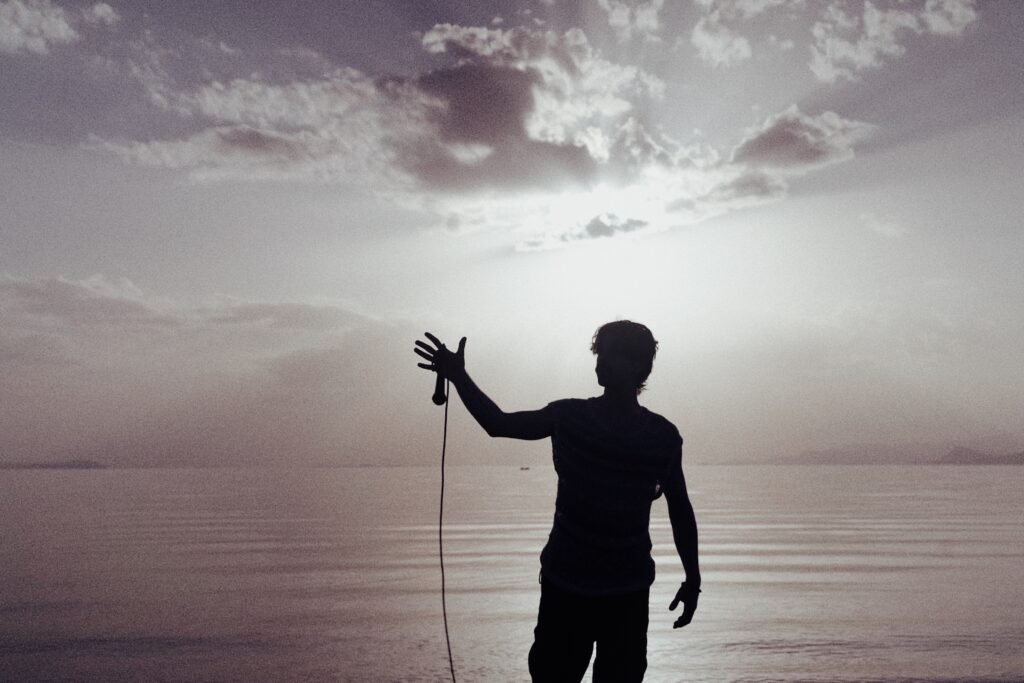
Images and colors tend to arrive hand in hand with the music, so the visual identity of all of my music lives in its DNA from day one. The single’s cover was put together with miscellaneous items I have kept purely out of my obsession over trinkets and what-have-you’s. The video came to me as I was pacing around my living room, signing the song. I remember feeling so light, dancing around with a microphone in my hand as my cats looked at me with their usual curiosity before remembering “hey this song is about heartbreak actually”. And then I got the image of someone doing just that on a beautiful beach, like nothing else exists, like it doesn’t matter if I’m drowning or where the microphone’s connected. The video was shot and edited by Vagelis Tziavaras, whom I rarely need to explain myself to. He understood the concept right away and delivered the grainy, nostalgic, oblivious visuals you see.
As these singles build toward what seems to be your debut full-length project, how are you thinking about expanding the themes of ambiguity and emotional self-awareness across a longer body of work? Does the project deepen the contradictions already present, or begin to resolve them in some new way?
With a larger body of work I have the opportunity to take my time, and I can’t wait to tell a more complete story through it. I think resolution is relative, or at the very least temporary. Most of my favorite stories have a common point, however, and that is that by the end our heroes and the world around them are fundamentally changed and can never go back to what they were in the beginning. In ways less flashy but equally as powerful, I think this is the case for each of our own personal cycles. We are called to face ourselves and dive deep into the absurd. Our contradictions are our momentum, and a most incessant voice beckoning us to change. Our failures inform our values, our losses make way for new beginnings, and yes, the depth of our pain holds the roots of our compassion. I want the album to give these contradictions a narrative. One where you can see yourself as you are, as you were, and perhaps as you might come to be.
Now that “Talisman” is out in the world, is there anything about the song, or the early reactions to it, that has surprised you or shifted how you hear it yourself?
I generally can’t listen to my songs by the time they’re out. I’m usually hyperfocused on them and then when they’re finally public it’s like some weird postpartum thing where I need space. This hasn’t happened with Talisman though! I have certainly noticed that folks are mirroring the song’s energy, and that’s refreshing, especially since Cold Fingers was a heavy winter song. Seems like everyone’s just about done feeling bad and is ready to bob their head to something. In this respect, the song feels lighter to me as well. I don’t think too much about it. Just bob my head right along.
What, in the end, do you hope listeners connect with most: the surface warmth, the unease beneath it, or the particular space that opens up between the two?
My favorite part about listening to music is the sense of familiarity you get when you listen to something that resonates with you. Like you know if you ever met the person or people behind a song you love you’d definitely hit it off, or at least understand one another. The best comment I’ve heard so far is someone saying that it feels like they’ve known the song from before. I try to keep my conclusions to myself about my own music, and urge people to arrive at their own, and it’s thanks to other people’s interpretation of my music that I end up discovering more about it myself. If I can hope for one thing, it is that my music keeps listeners company when they need it.
Follow Sotto James
Talisman is out now.
Listen: Spotify
Follow: Instagram · YouTube · Official Site