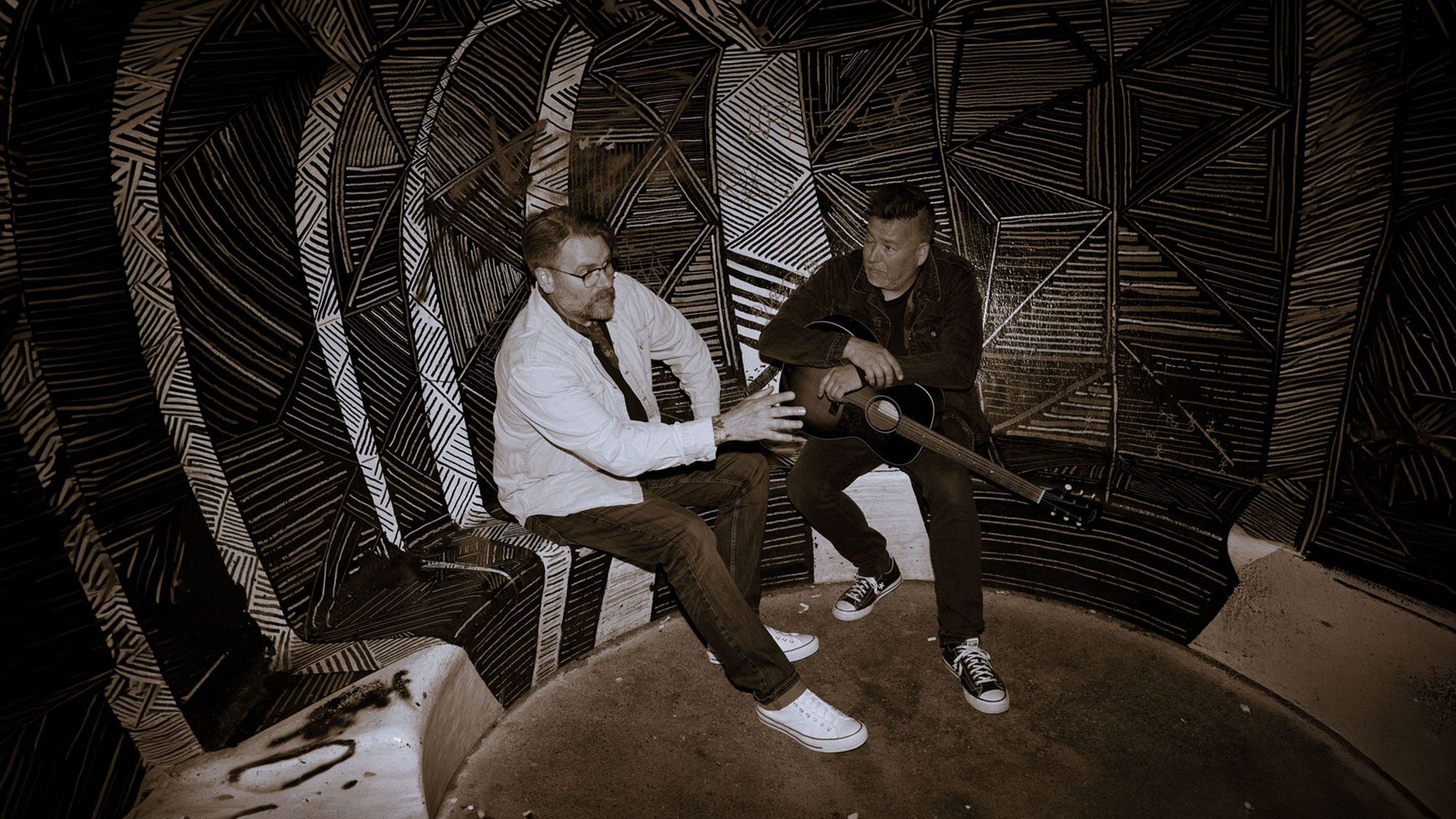
David Yazbek has spent decades writing music that knows how to hold a room. Born in New York City in 1961, he came up through bands and jingles, won an Emmy on the Letterman writing staff, and co-wrote the theme that still makes a generation of kids picture a red fedora and a globe. His Broadway scores for The Full Monty, Dirty Rotten Scoundrels, The Band’s Visit (Tony and Grammy), Tootsie, and now Dead Outlaw have always carried a dry New York intelligence that refuses to treat the stage as a place where feeling has to arrive dressed up. The new EP, Four Songs From Dead Outlaw, brings four of those songs back to the three people who first cut them as a concept album in the middle of COVID: Yazbek, co-writer Erik Della Penna, who shares the EP’s credit, and producer Dean Sharenow. Yazbek calls them “the purest versions of the songs that became the show.”
It is also Yazbek’s first release on Meridian, the imprint of ECR Music Group, the New York company Blake Morgan founded as Engine Company Records in 2002, where every artist owns 100 percent of their master recordings and The Orchard carries the records worldwide. ECR presents the EP as a first step: reissues of his solo catalogue and a new record of his own are announced to follow. ROMBO readers have seen that road before. Block took it on Meridian, reclaiming his catalogue before Love Crash, his first album of new songs in thirteen years, and Patti Zlaket came back to recording on the same imprint with Dance Again. For Yazbek the catalogue in question is five full-band solo records, from The Laughing Man in 1995 to Evil Monkey Man in 2007, the side of him the Broadway audience has mostly missed.

Think for a moment about the coins in a dead man’s mouth. In 1911 an undertaker in Pawhuska, Oklahoma, embalmed Elmer McCurdy, the outlaw of the title, a thirty-one-year-old train robber who had already failed at almost everything, and charged visitors a nickel to look. The story told ever since says the nickels went between his lips. In 1916 two carnival men posing as his brothers took the body away, and for sixty years it traveled through sideshows, a crime museum and wax displays, until a prop man in a Long Beach funhouse moved a glow-painted ‘mannequin’ hanging from a gallows, broke off its arm and found bone. When the coroner opened the mouth, he found a 1924 penny and ticket stubs from Louis Sonney’s Museum of Crime. The price of admission was still inside. Four Songs From Dead Outlaw keeps returning to that transaction. The music understands that American death is rarely allowed to stay private. It gets catalogued, auctioned, painted, and hung where people can still pay to see it.
“Dead” opens the EP with the blunt accounting that runs through the whole project. Yazbek says the story of the show begins and ends with it, and puts its idea plainly: “Death is going to happen. Realize it, own it, and life is sweeter.” The voice moves like a street preacher who has already decided the congregation is made of ghosts. Lines stack the dead without hierarchy: Abe Lincoln, Frank James, Dillinger, Tupac, Anne Frank, Babe Ruth, George Custer, Black Elk, your mama, your daddy. The electric guitars stay dirty and the drums refuse to settle, turning the list into something closer to an auctioneer’s chant than a eulogy. The lyric already has a crazy auctioneer yelling at you, and when the spoken chatter of a real one cuts through the middle, the metaphor turns literal. Its road to hell is a gravel one, crowded with hungry ghosts, and the band drives it like a sales route. The voice stays sarcastic and in control right up to the final “so are you,” then the band keeps pushing as if the sale has not closed.
“Crimson Thread” drops the percussion and lets an organ hold the room like a chapel that has not been cleaned in decades. The lyric names Elmer McCurdy directly: dead at thirty, fingernails long and dirty, ruined lungs and ravaged liver, crossed that one last river. The vocal stays close and tired at first, then opens into stacked harmony on the name itself, turning a private inventory of damage into a public epitaph. The electric guitar arrives late, soaked in reverb and tremolo, circling the same slow figures that the lyric calls a crooked carousel. Desire is described as an invisible thread attached below the heart, an umbilical that pulls in reverse. When the inside meets the outside, the song says, that is where the troubles begin. The production keeps the temperature low enough that the line lands as diagnosis rather than drama.
“Killed A Man In Maine” returns the volume and the swagger. The voice growls the story of a bare-handed killing, calls itself rattlesnake and tornado, then collapses mid-threat into the search for a missing shoe and the admission that the bottle is almost empty. The guitars stay raw, the piano arrives honky-tonk and frantic, and the whole arrangement begins to slip its timing as the narrator loses the room. Nobody asks for sympathy here: the take simply runs out of gas in real time, so the listener hears the distance between the claim and the body that is trying to stand behind it. The same hunger that “Dead” treated as national condition appears here as private, slurred, and finally unmanageable.

“Leave Me Be” closes the sequence with acoustic guitar and slide, the voice now low and even. The lyric asks to leave the carnival and all the years of laughter and tears, to be buried rather than displayed. Above the rafters is open sky. A distant whistle is calling. The slide and the strings open a wide, dry space around the repeated request, and the final long note on “bury me” hangs until the instruments take it. After the auctioneer’s noise and the barroom collapse, the song offers the one thing the real McCurdy spent more than sixty years not receiving: a request that the looking stop. The EP ends on that request, a clear preference for dirt over another coin in the mouth.
Across thirteen minutes the four tracks keep the same argument in motion. Death levels every ambition the earlier songs catalogued, yet the body that remains can still be bought, painted, and hung for the next crowd. Yazbek, Della Penna, and Sharenow recorded these versions as three friends who already knew the songs from the inside. What arrives is the sound of that knowledge: electric when the living are still bargaining, spare when the bargaining is over, and precise enough that the coin still clicks against the teeth.