IRONA works as a genre-fluid cinematic pop artist whose music treats sound as canvas and words as paint. Shaped by New York and London, with a background that crosses design, the arts, healthcare and multiple cultures, she has moved across intimate piano and cello pieces, darker art-pop edges, and rhythmic global textures. Recent singles have included GLORIOUS, which directed support toward animal welfare, Jack, Let’s Go for a Walk with its cello focus, and others that shift temperature without losing the sense of a carefully built world. Visual language has remained part of the practice, extending the songs into imagery that can be both heard and seen.
Marble White arrived as a quieter, more architectural single. Inspired by the story behind the Taj Mahal, commissioned by Mughal emperor Shah Jahan on the banks of the Yamuna at Agra in memory of his wife Mumtaz Mahal, the song treats the monument as the moment when private devotion is given lasting public form. ROMBO reviewed the track in IRONA Listens for the Pulse Inside the Taj Mahal’s Marble White, reading the Makrana marble’s changing light and mineral veins as traces of the human cost that went into the building, and noting how the arrangement holds space for that cumulative work. The lyrics, written by the artist, open with the line that love has no shape until it mirrors you, then move through the patient labor of stone by stone and the repeated image of crimson life flowing through marble white. AI-assisted tools formed part of the production process, while creative direction stayed with IRONA and further human arrangement and development shaped the final form.
We spoke with IRONA about the choice of that particular monument, the work of writing and directing the song, and what remains once the last light is logged and the form is left ready.
In Conversation with IRONA
1Marble White takes the story of Shah Jahan and Mumtaz Mahal and treats the Taj Mahal as the place where love finds material shape. What first drew you to that specific history, and how did the decision to write into the monument rather than around it arrive?
Interestingly, my inspiration did not begin with the Taj Mahal itself. It began with a thought about love and the extraordinary things that can emerge from it.
Love is intangible. We cannot hold it in our hands or give it a physical shape, yet it can inspire some of the most remarkable human creations. I became fascinated by that transformation: how something entirely emotional could become visible, something that might endure long beyond the lives of those who first experienced it.
Marble entered my imagination as the material through which I wanted to explore that idea. It appears cold, still and almost impenetrable, yet it can carry an intensely human story.
The Taj Mahal became the natural expression of this thought. I had visited it many years ago, and I remembered its extraordinary presence. But I was interested in something beyond its architectural beauty or the historical narrative alone.
What fascinated me was not only the love between two people, but what their love left behind.
I wanted to approach the monument from within that emotional possibility, almost as though listening for the human life behind its creation: the imagination, decisions, craftsmanship and devotion that transformed an emotion into something monumental.
The Taj Mahal was not the starting point of my composition. It became the place where my original question about love found its architectural expression.
And yet, having stood before it myself, I cannot imagine a more beautiful expression of that idea. There is something extraordinary about the Taj Mahal that goes beyond its architectural magnificence. Its beauty is inseparable, in my imagination, from the love that inspired its creation.
Perhaps that is why I find it so profoundly beautiful. Because love itself is beautiful, and here, something invisible was given a form that the world can continue to admire centuries later.
2The opening line names the problem of form: love has no shape until it mirrors you. How did that idea sit in the writing, and what did you want the lyric to hold open before the work of building begins?
“Love has no shape until it mirrors you” became the philosophical foundation of the entire composition.
For me, love is not a fixed object or a single emotion. It takes on different forms through the people we encounter, the experiences we share, the choices we make and the ways in which we express it.
We often speak about falling in love, but I am equally interested in what it means to practise the art of loving. Those are not necessarily the same thing.
I wanted the opening line to create a moment of reflection before introducing the monument. Before there is marble, before there is architecture, before anything can be built, there must first be a genuine feeling, profound enough to inspire us to grow and discover who we are capable of becoming through love.
The word mirrors is particularly important to me. A mirror does not create what stands before it; it reveals something through reflection. In that sense, love can reveal dimensions of ourselves that might otherwise remain unseen.
Yet reflection is also personal. What one person recognises in love may be entirely different from what another experiences.
I wanted to leave that thought open because every listener brings a different understanding of love to the composition. The monument may be extraordinary, but the emotion that gives it meaning remains deeply individual.
3The production used AI-assisted tools as part of the process, while the lyrics and creative direction remained yours, with additional human arrangement and musical development. How did those tools function once the intention was set, and what stayed in your hands throughout?
I have always been interested in the relationship between art and technology. Long before I entered music, I worked on innovative ways of presenting and promoting fine art, exploring how emerging technologies and new business models could bring artists and their work to audiences beyond traditional gallery spaces.
Those experiences shaped a belief I still hold: technology, however new or unfamiliar, can serve an extraordinary purpose when used ethically and responsibly in support of human imagination.
I also believe there is an important distinction between using technology as a creative instrument and presenting an entirely automated work, produced without meaningful personal artistic contribution, as one's own creation. For me, artistic authorship requires imagination, intention and genuine creative involvement.
With Marble White, I began with my own lyrics, the philosophy behind them and a clear emotional and sonic vision. I wanted intimate vocals, expressive cello, delicate piano and an atmosphere that felt simultaneously fragile and monumental.
AI-assisted tools helped me explore and develop the musical environment I had envisioned. But writing the lyrics was only the beginning. Much like an architect translating a vision into a structure, I designed the emotional and sonic architecture of the composition — shaping its atmosphere, developing its musical direction and making the artistic decisions that brought the work together, with human musical development and sound engineering contributing to its final form.
4The image of crimson life flowing through marble white returns more than once. What were you listening for in that contrast, and how does the vein of the stone carry the cost that the pure surface does not show?
“Through Marble White flows Crimson Life” is one of the most important images in the composition.
White marble suggests purity, stillness and permanence, while crimson represents blood, warmth, vulnerability and life itself. I wanted to bring these seemingly opposing qualities together, because what appears motionless can carry an extraordinary depth of human emotion.
My background in healthcare and science has always influenced the way I observe and interpret the world. In the human body, veins carry blood, sustaining life. In marble, veins reveal something entirely different: a geological history shaped by immense heat, pressure, minerals and the passage of time. I found a fascinating parallel between the two.
We admire the beautiful veins and cracks in marble, but how often do we stop to wonder what lies within them? What created them, and what histories might they reveal?
For me, those markings became more than geological features. They offered a way of imagining the human history surrounding the Taj Mahal — not only the extraordinary craftsmanship behind its creation, but the love, loss, devotion and memories that have accumulated around it over centuries.
The marble cannot literally preserve those emotions, of course. Yet through artistic imagination, its veins and fractures can become symbols of everything that the magnificent polished surface does not reveal.
That is where crimson life enters the composition. I imagined the stone almost as a living presence, its veins carrying the invisible emotional history of the monument, just as our own veins carry life beneath the surface of our skin.
Musically, I wanted the delicacy of the piano and the expressive warmth of the cello to reflect that contrast between stillness and life, permanence and vulnerability.
To me, the beauty of marble is not only in what we see, but also in what it invites us to imagine beneath its surface. What appears motionless can hold centuries of meaning.
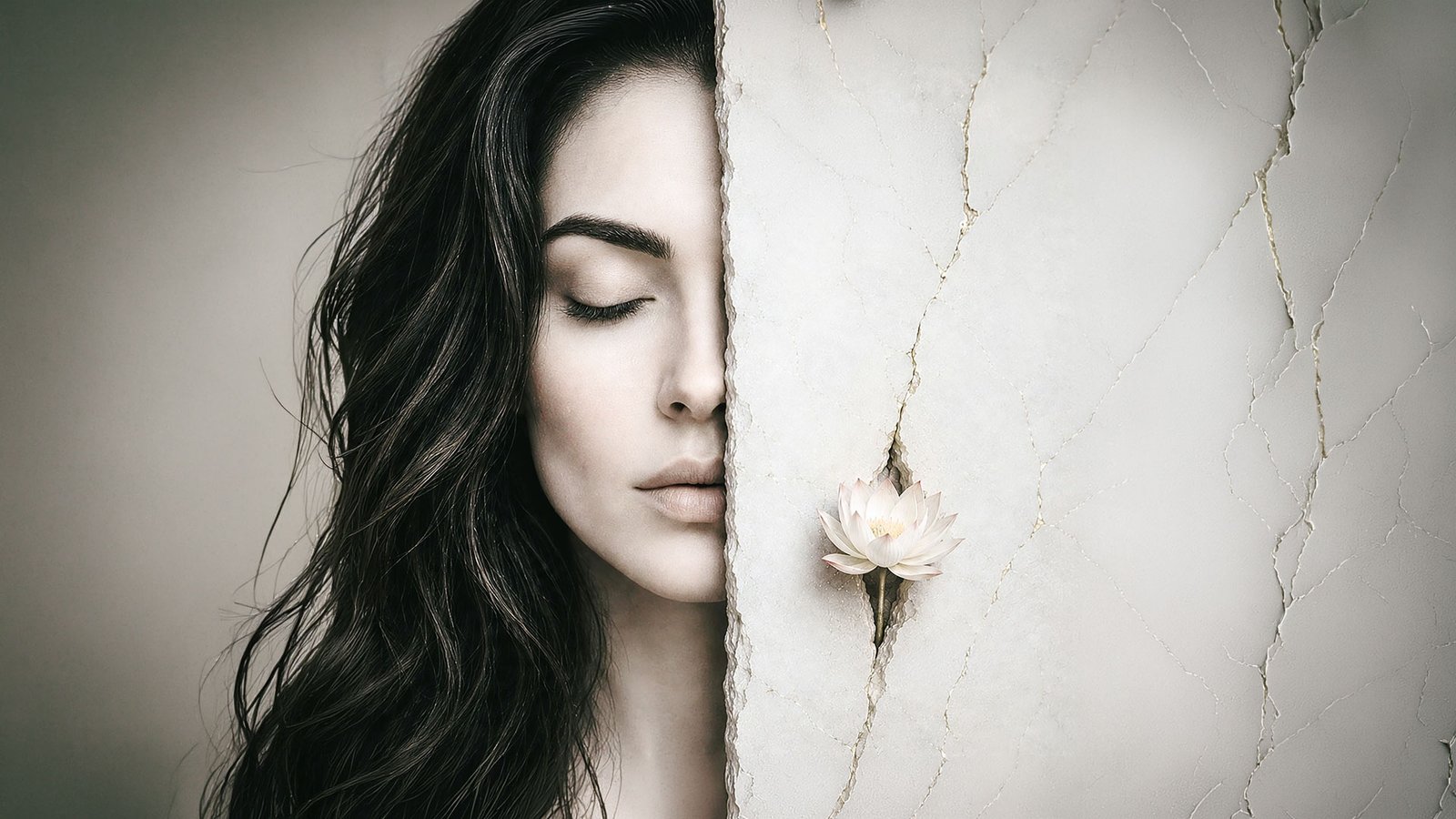
5The artwork places a face against cracked white marble with a lotus emerging from the break. How does that visual world extend the song, and what did you want the image to keep rather than resolve?
I wanted the artwork to be an extension of the composition rather than simply an illustration of the Taj Mahal.
The human face and the marble appear almost inseparable. That relationship was important to me because Marble White explores the transformation of something deeply human and intangible into something physical and enduring.
The cracks introduce another dimension. Even marble, which we associate with strength and permanence, is not immune to time, change or fragility. I find something beautiful in that contradiction. What appears everlasting can still carry the marks of its own vulnerability.
And then there is the lotus.
For me, its emergence from the fractured marble represents the possibility of life, renewal and beauty arising from unexpected places. The flower does not conceal or repair the cracks. It grows through them.
I wanted to preserve that tension between fragility and resilience, between what remains and what continues to emerge.
Is the human face slowly becoming part of the marble, or is something human awakening within it? Is the lotus a symbol of renewal, a memory refusing to disappear, or perhaps the continuation of something that once existed in another form?
I deliberately wanted to leave those questions unanswered.
I believe art becomes particularly meaningful when it allows the viewer to bring their own memories, emotions and imagination into the experience.
For me, the artwork is not about resolving what time has changed or taken away. It is about recognising that even within what appears broken or motionless, something beautiful may still be growing.
6Your recent singles have moved between intimate cello-led pieces, advocacy work, and other temperatures. How does Marble White sit inside that run, and what still feels unfinished about the larger conversation the songs are holding?
I have never approached my compositions with the intention of belonging to a particular genre or maintaining one emotional atmosphere. I approach sound as an artistic medium, much as another artist might approach painting or sculpture. The idea comes first, and the musical language follows.
Sometimes an emotion needs only a piano, a cello and the intimacy of a human voice. At other times, it demands darker textures, rhythm or an expansive cinematic environment.
Jack, Let’s Go for a Walk (Cello Whisper) explores love through acceptance and letting go. GLORIOUS was born from my profound disappointment at the cruelty inflicted upon animals, and from my love for this planet and its living beings — a love that continues to fuel my advocacy and determination to make a difference. That work is far from finished.
Marble White, meanwhile, explores the art of loving and how love can inspire us to create something greater than ourselves — something that may endure for centuries, long beyond the lives of those who brought it into existence.
These are different emotional worlds, but they belong to the same continuing exploration of human experience and our relationship with the world around us.
And what remains unfinished? Perhaps everything!
Human emotions are far too complex to be contained within a single composition, a particular genre or even a lifetime of artistic exploration.
What interests me is that an entire emotional world can exist within a story spanning decades, but equally within a moment lasting just one second. A glance, a silence, a memory, the sudden awareness of someone's presence or absence — sometimes the smallest moment carries the greatest emotional weight.
I want to continue discovering those moments, understanding their different dimensions and finding ways to give them a voice through sound.
I don't believe every emotion needs to be explained, nor every story brought to a conclusion. Sometimes the most meaningful thing an artist can do is capture a feeling and allow someone else to recognise a part of themselves within it.
As long as human emotions remain complex, my artistic exploration will remain unfinished. And I find that a wonderful reason to keep creating.
7You have spoken about exploring what it means to practise the art of loving. Once the song has named the patience, the repeated small acts, and the courage required to give love lasting form, what does that practice still ask of the listener, and of you?
I believe there is a meaningful distinction between experiencing love and knowing how to love.
We can feel something deeply without necessarily understanding how to care for it, how to recognise another person's individuality or how to sustain a connection through the changes life inevitably brings.
To me, the art of loving requires curiosity, patience, respect, appreciation and, perhaps most importantly, a genuine willingness to discover another person rather than simply believing we already know them.
We need to ask questions, but we also need to know how to listen. I remember a family member once asking me something that stayed with me: “Did you ever ask what I went through? Or even what my favourite colour is?”
Such a simple question, yet it made me reflect on how easily we can confuse familiarity with understanding.
I find it interesting that the psychoanalyst Erich Fromm explored this distinction in his book The Art of Loving, published in 1956. He approached love not simply as an emotion we experience, but as an art requiring knowledge, effort and practice. Similarly, psychologist John Gottman's research on relationships emphasises the importance of small, everyday gestures of attention and connection.
Both perspectives resonate with my own reflections, although I believe that sustaining love is ultimately something unique to the two people experiencing it. There is no universal formula.
When I think about Shah Jahan and Mumtaz Mahal, I wonder what it took to nurture their relationship amid the extraordinary responsibilities and complexities of their lives. Their love is remembered centuries later through the Taj Mahal, but how often do we stop to wonder what it actually takes to sustain a love so profound while we are living it?
I often hear people say that they are still searching for their soulmates, sometimes imagining that the grass might be greener elsewhere. Yet perhaps, in searching for something extraordinary, we overlook the possibilities within what we already have.
There is also appreciation, and sometimes a certain surrender — the willingness to set aside pride, embrace vulnerability and recognise that love requires something beyond our individual desires. Not the surrender of our dignity or individuality, but the humility to truly understand another person.
Of course, not every relationship can or should be sustained. But when two people genuinely love and respect one another, perhaps returning to the simplest things — listening, understanding, forgiving, appreciating — can help them discover their own way forward.
What does this practice ask of the listener? I would never presume to tell anyone what they should feel or how they should live. I simply hope that the composition might inspire a moment of reflection — on what we cherish, what love means to us and the possibilities we may discover along the way.
And what does it ask of me? Exactly the same. To continue listening, appreciating, questioning my own assumptions and learning from the people I love.
Perhaps the art of loving is not about discovering the perfect relationship, but about two people discovering, together, what makes their love worth nurturing.
A monument may preserve the memory of love for centuries, but it is the smallest acts between two people that keep love alive — and perhaps, through that devotion, inspire a work of art that generations to come will admire.
8The track ends by returning to the opening whisper and leaves the question of how deeply one can love without forcing an answer. Once the last light is logged and the form is left ready, what do you still want a song like this to be able to do?
I have always believed that a work of art begins another life once it leaves the hands of its creator.
I know the thoughts, emotions and imagination that gave birth to Marble White, but I cannot possibly know what another person will bring to it. That is something I find particularly beautiful about art.
Someone may hear a story of romantic devotion. Another may remember a parent, a relationship, a loss or a moment they thought they had forgotten. Someone who has never visited the Taj Mahal might still discover something deeply personal within the composition.
The return to the opening whisper was intentional. I wanted the music to return to where the question began, but not necessarily to where the listener began.
“Love has no shape until it mirrors you.”
Every time we look into a mirror, we may notice something different. Time changes us, experiences shape us, and even our emotions can influence what we see. But how often do we look into our inner mirror with the same attention?
What has love revealed about us? How has it changed us? Have we discovered something within ourselves that we had never previously recognised?
Perhaps, by the end of the composition, the opening words will carry a different meaning for the listener. And perhaps, years later, those same words will offer an entirely different reflection.
I am particularly interested in the relationship between music, memory and human emotion. A composition can become associated with a moment in someone's life, and hearing it again years later may bring an entire emotional experience back to the surface.
Perhaps Marble White will become part of someone's memories. Perhaps it will encourage someone to appreciate a love they already have, recognise something they have lost, or discover a feeling they have never quite been able to express.
Or perhaps it will simply offer a moment of stillness.
I cannot determine what it should mean to another person, nor would I want to.
For me, the composition is complete when I release it. But its possibilities are only beginning. If it finds a place within another person's emotional world, in whatever positive form that may take, then something I created has found a life beyond my own.
And that is one of the most extraordinary possibilities of art.