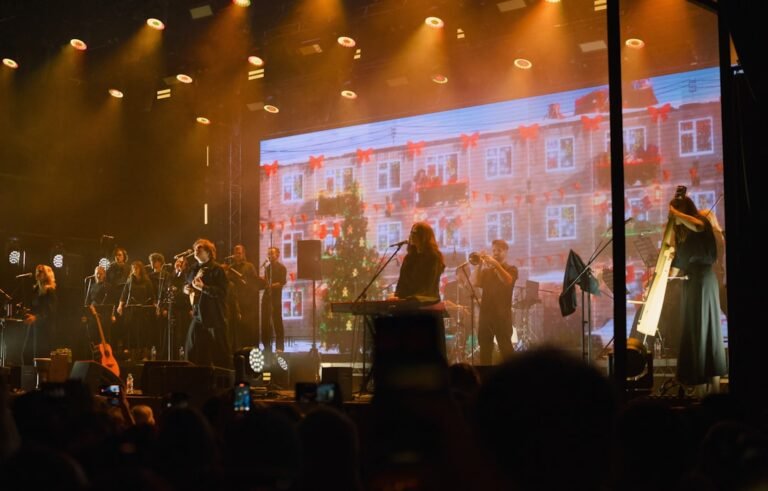
In Los Angeles, Tiffany Day constructs expansive electronic pop from a foundation of close connection, shaping a new chapter with her upcoming album HALO.
Tiffany Day builds her music like a space you can move through. It starts small, with a voice and a feeling, and then the walls begin to shift. From a bedroom pop foundation, she has been constructing increasingly elaborate electronic environments, rooms where intimacy is not lost but amplified by scale. Her work in Los Angeles feels like a direct response to that city’s own contradictions, the vastness of its sprawl held together by private, intense connections.
Her trajectory shows a clear architectural instinct. Early work established a direct line of communication, a closeness that felt conversational. The production was a frame, not the entire picture. But with each release, the blueprints have gotten more ambitious. The synthesizers grew wider, the rhythms more defined, the atmospheric details more precise. She never abandoned the core of personal songwriting. Instead, she started building grander structures to house it.
This evolution finds its next logical expression in HALO, her upcoming album. The title suggests something celestial, a ring of light, but also something that surrounds and contains. It is a fitting image for her method. She creates these glowing, synthetic halos around moments of raw emotional disclosure. The contrast is the entire point. The vulnerability feels more acute when it is broadcast across such a sleek, expansive frequency.
Visually and sonically, Day cultivates a specific kind of LA cool, one that is digitally native and self aware. Her aesthetic is clean, colorful, and meticulously composed, mirroring the polished sheen of her productions. But the content within that frame remains resolutely human, focused on the intricacies of relationships and self perception. She operates in that contemporary pop space where the personal diary entry is encoded into a crystalline digital signal.
What defines Tiffany Day now is this balance. She is an artist who understands that intimacy in the modern sense is often a constructed thing. It does not happen in spite of technology, but through it. Her music is that process made audible. She takes the close connection, the whispered confession, and gives it architecture, lighting, and a massive, immersive sound system. The result feels both incredibly private and designed for the biggest room available.
Join the Club
Like this story? You’ll love our monthly newsletter.
Thank you for subscribing to the newsletter.
Oops. Something went wrong. Please try again later.

ROMBO Editorial Staff
The collective voice behind ROMBO Magazine’s news, reviews, features, and cultural coverage.