Marie Ann Hedonia’s artistic progression is a map of signal paths. It traces a deliberate journey from seeking presets to dismantling them, from the contained interfaces of a microKORG to the open-ended geography of modular synthesis. Her work is defined by this foundational curiosity, a need to understand and command the skeleton of sound itself.
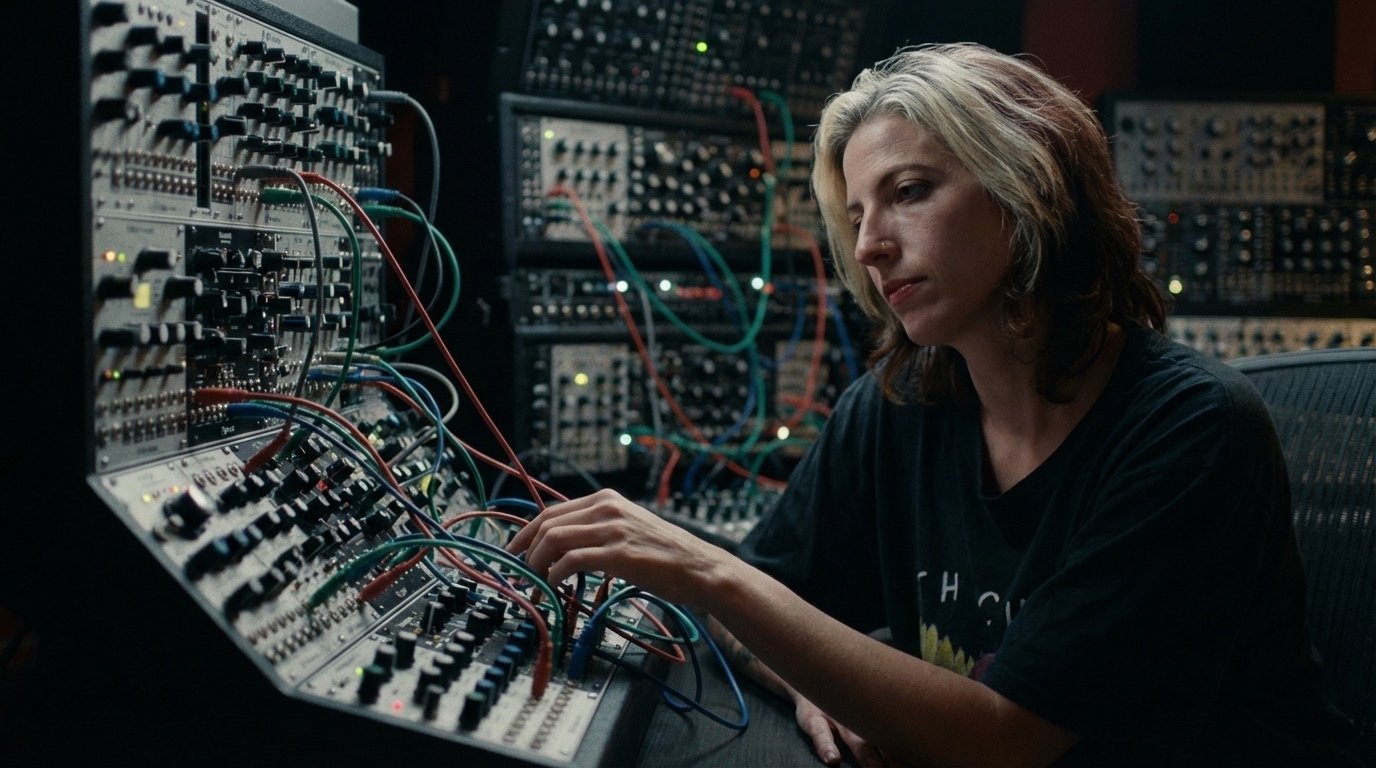
Based in Baltimore and co-operator of the label Paul and Marie’s Country Kitchen, Hedonia’s practice is one of tactile exploration. Her early "Eurorack era" cultivated what she calls "a hard, weird, industrial sound," a period of live experimentation documented on albums like *The Inevitable Collapse* and performances with collectives like Luminous Abstract. This was music built patch by patch, where the sprawling instrument was as much a visual spectacle as an auditory one.
A significant pivot arrived with her adoption of the Buchla 200-E system, a move towards what she terms "a more classic sound." This was not a step backward into tradition, but a lateral shift into a different philosophy of voltage and space. The Buchla’s distinct architecture reshaped her output, leading to the spacious, contemplative environments of the Quiet Time EP and a notable collaboration with trumpeter Jeremy Pelt on his album Woven. Here, her synthesizer work is described as a "shadowy presence," a textural layer woven into an acoustic jazz context with natural fluency.
Hedonia’s trajectory resists easy categorization. It flows from industrial-tinged modular to ambient synthwave, and into acoustic-electronic fusion, unified by a maker’s mindset. Her identity is that of a synthesist in the most integral sense, one for whom the instrument is not a means to an end but a partner in cartography, charting unknown territories from the circuitry up.