The young songwriter from Leamington Spa and Shanghai turns a private mental landscape into something architectural. My Morbid Reverie is out now as her most focused statement yet.
There is a particular kind of song that rebuilds the room a feeling occupies. The walls, the light, the temperature, the way sound behaves once you are already inside. Lilia Asha’s new single belongs to that smaller, more difficult category.
Asha is fourteen, approaching fifteen, and has already spent years moving between places. British and South African roots, childhood years across Malaysia, Tunisia, Myanmar and Shanghai. She writes from a life that never stayed still long enough to harden into one fixed identity. Songwriting became the place where the unspeakable could take shape. “I write songs to express what I cannot express in conversations,” she has said. My Morbid Reverie is the clearest proof of that statement so far.
The track was written in one sitting. It was developed with Starcle Music in Shanghai, then mixed and mastered in Sydney. Musically it sits in the darker, more atmospheric corner of alternative pop. The production is careful and intentional. It begins close and restrained, with an intimate vocal that feels almost conversational, then gradually thickens. Layers of atmosphere accumulate. The space around the voice becomes denser and more distorted as the song progresses. The arrangement never rushes. It builds pressure through texture and movement rather than volume alone. Then, near the end, the intensity cuts away and the track opens into birdsong. That final shift leaves the listener suspended between the internal world the song has constructed and the outside one.
Listeners drawn to emotionally precise songwriting that prioritises atmosphere and pacing will find something to hold onto here. The track shares a certain temperature with the more restrained and introspective side of artists like Phoebe Bridgers, where the production serves the emotional weight instead of decorating it. It also carries a quiet theatrical quality, the sense of a scene slowly unfolding rather than a standard verse-chorus structure. The song does not explain itself quickly. It lets the feeling arrive through accumulation.
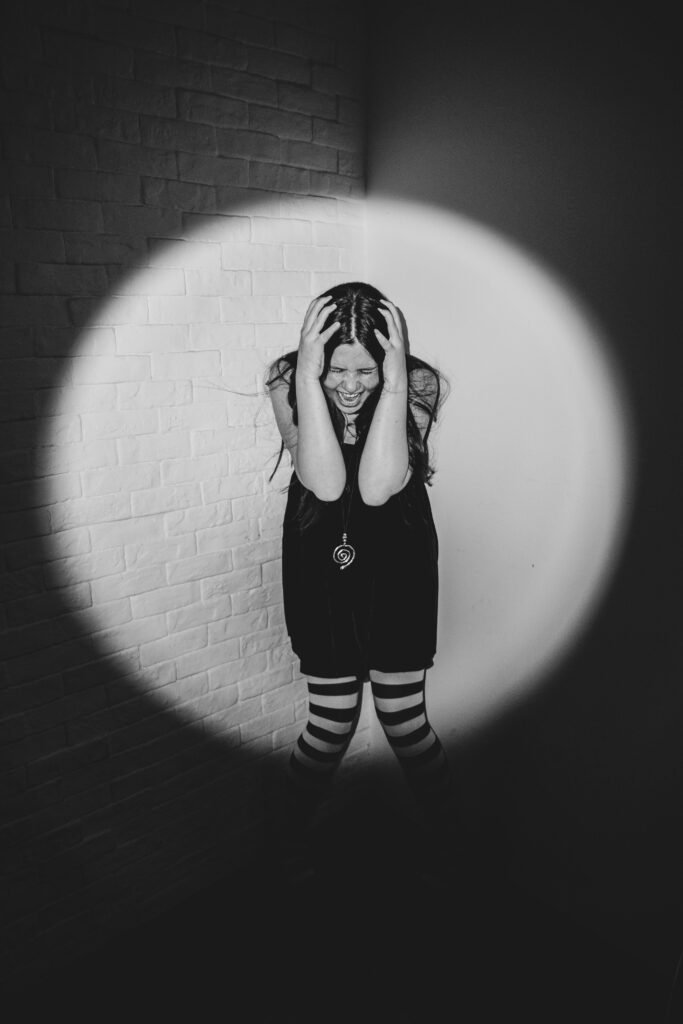
The lyrics move with unusual precision through states that are usually left vague. One more day drifts to fog. Another bruise wrapped in lace. Another broken rhapsody. The opening verses register a quiet normalisation of damage. Pain becomes routine. The self watches itself from a slight distance. Then the questions begin. Can you taste the obscurity. Do you walk through the crowds with shivering hands, head down. Do you see the light when it hits the grave, reflecting on your name. The address is direct. The song asks whether anyone else can sense the same texture of absence.
What gives the writing its weight is the sensory translation of disconnection. The speaker no longer hears the slam of the door or the rain on the streets. She misses the will to breathe, the will to speak, the running bare feet of an earlier self. She misses the version of life that still felt like living. The grief is directed at the self that has already gone. “I miss when it wasn’t me I grieve.” That single line carries the entire emotional architecture of the song.
Later the imagery turns physical and absolute. Water rises above the neck. The surface shudders at the breath. The earth collapses under the skin. The layer rips. White walls and a death bed. The language starts enacting the collapse rather than simply describing it. Then the intensity breaks. The final repetitions of “You don’t see” land in near emptiness. The isolation is complete.
Asha and her collaborators at Starcle Music shaped the arrangement so that it mirrors this movement. The production creates the sensation of a reality slowly warping around the voice. Density increases. Space becomes oppressive. Then the sudden cut into birdsong arrives as a different temperature of silence.
The song offers recognition. It takes a private internal weather and turns it into a coherent sonic space with its own rules of gravity. The achievement is formal as much as emotional. The structure holds. The details stay sharp. The feeling is allowed its full range without being softened into something more palatable.
My Morbid Reverie stands as more than a single. It marks a clear step in Asha’s development of a complete artistic identity that already includes lyric-inspired artwork and an ambitious solo concert planned for December in Shanghai. The song stands on its own as a piece of precise, atmospheric writing. It also signals an artist who understands that the most personal material sometimes requires the most careful architecture.
Follow Lilia Asha
My Morbid Reverie is out now.
Listen: Spotify