At 18, New York City songwriter Owen Steib opens his catalog with Jolie, a full-band single that moves like 90s college rock while the story arrives in pieces.
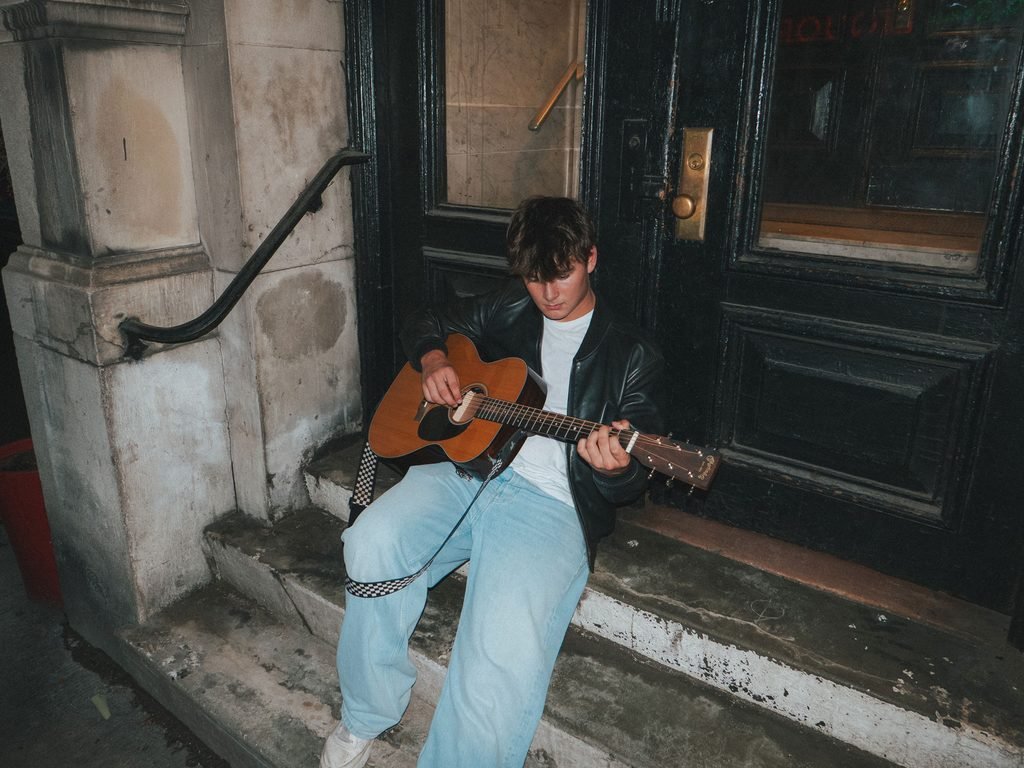
Owen Steib is an 18-year-old songwriter and guitarist from New York City, currently finishing high school. He has called himself a 90s kid born too late. As a toddler he cried when people sang Happy Birthday because it was loud and out of tune. That early sensitivity to detail turned into an obsession with the small things in a record, the ear candy most listeners feel without naming. It led him to the guitar and to writing his own songs, and he has not put it down.
There is a particular kind of attention that begins with what remains in a room rather than with what occurred there. A denim jacket wrapped tight enough to resemble a straightjacket. A cashmere sweater marked with blood. The yellow handle of a fireman’s hatchet, bright against whatever else is present. Stars that may or may not still be visible. Owen Steib’s debut single Jolie begins from those objects. The song treats them as the first and most reliable facts. Everything else arrives later, out of order, or not at all.
The track is written by Steib and produced by Arthur Pingrey. It moves with the steady, almost running character of 90s soft and college rock. Bright arpeggiated guitar leads sit over acoustic strumming. Saturated electric guitars push the arrangement forward in a wall of sound. Thick three-part harmonies open the chorus. The references are clear enough to name: the guitar figures associated with the Goo Goo Dolls, the acoustic drive of Deep Blue Something, the stacked hooks of Gin Blossoms and Toad the Wet Sprocket, the third-person narrative habits of Pearl Jam. Steib does not hide them. He uses them as the engine that keeps the song in motion while the story stays fragmented.
Lyrically the song follows an imaginary girl, called Jolie in the title and Julie in the verses and chorus. She is found in a hallway, swaddled in the denim jacket, near the bloodied sweater and the yellow-handled hatchet. The details stay specific and disordered. She is later described as a martyr from Wisconsin, called Saint Cecilia, the youngest of three sisters. A man is mentioned in the past tense. She loved him. She killed him. She will never hear from him again. The tears turn black under his fingers. The sequence does not resolve into a single timeline. It stays fixed on the random objects and the repeated refusal to go back.
The chorus is the simplest part. “Julie, Julie, Julie, don’t you cry.” It returns with the harmonies stacked high. Against the verses, which stay rhythmic and almost recited, the chorus functions as the attempt to comfort her, to solidify the story, and to leave a small opening for recovery. The contrast is deliberate. The music keeps pushing at a constant pace. The narrative holds still on the objects that refuse to explain themselves.
What gives Jolie its weight is the precision of those leftover details set against the forward motion of the arrangement. The song does not rush to complete the picture. It lets the yellow handle, the denim, the stars, and the simple chorus do the work of holding attention. For a debut single from a high school senior who has already spent years listening for the things most people skip, that restraint feels earned. The track is available now.
Follow Owen Steib
Jolie is out now.
Follow: Instagram · TikTok · Facebook · Official Site