From Ploumagoar, the Breton five-piece return with a second album that treats time as something the sea can move, and a song can still try to hold.
An hourglass is a polite instrument. Turn it, and the sand agrees to start again. On the Côtes-d’Armor coast the tide does not offer that courtesy. It rearranges the beach overnight and leaves the count where it left it. Santa Claws come from Ploumagoar, near Guingamp, close enough to that clock to know the difference. Sands of Time, their second album, is out now, and it spends eight songs arguing with a measure that will not flip.
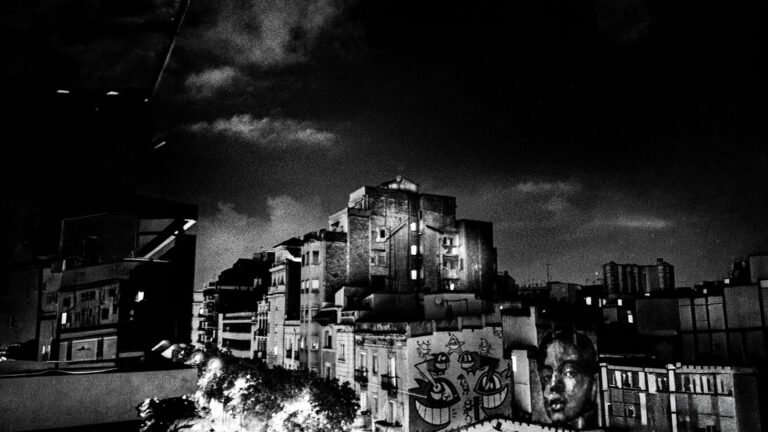
The sleeve already knows the argument. Grégory Dargent’s black and white city sits under a heavy sky, windows lit like private timers, graffiti faces grinning at street level, and one oversized painted head cropped hard at the right edge. The face is too large for the block. It looks like someone who stayed in the frame after the hour ran out. That is the record’s temperature. British indie grammar is in the guitars, the melodic nerve, the willingness to let a chorus carry the weight. The subject is what remains when the count reaches zero.
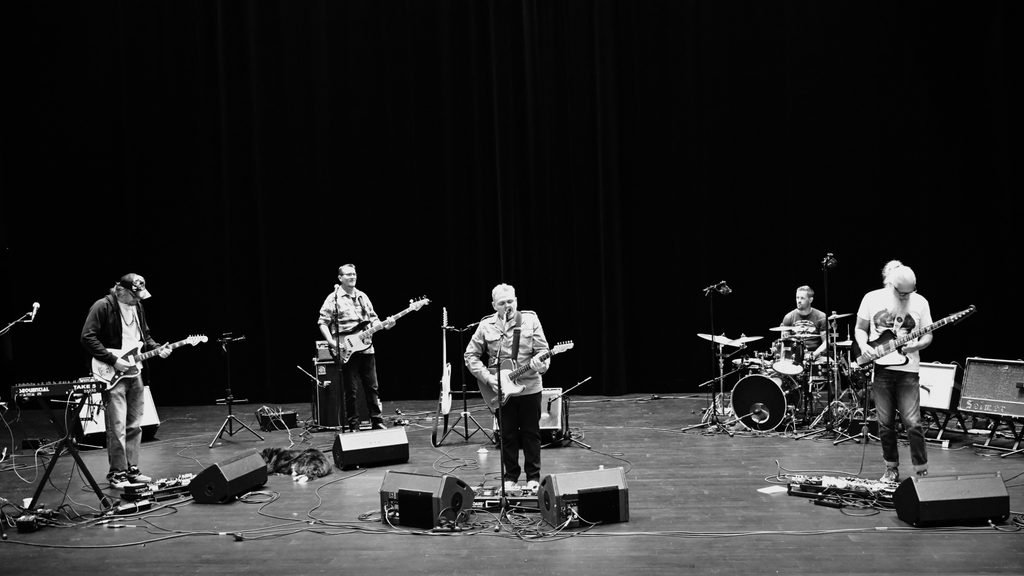
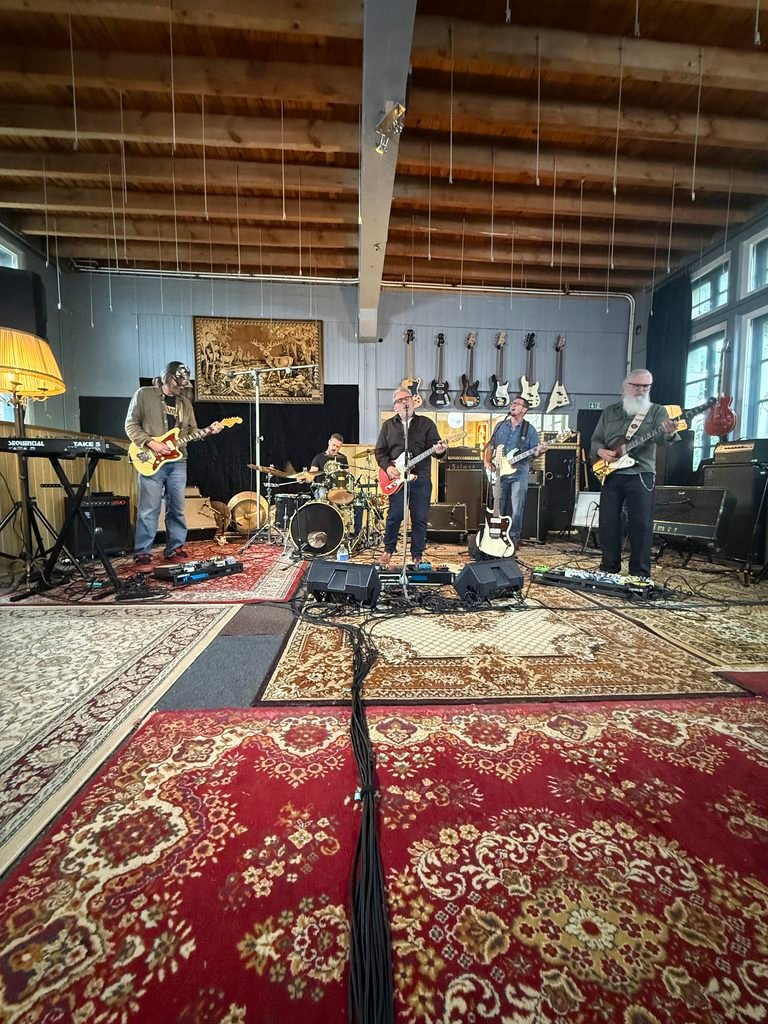
The band have been living with that delay. Formed in the mid-2010s around Greg Aubert, Santa Claws made their debut, Life Is a Lie, with the American producer Greg Gordon and released it in 2018. An Echoes EP followed in 2022. The years since have been spent independently, writing toward this album, with early singles already testing the water. Aubert still leads, on voice, guitar, and keyboards. Antoine Montgaudon handles guitars, keyboards, and arrangements. Teddy Moisan is on bass, Julien Pinel on drums. Stéphane Kérihuel joins as the fifth member, a third guitar, and the set thickens because of it. They marked the release with a showcase at Studio Kerwax, recorded straight to analog tape. The grain is the point. Sand, tape, distortion. Materials that keep a trace.
Gimme a Minute opens at a sprint. Distorted guitars lock into a compact wall, the rhythm section pushes, and Aubert sings Sally as a small comic emergency. She is always in a hurry, then suddenly not. Lipstick, the stairs, the dragster waiting outside. The hook is the title, repeated until the request starts to sound like a joke the other person will not hear. Under the grin there is already a clock. A minute is the smallest unit the song can beg for, and it still is not granted.
Rainy Day drops the voltage without dropping the subject. Acoustic guitar, soft pads, harmonies that hover rather than shout. The writing sets two births against each other. One child arrives during a fight, a mother and father gone, a war for a childhood. The other arrives on Christmas Eve, loved into safety. The chorus keeps insisting on a shiny day, and on the wish that it should be a smiling one. The shine never quite arrives. What holds the track is the restraint. Aubert stays close to the mic, and the arrangement refuses the release the lyric keeps asking for.
Two Days Ten Hours is where the album states its method. The count shrinks in public. Two days and ten hours. One day and one hour. One hour and ten seconds. Guitars move from a tense arpeggio to a rougher wall, the drums keep a hypnotic push, and the refrain lands on a hard little phrase, no time to flow. It is alternative rock with a grunge grain, though the interest is less in the lineage than in the subtraction. Each section removes a unit of time and asks if the feeling has changed. The song already knows the answer.
Too Late turns the same deadline toward a drum machine. Vintage pulse, synthetic bass, night-colored keys, a chorus answered by its own echo. The story is an exit with no explanation. Not rich enough, not popular enough, maybe too romantic, then a later meeting where the apology comes after the life has moved. Aubert’s tone stays firm. The line that seals it is simple. But I won’t fall apart. The track earns that firmness by letting the machine do the urgency, so the voice can hold its ground.
Surrender stops negotiating. The guitars are heavier, the drums blunt, the vocal frayed at the edge of a shout. A demand to tell the truth runs through the verses. The chorus circles one question until it becomes a command. Why not to surrender. Then the song gives the last stretch to noise. A long instrumental tail, distortion stacking on distortion, no new lyric to tidy the room. It is the most physical moment on the album, and the most honest about what a wall of guitars can do when the words have run out.
Tattoo Me cools the room again. Clean, effected guitars and synth pads open a wide space. The lyric wants proof. A burn on a shoulder, a ring, a mark on the lips. The chorus offers the mark and withdraws it in the same breath. But that love isn’t real. The repetition turns the title into a mantra with nowhere to land. Dream pop, here, is a way of keeping the feeling in suspension, so the listener can hear the promise and the cancellation at once.
Rescue Me returns to the acoustic frame and makes the refusal personal. A house, a garden, a dog, two cats. Hands in hands, eyes in eyes. The chorus will not allow the ending. You’re not allowed to say goodbye. By the close the plea has changed shape. Rescue me, because the singer does not want to fall in love. The tenderness is real. So is the fear inside it. The lo-fi haze keeps both from becoming a speech.
Grain of Sand closes with the widest lens. Same television, same game, a rule that everyone should look the same. The chorus reduces a person to a number, a grain of sand, then to a puppet in the hands. Angular riffs and a hard groove carry it, with the vocal moving from a lower narrative tone into a shouted hook. After an album of private countdowns, the last song admits the crowd. The face on the sleeve, too big for the street, finally has a lyric.
Sands of Time holds because the band let the count stay uneven. A joke about lipstick sits next to a war childhood. A synth-pop refusal sits next to a noise coda. Aubert’s voice is the thread, warm when the arrangement thins, scraped when the guitars close in. The tide does not turn back. The songs keep asking for one more minute anyway.
Follow Santa Claws
Sands of Time is out now.
Listen: Spotify