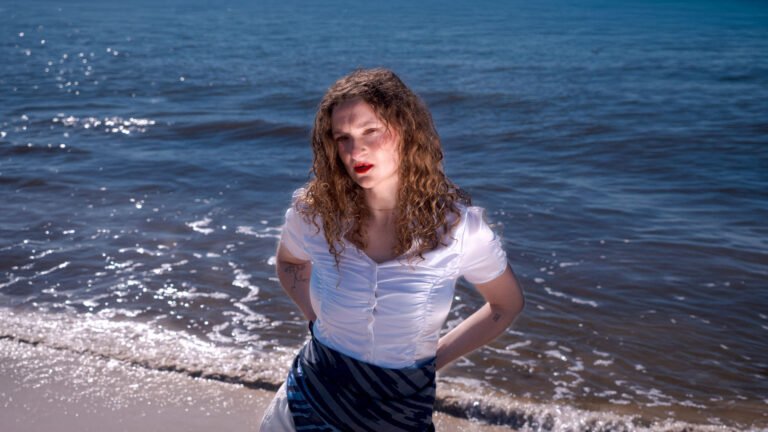
The Stockholm songwriter puts Patroclus at the centre of a trip-hop single that treats myth as a garment you can wear until it starts to weigh the same as love.
Dorothy Mour grew up on Gärdet and found her voice in late-2010s Berlin, where club hours, jazz harmony and a darker electronic pulse started to sit in the same room. Back in Stockholm she has kept that mixture close. The records that precede this one move between languages and temperatures. Wicked and Ferocious Complexion marked the first public cuts. Speed made a relationship sound like a private joke with a bruise under it. Västerbron, her first Swedish-language single, set sudden loss against a city that still looked beautiful from the bus. Fühlt So Schön slipped between German and Swedish like someone pacing a waiting room. Wiser & Younger arrived in 2025 with the strange lift that follows a breakup once you stop forcing it to live. Live she works with The Mours, and the rooms have included Kulturhuset Stadsteatern, the Stockholm International Film Festival and Katalin. Run to the Gates of Troy, released on 16 September 2026 and co-written and produced with Stockholm producer Vilmar Jansson, is the first preview of a debut album of the same name, due in winter 2027.
In 1873 Sophia Schliemann stood in front of a camera wearing gold that her husband had just pulled out of the ground at Hisarlık. The jewels were billed as Helen’s. The photograph did the rest. A modern face, a borrowed hoard, a story pressed onto a living body so the public would believe the dig had found the right city. The picture is slightly absurd and completely serious. That is the mood this single understands. Mour is not excavating Troy for prestige. She is doing what Sophia did with the necklace. She puts the myth on and lets the camera, or in this case the microphone, decide whether it still fits.
The source is Madeline Miller’s The Song of Achilles, the novel that taught a wide readership to hear the Iliad as a love story before it is a war story. Mour writes from Patroclus. The opening is small on purpose. Sparse keys, a warm saxophone, the sense of two people talking before any army has a claim on them. Then the track breaks the way the decade at Troy breaks. Trip-hop drums start to drive. Choirs arrive with a 1960s smear. Electric steel guitar sweeps across the middle distance like weather coming in off a hotter sea than the Baltic. The arrangement traces the same arc the lyric does. First the room. Then the beach. Then the gate.
The writing is explicit without turning into a school recitation. Ocean’s rage, gold Phoebus, Zeus’ glory. Hair like fire, eyes like a green sea. Aristos Achaion spoken as endearment rather than caption. The chorus keeps returning to a line that sounds like comfort until you notice it is also permission. It’s alright I know. Run to the gates of Troy. With you in my soul. The song’s centre is the moment Patroclus puts on Achilles’ armour and walks out so the army will shout the wrong name. They think the best of the Achaeans is coming. He knows he is not. Mour sings that swap with a steadiness that makes the spear feel delayed rather than sudden. And when the spear came, you rocked me off this earth. The image is physical. A body lifted, then gone.
What gives the single weight is control. Mour has always been interested in atmosphere as structure, and here the production leaves space for the lyric to arrive at walking pace before the drums insist on war. The stacked vocals in the refrain work like a camp answering one person. Your cataclysmic wrath. Don’t waste your time on sorrow. Those asides sit behind the lead like someone who already knows the ending and is trying, poorly, to be kind about it. The steel guitar keeps a slight country ache inside a myth that usually gets scored with brass and ruin. That choice is specific. It makes the story feel handled by a contemporary singer rather than by a soundtrack department.
There is a limit, and it is honest. Once the full band language is in place the song holds its shape more than it transforms it. The death verse does not need a bigger explosion than the one already written into the words. Still, a late change in density, a choir that leans harder or a drum pattern that frays, would have made the last run at the gates feel more costly. The track trusts the text, and the text can carry that trust. It just leaves a little unused pressure on the table.
Mour has spent years writing about intimacy under strain, in Berlin rooms and on Stockholm bridges, in two languages and in the grey weather between them. Run to the Gates of Troy takes that same private attention and aims it at a story everyone thinks they already know. The result is a single with a clear identity. Love as the reason you put on someone else’s name. War as the thing that makes that decision look inevitable. A Baltic artist standing in shallow water on the cover, red mouth, white blouse, the sea behind her behaving as if it had never heard of the Aegean. The myth still fits. It just fits differently when the person wearing it refuses to be Achilles.
Follow Dorothy Mour
Run to the Gates of Troy is out now.
Listen: Spotify · SoundCloud · YouTube
Join the Club
Like this story? You’ll love our monthly newsletter.
Thank you for subscribing to the newsletter.
Oops. Something went wrong. Please try again later.

ROMBO Editorial Staff
The collective voice behind ROMBO Magazine’s news, reviews, features, and cultural coverage.