
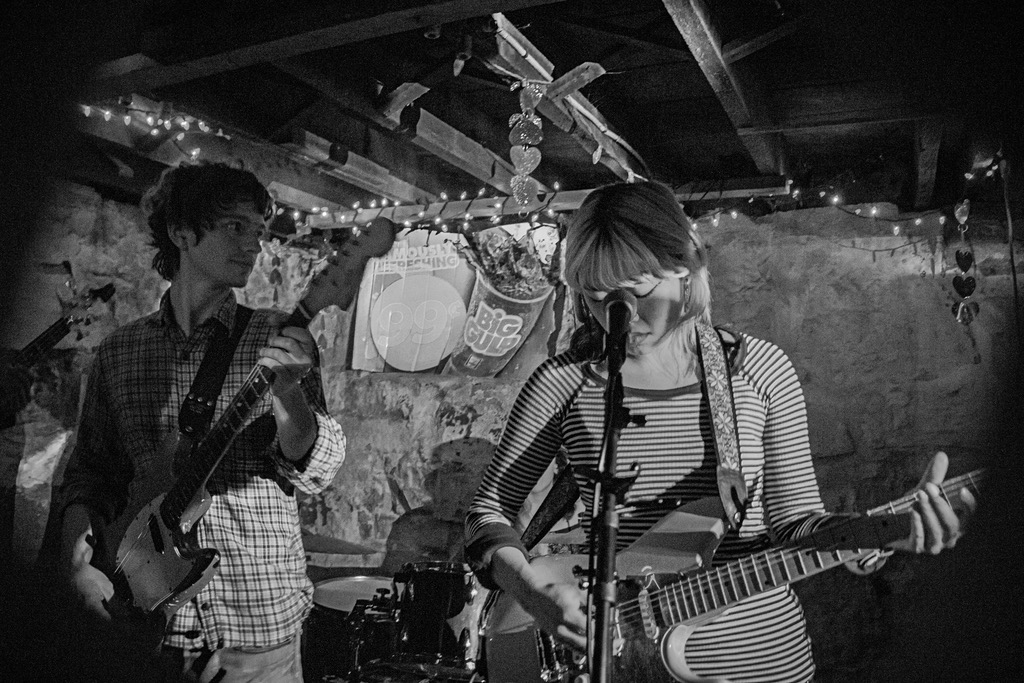
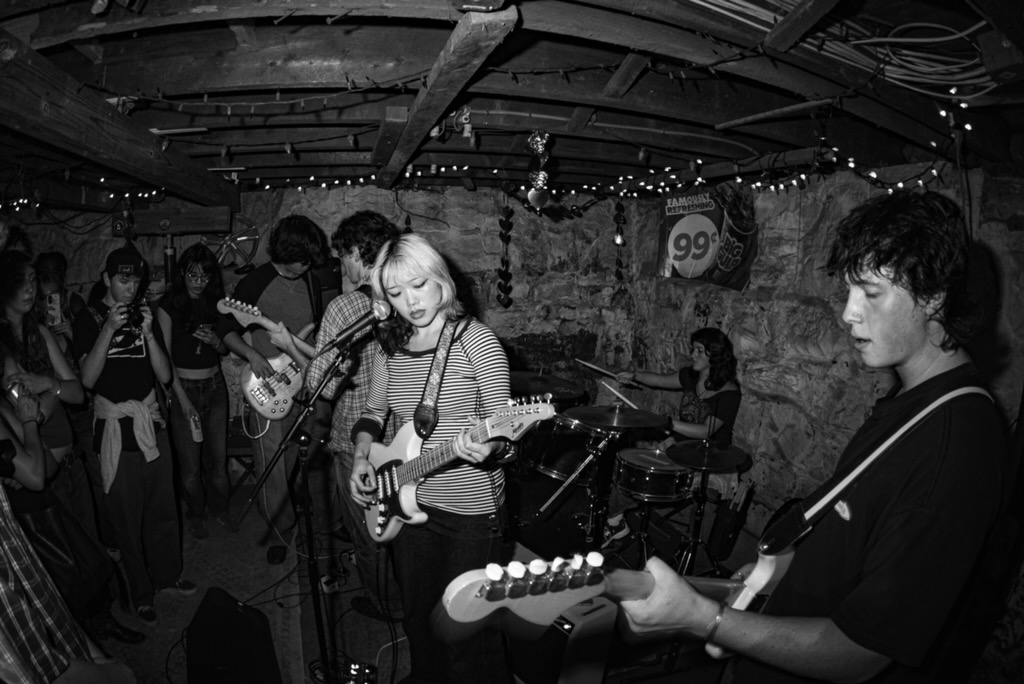
In Burlington, Vermont, Izze Kaukonen and Ethan Fitzpatrick work under the name first known use. The moniker comes from their sense that songs exist outside the people who play them. Writing, recording, and performing become acts of capture and translation rather than pure invention. They make the music at home. The arrangements stay dynamic, the lyrics stay close to the cracks in ordinary experience, and the project still looks outward. Yielding is their debut EP, five tracks that stay with the cost of giving way.
In materials science a material reaches its yield point when applied stress stops producing temporary stretch and begins to produce permanent change. Below that threshold the object returns to its original shape. Past it, the deformation remains. The shape is different and the difference does not reverse. Yielding listens for that threshold inside asymmetric relationships. The songs register the moment a person stops returning to form and accepts the new shape, even when the language used to describe it keeps shifting.
“Semantics” opens on the gap between what is said and what is understood. The lines “Call it semantics / But I think I know / What you really mean / When you say that you don’t” place the speaker already past the point of easy recovery. One part of the self stays in the water, down on its knees. The taste is called romantic and immediately corrected as bittersweet. Acoustic guitar holds a closed room for a while. Then distortion arrives and the voice moves from close breath into a longer, strained reach that cuts through the wall before the coda thins into synthetic haze. The track does not argue for clarity. It records the decision to keep spinning the block, waiting to get caught.
“Mirage” continues the same accounting. A feeble man is made into a god. The hand that fed is bitten. A golden crown shows itself painted rust. The refrain names the figure directly as a mirage. Arpeggios stay close at first. Synth pads and reverberant electric lines open space around them, then a slow pulse thickens the atmosphere until the voice holds long notes on the title word and dissolves into the layers. The sound does not resolve the illusion. It lets the listener hear how hard it is to run once the fumes have been accepted as substance.
“Roadkill” drops the remaining softness. The speaker is already the animal on the road. Blood pours from the throat. Lips are licked. Bones are pulled from the meat. The demand for a fight arrives after the guts are already on the floor. The arrangement starts with acoustic phrasing and a dry, measured beat, then empties into dark electronic pulses before the final stretch fills with distortion, drone, and fragmented radio-like loops. The voice stays low and close through the early images, then climbs into a tight falsetto on the sizing of appetite and later lets long cries be swallowed by the noise. “I’m not gonna save you / I’m not in the place to” is delivered without rescue. The track treats consumption as an ongoing process rather than a single event.

“Synthesis” pushes the same logic further. Everything is given “like a god / Burning at the cross.” The taking is endless. Chemical feeling is named and then undercut. A descending, acidic guitar figure repeats over a martial low end. Distortion expands in the choruses and the long closing stretch until the voice, which had stayed partly buried, rises on sustained notes and is absorbed again. The song holds the tension between the wish to feel something again and the recognition that the offering has already been made.
“A knife” gathers the prior damage and places it against time that will not reverse. Waiting is compared to a knife. The war that has been waged is called the familiar thing. Bodies appear draped in snow. The line “Oh but I / Can’t go back in time / No matter how hard i try” arrives after the acoustic section has stripped the earlier density away. The opening movement stays inside saturated guitars and a heavy beat. The middle clears to close acoustic guitar and a quieter delivery. The final expansion brings spoken fragments and wide synthesizer and organ-like drones that lift the repeated “A knife is like waiting” into longer, higher lines. The voice does not claim resolution. It marks the limit of what can still be changed.
Across the five tracks the production, handled by Kaukonen and Fitzpatrick with mixing by Fitzpatrick and contribution from Kaukonen, and mastered by Julia Rangel and Ben Collette at Tank Recording Studio, keeps the shifts between intimacy and saturation tied to the same movement. Quiet passages hold the waiting and the self-correction. Heavier passages register the point at which the shape no longer returns. The EP does not treat yielding as a single decision. It treats it as the accumulated record of what remains after the threshold has been crossed.