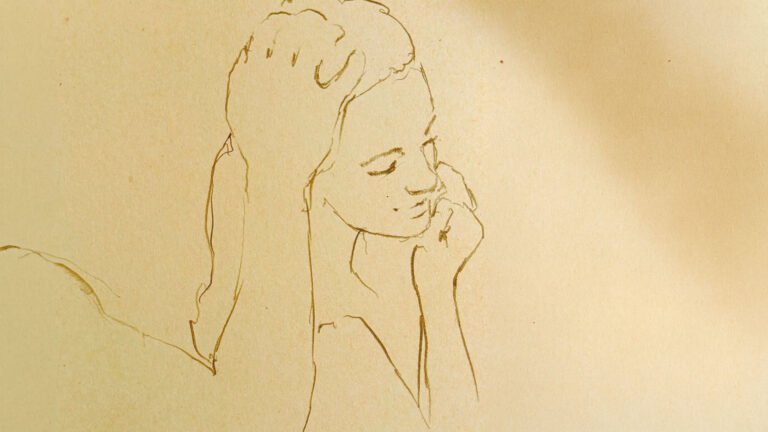
The Brooklyn singer-songwriter’s third album treats a single unreplied message as the center of a longer domestic weather system.
Maria Lane has spent the past five years building a catalog of precise, vulnerable indie folk from a Brooklyn bedroom. Originally from Orlando, she began releasing music independently in 2021 after years of musical theatre training and early piano writing at home. Her 2022 album maybe i’ll feel better and the 2023 EP 35 days established a voice that could sit close to the microphone and still carry weight. Black and Blue (2024) and Kiss Me, I’m Haunted (2025) expanded the palette without losing the conversational intimacy that earned her a FADER feature in 2023. I Love You Always, her third full-length, arrives as the most sustained document of that approach so far.
In the conservation of old manuscripts, archivists sometimes work with paper so thin that ink from one page bleeds through to the next. The later writing never fully erases the earlier marks. What remains is a double image, readable only when the light is held at a certain angle. I Love You Always operates with a similar patience. The album’s title comes from the final words of a text Lane never answered. Those three words sit at the center of a fifteen-track sequence that treats the friendship before the romance, the romance itself, and the careful distance that followed as layers that continue to show through one another.
The record opens with “airplanes in the sky,” an acoustic guitar and restrained vocal that counts planes as a way of measuring absence. Production by Justin Meyer, with Lane as co-producer, keeps the room audible. Acoustic guitar and soft electric piano sit beside low electronic pulses and occasional string lines. The mix, mastered by Joey Messina-Doerning, leaves space for the voice to move between near-whisper and clearer, more open phrasing without forcing a climax. “sage my room” follows with the explicit ritual of clearing a shared bed. Lane sings about the first of October and the side of the mattress that still holds a shape. The lyric moves between the practical act of saging and the harder admission that “it wasn’t even just romantic love.”
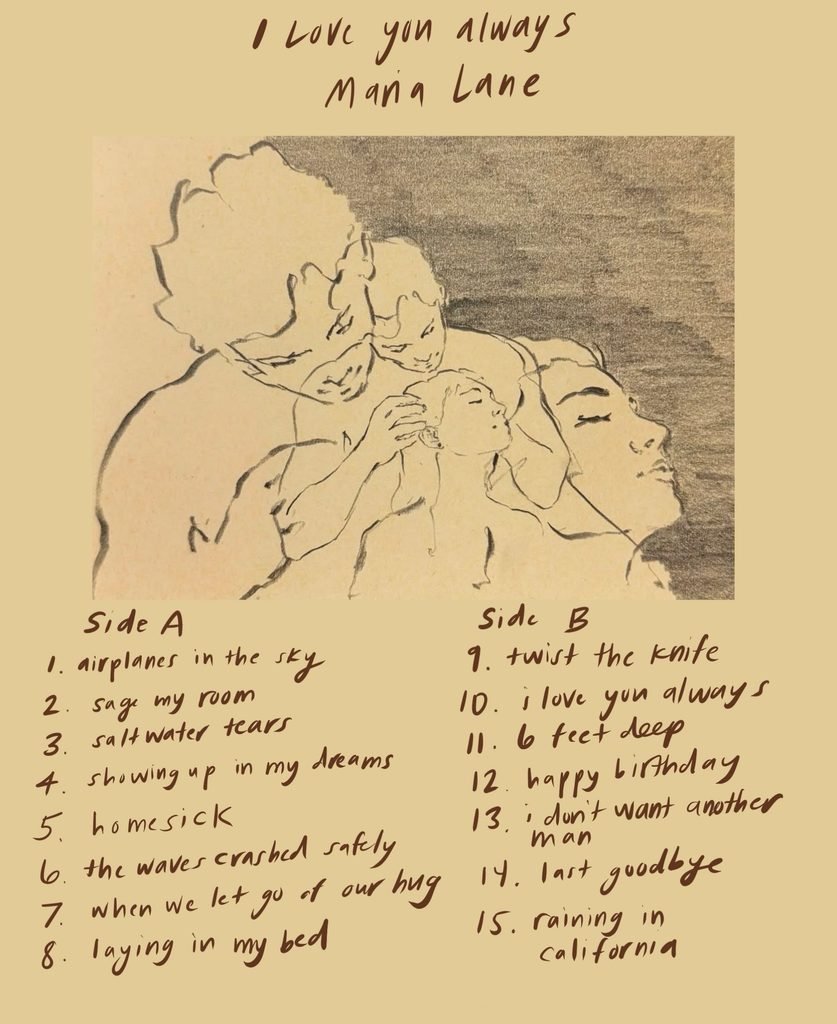
Across the first half, the songs stay close to domestic scale. “saltwater tears” uses botanical images and a request to be planted and watered. “showing up in my dreams” begins spare and then thickens with distorted guitars and a heavier kit, the arrangement matching the sense of a person who will not leave the walls or the sleep. “homesick” and “the waves crashed safely” sit in the warmer middle of the sequence, the former built on a soft acoustic bed and layered harmonies around the repeated phrase of missing someone who once felt like home. “when we let go of our hug” and “laying in my bed” keep the temperature low, electric piano and close vocal doubling preserving the physical memory of proximity without turning it into spectacle.
The turn arrives with “twist the knife,” one of the three singles. Acoustic guitar and digital percussion lock into a tighter, more nocturnal pulse. The lyric is sharper here, the arrangement refusing the earlier softness. From that point the album widens. The title track runs just over ten minutes. It functions less as a conventional centerpiece than as a long corridor where the earlier domestic details are allowed to stretch and thin. Synth pads and gradual harmonic blooms support a vocal that repeats the unreplied phrase until it loses its original weight and becomes something closer to atmosphere. The length is not decoration. It is the time required for the words to stop functioning as a message and start functioning as a room.
“6 feet deep” and “happy birthday” return to more compact song forms while keeping the same emotional weather. The former uses the burial metaphor with direct language and a rising band arrangement. The latter places a birthday greeting inside the silence of no-contact, the production balancing piano and electronic pulse so that the sentiment remains specific rather than general. “i don’t want another man” moves in a slower ternary feel, the vocal opening from conversational to more sustained before the drums arrive. “last goodbye,” the track Lane has described as a direct homage to Jeff Buckley, carries the album’s most extended vocal moment. The arrangement stays controlled even as the line rises. The final song, “raining in california,” closes with rain textures, guitars, and a repeated acceptance that the other person has been let go. The electronic elements never overwhelm the acoustic core.
What holds the seventy-seven minutes together is the refusal to treat the ending as a single dramatic event. The album keeps returning to the ordinary objects and times that continue to hold residual heat: a bed, a phone screen, a flight path, a room that needs to be cleared. Lane’s voice remains the consistent instrument, capable of staying close and then opening without losing its conversational grain. The production supports that movement rather than imposing a larger sonic narrative. The result is a record that understands the difference between the friendship that existed, the romance that briefly overwrote it, and the distance that remains visible underneath both. I Love You Always does not resolve those layers. It holds them at the angle where each can still be read.
Follow Maria Lane
I Love You Always is out now.
Listen: Spotify
Follow: Instagram · Bandcamp · SoundCloud · X