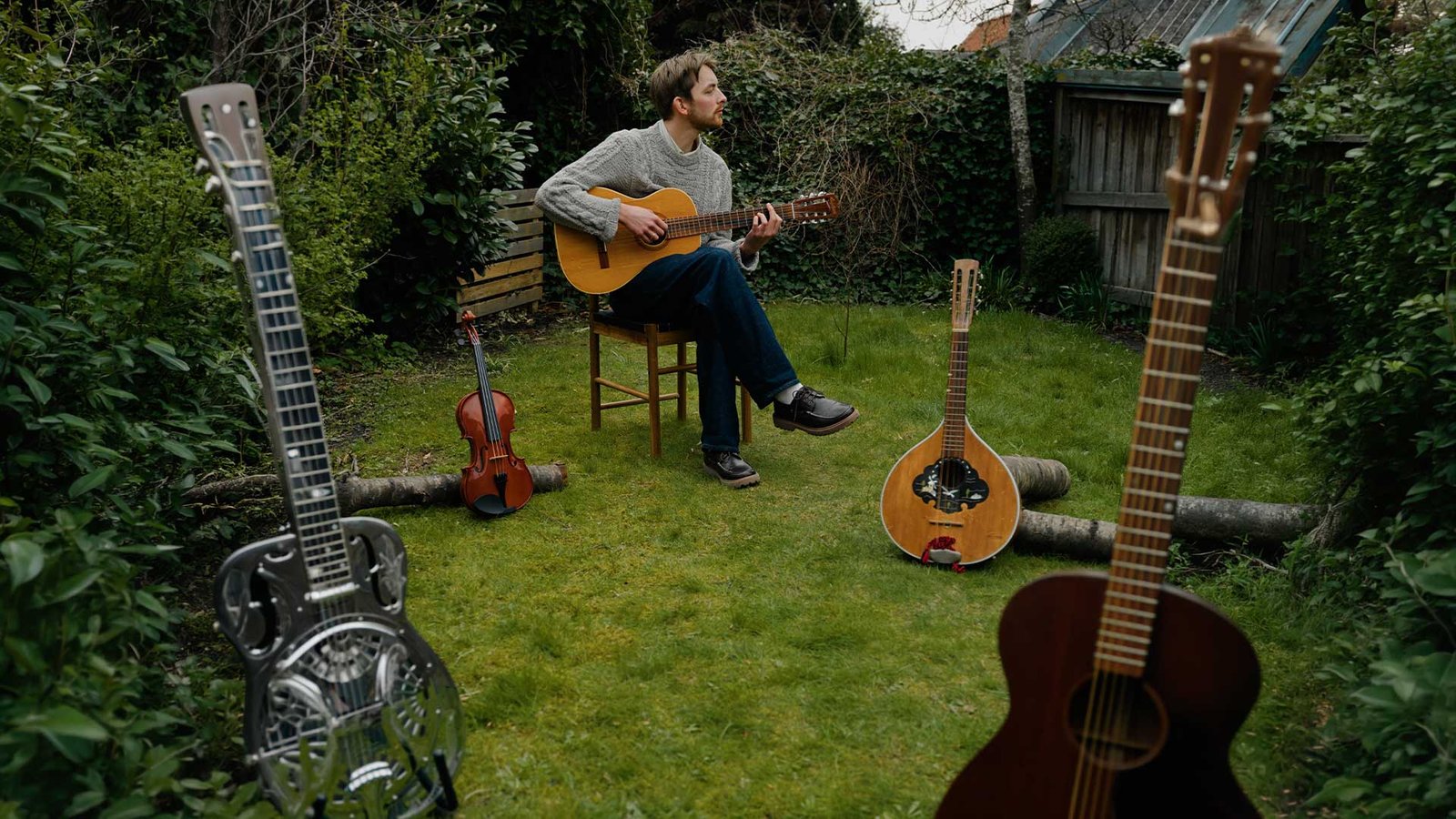
Terry Dammit, whose real name is Terence Sheehan, recorded most of the album in a garage lent to him by his girlfriend Jen Kiddo, who also sang on one track. All the drums were played remotely by Brooks Farris. Mixing and mastering were handled by Ivan, recording as Blindsight Mix, who worked through an intense level of perfectionism. The process itself was long and obsessive: the recordings sat unused for nearly two years before a sudden return forced a full year of revisions across vocals, guitars, synths, bass and arrangements.
The album opens with “Dear Bunny”. Electric guitars hang suspended in the first verse, thin and slightly distant, before the chorus arrives with a direct, impactful punch. The voice cuts through cleanly, almost conversational, singing about wanting to be taken back to where things were, about love that needs to be tested, about the repeated ache of “when you’re gone”. The choice to address the song to something as fragile-sounding as a “Bunny” already signals a certain tenderness mixed with loss. It reads like a letter written to someone, or something, that can no longer answer back.
“Pills” shifts the atmosphere completely. Acoustic guitars and a suspended, dreamy production create a different kind of space, airier, more interior. The lyrics circle around coming down, around the desire to “be right” and “see the night come down”, around the blunt repetition of “I’ll kill, I kill”. The track never really breaks out of its loop, which feels like an honest reflection of how someone negotiates with their own coping mechanisms day after day. It is one of the most honest and least dramatised tracks on the record.
“Sweet Girl” and “It Ends Today” stay in guitar-driven territory but move into a clearer art-rock register that carries echoes of Bowie’s more theatrical periods and a certain Beatles-esque melodic directness in the phrasing. In “Sweet Girl” the voice sings about a ghost in the radio, about buried love and ashes, about not wanting to come back home. The repeated “my love, my love” feels both tender and exhausted. “It Ends Today” brings fear, the company of friends, the question of when one will breathe again, and the image of an empty room. Both songs share a similar sonic palette, electric guitars that are present but not overwhelming, a voice that stays articulate even when the subject matter turns heavy. There is a shared sense of endings that are acknowledged but not yet fully accepted.
The title track “Evening Powerlines” arrives as a deliberate break. It is largely instrumental, built around a modular synth that feels dreamy and slightly unstable, like signals drifting in and out of focus. After the more song-based opening stretch, this short piece resets the emotional temperature. It is beautiful in its restraint and serves as a kind of palate cleanser before the album returns to more personal material. Placing a nearly wordless, synth-led track in the middle is one of the album’s smartest structural decisions, it acknowledges that sometimes the clearest transmission happens without words.
“Watch As Green Leaves Fall” and “Station Babe” return to acoustic textures. The former carries a gentle, almost pastoral quality while still holding an undercurrent of loss. “Station Babe” feels more skeletal, with a voice that sounds closer to spoken word in places, describing pain, work, and the sense of having been betrayed by something that was supposed to feel like home. Both tracks keep the guitar work intimate and the production relatively dry, letting small details of performance carry weight.
“Am I Humble Now, Jesus Christ?” is one of the most distinctive moments on the album. It begins with synth and an unusual, slightly off-kilter rhythm before the guitars enter. The voice moves between something close to shouting and a more vulnerable register, asking the title question with what sounds like genuine desperation rather than irony. The lyrics speak of fear, of roads and tunnels, of destiny that feels self-made and therefore inescapable. The question in the title lands with real weight, it sounds like someone genuinely asking for humility while also challenging whatever might be listening.
“You Know I’m Sick” is the most pressing and urgent track. The guitars drive harder, the rhythm feels tighter, and the voice carries a rawer edge. The lyrics deal with contempt, with floating make-up oceans, with the difficulty of being cared for when one is in this state. It is one of the moments where the album feels closest to traditional rock energy while still maintaining its own internal logic.
“Everyone Is Better Than Me” and “Everyone Is Going To Die Anyway” sit in a clear art-rock lineage that recalls Bowie’s more composed, observational periods. The first deals with self-comparison and the feeling of being peripheral to one’s own life. The second is more expansive, almost philosophical, moving between the inevitability of death and the small acts of connection that still matter. Both tracks use guitars in a way that feels architectural rather than purely rhythmic, lines that support and comment on the vocal rather than simply driving it forward.
“Only A Broken Bone” brings the album back to a more intimate, emotional register. Delayed acoustic guitars and a voice that sounds closer to the bone create a sense of minimal but real damage. The title itself is revealing in its understatement: it acknowledges pain while suggesting that the damage is survivable, perhaps even ordinary. It is one of the quieter tracks that still manages to land with weight.
The album closes with “When I Drove Away…”, the final single and one of its emotional peaks. The voice carries the image of a burning stone in the palm of the hand, something hot and heavy that must still be held. The guitars and overall arrangement feel more open here, allowing the lines to spread rather than tighten. The theme of departure runs through the whole record, but it crystallises here with unusual clarity: the decision to leave while still carrying what one has lived through. It is a fitting and quietly powerful ending.
Evening Powerlines is not an album designed to win listeners on first contact. It asks for time and repeated attention. Those who give it both will find one of the most rigorously constructed and quietly personal independent debuts of the year, an album that transmits difficult states without ever letting them collapse into chaos or easy catharsis. In a landscape full of quick, disposable releases, that kind of patience and clarity is still worth something.