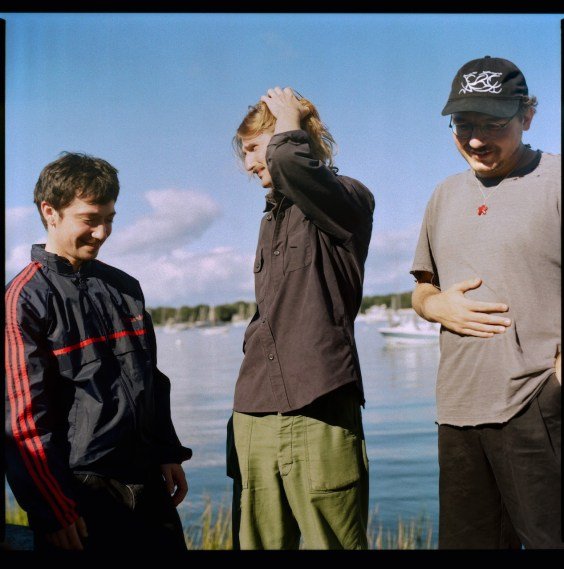
Cash O’Brien is a Brooklyn songwriter, producer and multi-instrumentalist who has spent years building a solo presence from his bedroom while contributing to other people’s records. One of those contributions was the composition for Frances Forever’s “Space Girl,” the track that moved from a Tiny Desk submission into a viral hit with hundreds of millions of streams. The work that followed was quieter and more local: singles released across 2025 and 2026, shows in the city’s indie rooms, and the slow accumulation of a seven-song EP that he engineered and recorded himself. Starting Bell is the first full statement of that solo work, out now after nearly three years of writing and production.

There is a particular quiet that settles in a boxing corner between rounds. The fighter sits, the cutman works methodically, the clock keeps moving, and the decisive part of the night stays postponed. It looks like care. It functions as delay. Starting Bell lives inside that same interval. The title track makes the image literal: “I wanna be in your corner / I wanna watch from the ring” and “When the starting bell will chime / I see you run out the clock for a while.” The rest of the EP treats that postponement as the central condition of contemporary relationships, the place where people yearn and avoid at the same time, accept temporary arrangements, and keep the hard conversation for later.
The writing is direct and first-person, always addressed to a “you” who remains slightly out of reach. It returns again and again to the same practical settings: bars where strangers can see the performance, dinners that cannot be afforded, a plane that already took someone away. In “Don’t Stick Around” the request is for a known ending before the beginning: “You can have me for a season / If you’ll be on your way.” The reason is named without decoration: an old flame who was “getting on a plane” the last time they spoke. The arrangement begins with acoustic guitar and spare piano, then opens when the refusal becomes a plea, the voice moving from close and hesitant to something more urgent on “So promise you’ll go / Baby, please / Don’t stick around.”
“Velvet/Velour” stays inside the aftermath of a closeness that has thinned into formality. The surface details do the work: velvet or velour, a particular hue, the difference between “one and the same” and “just pleasantries.” The words catch. “How’s this supposed to go?” repeats until the question itself becomes the texture. The production keeps a measured pulse underneath, then lets saturated guitars and synthetic layers rise when the silence can no longer hold. “Cold Weather” shifts the metaphor to the sidelines of a baseball game. The cold cuts through clothes even when fully dressed. The response is to stay planted on the bench: “From the sidelines it looks better” and “I would never win.” The voice stays tired and clear, layered only when the repetition of the last line meets the denser guitars.

At the center, “Starting Bell” makes the waiting rhythmic. The bass and drums keep a steady forward motion while the lyric refuses the fight: “I stand to lose if I put up a fight” and “I can’t pretend every inch is a mile.” There is a brief clearing onto piano where the voice admits the temptation to hide it “Through dilated eyes / And sealed lips too shy to say goodbye,” then the full arrangement returns. “Out on a Limb” accepts the smaller share: “I’ll take what is offered, content with a handful.” The other person wants contact but “won’t let them in,” a fair-weather presence who appears when convenient. The plea for a decisive cut arrives in falsetto: “I’m begging for mercy, swing your axe through me.” The production holds the tension in measured arpeggios before letting the reverb thicken around the unanswered question.
“Kerosene” names the numbness that follows a deeper love. At the bar, “Every stranger at the bar can see / I’ve put on a face that’s strange to me.” Ordinary warmth is refused. What is wanted is the extreme version: “I want love, honey, I want kerosene.” The track opens on acoustic guitar and closed curtains, then builds into a dense wall of distorted guitars that carries the final lines before dropping back to the quiet instrument. “Double Edge” places the same stalemate inside a shared apartment and an unpaid meal: “A discussion over a dinner that we can’t afford.” The feeling is pushed down, swallowed as a pill, returned to with the knowledge that it will come back. The voice opens fully on “Well, I love you more than I’ve loved anyone,” then the arrangement leaves the long instrumental close to the guitar that has to finish what the conversation cannot.

Across the twenty-three minutes the arrangements follow the same logic as the writing. They begin contained, acoustic or clean electric, supported by dark synth pads and a steady low end, then expand when the unsaid pressure becomes too much. The reverb is not atmosphere for its own sake. It is the space in which the words that cannot be spoken continue to resonate. The voice stays close and soft for most of the length, only rising into falsetto or fuller harmony when the restraint finally gives. Starting Bell does not resolve the hesitation. It records the cost of keeping the gloves on, the dinner unfinished, the plane already gone, and the bell that has not yet been allowed to ring.