Sarah Khatami’s Play House keeps a bossa-leaning room warm for a life that never moved in, then leaves the dollhouse on the curb.
Sarah Khatami grew up in Pittsburgh between two record collections. Her older sisters played R&B and pop. Her parents kept traditional and contemporary Persian music in the house. Berklee came later, then Brooklyn, where the songs started to carry both rooms at once, English beside Farsi, jazz harmony beside a pop instinct for the line that stays. In June 2024 she released stalemate, an eleven-track debut produced by Dave Fugel and built around a first heartbreak, arranged with the patience of a chess problem. Jannah followed in October 2025. BAD arrived earlier this year, a smaller cut about being broke. Play House, out since 25 September, is the first time the visual world has been asked to hold the same weight as the writing.
Architects keep a strange object in the office. Before a building exists, someone builds a scale model so the life inside it can be argued over. You lean in. You move a tiny chair. You decide the kitchen faces the wrong light. Sometimes the client walks and the model remains, exact and unoccupied, a future with no tenant. Play House lives in that gap. Khatami has already furnished the small house. The song is what happens when only one person still wants to move in.
The single opens warm and close. A soft acoustic guitar lays bossa chords that feel already familiar, and the groove stays low, almost confidential. Fugel’s production leaves the air in. Light percussion, a rhythm section that never crowds the vocal, no decorative pile-up. Nicole Gemmiti mixes it so the voice can sit forward without strain. Noble Thomas masters it with the same restraint. Khatami sings as if the confession is happening across a table, measured, unforced, a little bruised. The chorus is simple enough to stay. “Baby, I would rather play house together than be a stranger hardly remembered.” Repetition does the work a bigger arrangement might have faked.
September is the first witness. She thought they would change with the autumn colors. Promise, in this lyric, turned out to be a decision only she was keeping. “What’s potential if only one person wants it?” The detail that holds the song down is domestic and specific. A weekend at his place. Coltrane. Barberry rice. Cookies with dates. That is a real room, not a mood. She would rather keep the fiction of the house than perform the social downgrade of a wave hello, because she still knows his weak spots and cannot pretend otherwise. The bitterness is precise. He is “riddled with relief.” She does not have the heart for niceties.
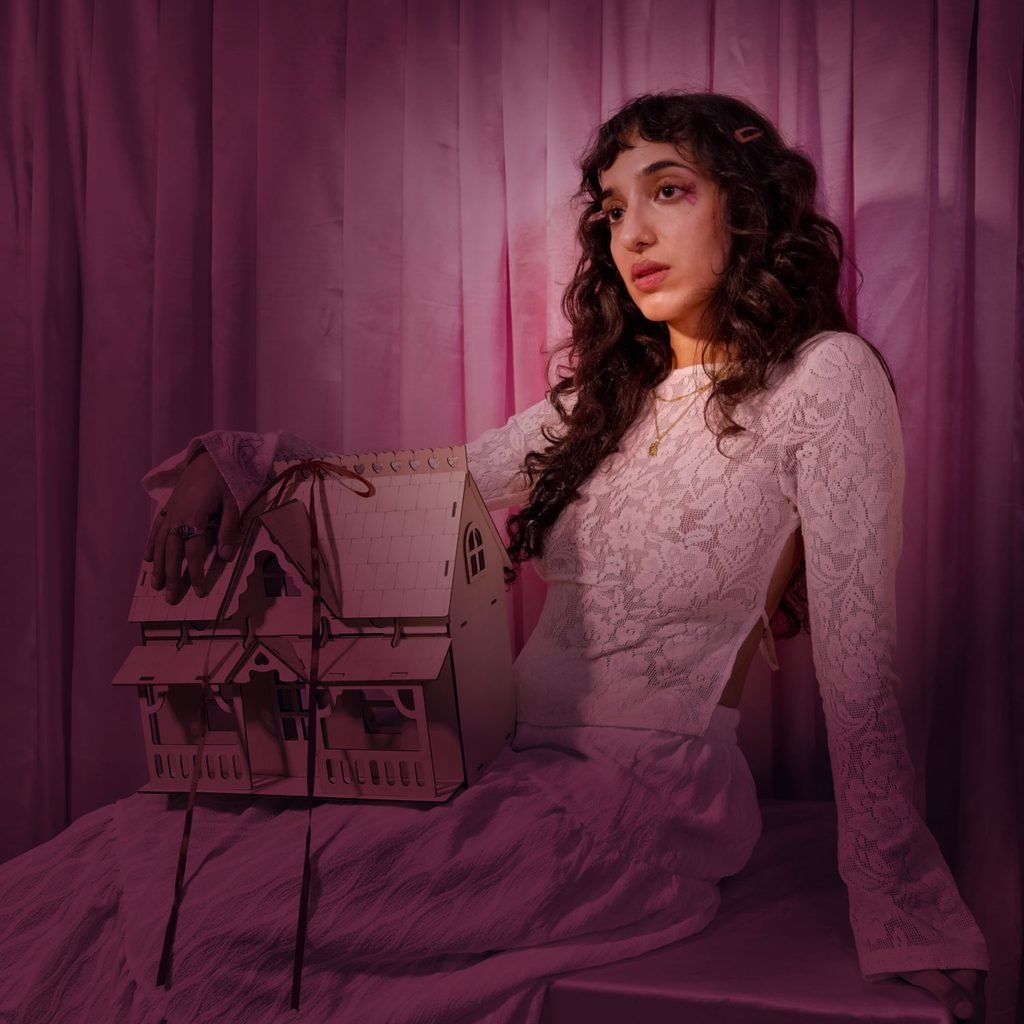
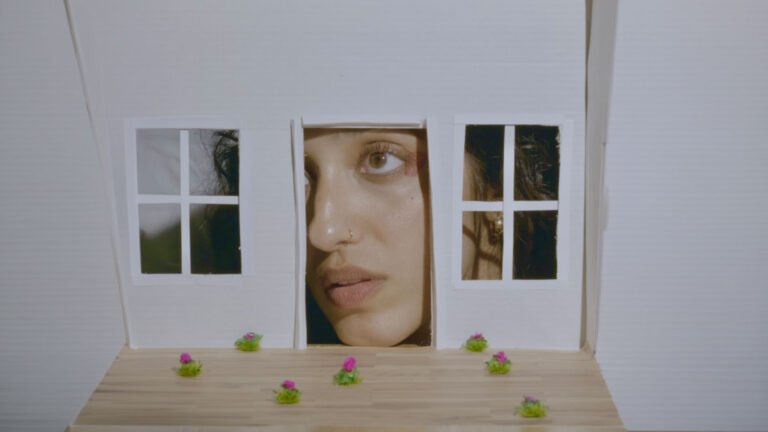
The video, her debut, directed by Layla Soboh with cinematography by Ryan Sinner and production assistance from Saja Hussein, makes the model literal. Khatami built every miniature set, on no budget, and the concept is hers. Her face fills a doorway built for a doll, too large for the scale, which is the feeling of the lyric in one frame. Inside the real apartment, the actions are the old ceremonies of care. Rice finished with the patience of tahdig. Tea and dried rose. A kitchen that looks lived in and already vacant. Sinner keeps the color warm, pastel, a little kitsch, lace and desaturated red against the white of the small house. A red gingham dress sits hard against garden green. Outside, the plants move. Inside, the rooms hold still. The last image leaves the dollhouse on a wet sidewalk beside pink trash bags. The model has done its job. Nobody is buying the life.
She premiered the video at The People’s Garden in Brooklyn the day the single arrived, with ticket proceeds directed to the Brooklyn Queens Land Trust, the Iranian Red Crescent, and The Sameer Project. The gesture fits the song without explaining it. A house, even a paper one, still sits on someone else’s ground. Earlier in 2026 she had already tested the piece in a home-studio band version for the NPR Tiny Desk Contest, so the room existed before the official cut. The single simply narrows it.
Play House earns its place because the fiction is chosen with open eyes. Khatami knows the foundation is cracked. She keeps setting the table, then carries the little house out to the curb. The control is in that sequence. Intimacy, here, is a structure you can build by hand, and still have to abandon.
Follow Sarah Khatami
Play House is out now.
Listen: Spotify · SoundCloud · YouTube
Follow: Instagram · TikTok · YouTube · X · Official Site