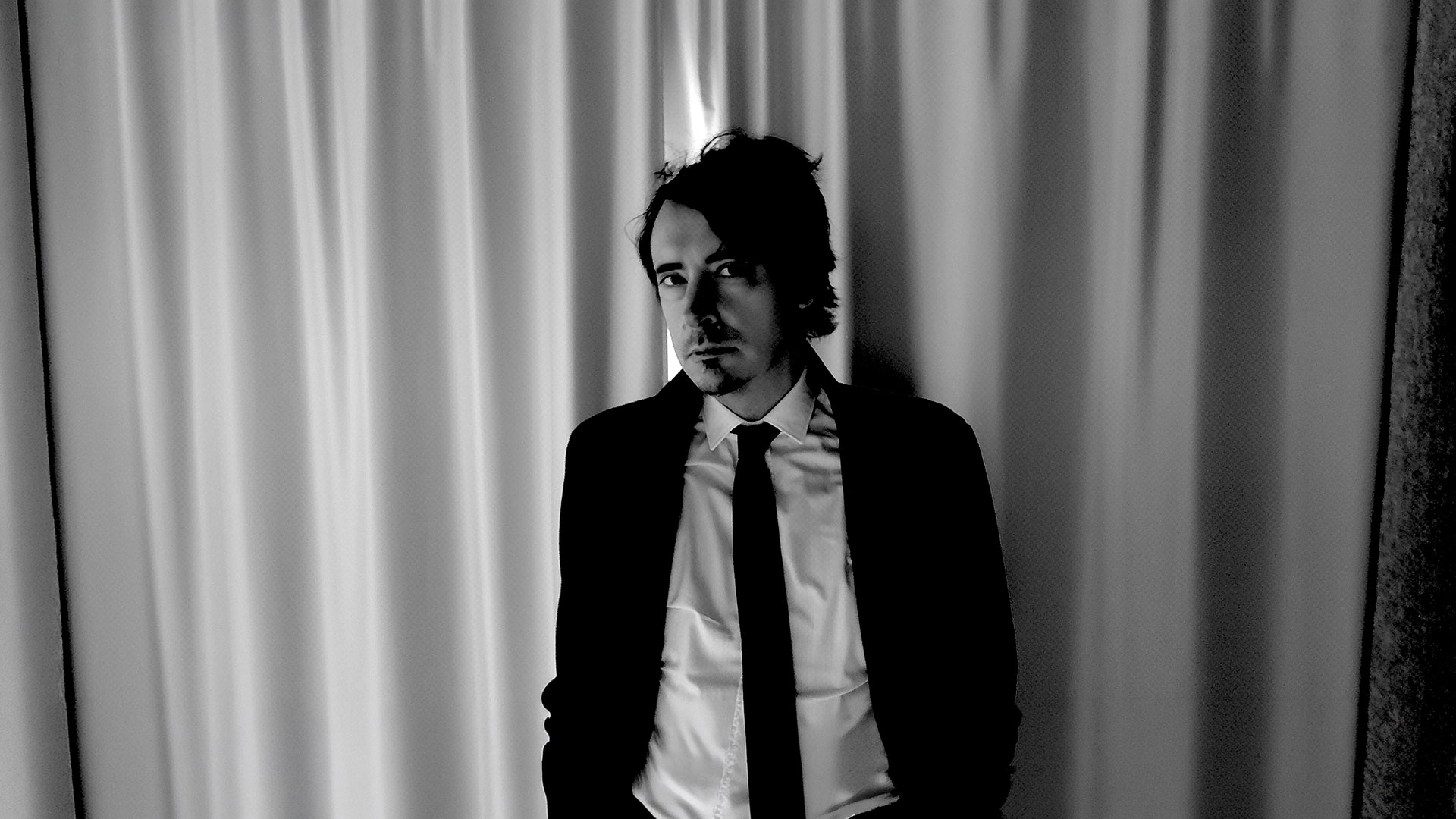
Saturn Spiders work in the space between Paris and Berlin. The group began by covering The Doors across European rooms. Chris Kay and Yigit Dokurlar later took older original ideas and shaped them into this thirteen-track debut. They recorded between the two cities with traditional instruments only. Joseph Holc sings, Kay and Dokurlar play guitars, Racim Boughrara holds the bass, Jean-Marc Weyl the drums, and Patrick Rivière moves between piccolo and keyboard. MoonCycle Records places them as romantic rock beside the baroque of The Court Jester. At Le Bateau Phare in Paris they closed a night on Lou Reed’s “Heroin,” reading the song as a portrait of self-hatred rather than a story about the drug.
In the older natural histories a spider does not hunt by sight. It waits until a vibration changes the tension in the web, then decides whether the change is prey, weather, or something that can be ignored. Saturn Spiders have built The Cosmic Contract of Being as that kind of instrument. The album registers the pressures of a present shaped by algorithmic loops, mass conformity, the rush to arm, and the quiet under street lights. It keeps the contract visible long enough to show where the strands can be broken.
The contract is the unspoken agreement that keeps a person inside the loop. On “Creepy lands” the voice moves through a spectral geography that quickly becomes “pixels around us, a digital maze yearning for freedom.” The bass and drums lock into an unyielding pulse that makes the trap physical while the lyric names “time is an iron glove.” Later the guitar opens a path that the words have already claimed: “Beyond the wires, breaking these chains.” The delivery stays low and controlled through the verses, then pushes higher once the maze is named.
“Silent minority (feat. ALLA ZHAROVA)” names the larger mechanism. “The army of dullness / Recruited your soul” arrives with dry irony in one presence and a heavier, worn answer in the other. The song refuses both the spectacle of the biggest gun and the technological exit that leaves a sinking ship. “All this struggle to find a new shuttle before the ship goes down” sits against the invitation that follows: “Come join me in the serenity of the silent minority.” Sparse electronic space and heavier guitar passages keep the two options audible at once.
The isolated self appears most clearly on “Heavenly blues.” The lyric shrinks the speaker to “just a little fly / Frantic about the world passing by.” The delivery stays flat and distant, almost spoken, while saturated guitars and a heavy rhythm hold the body still. “Heartbreak” strips the remaining ideal further. “Anyhow love is nothing but wind / Within the sail of old childlike dreams” is framed by vinyl crackle and wordless backing that fades with the admission that once the pain is gone, nothing followed. The final return of the line is almost bare.
“Stigmata” opens the record in winter moonlight and crimson lips, a gothic surrender that promises “forever young” and “forever wild.” The voice stays low and controlled until a liturgical counterpoint (“Take me to the dark”) and the repeated “I fly” push the descent into something that lifts. “Sweet surrender” begins with clear acoustic guitar and soft piano, then turns the gentle touch into “a razor blade.” Two registers meet on that line and stay locked through the final repetitions of “wild.” “You lose you love” keeps the wound open: the mask that hides from the sun, the weight of what has been done, the call that receives no reply. A long guitar passage holds the tension the words cannot close.
“Song for nephilims” calls the old giants who “break the chains” and walk among graves as guardians of what is still held dear. The rhythm marches under a vast black sky, then slows into wide keyboard fields where the epic becomes contemplation. “Street poetry” places the same need under real lights. “Under street lights, nothing to feel” is delivered with a rough, lived grain that later finds a shy smile and turns urban noise into a symphony. The promise that remains is simple: a love story that will never end.
“Pardonnez moi” asks forgiveness in French for a restless seduction inside “un monde si triste aujourd’hui.” The gait is quick, the guitars cut and open, and the final solo carries the attraction that ends in oblivion. “Ode to Bob D (Kings of horn)” gathers the voices into a rough, communal push for peace that flows “like a river.” Harmonica and background laughter keep the song close to a room rather than a stage. The chorus names the dreamers, the lovers, and the wise, then offers the song to the kings of the horn.
“Step me out” repeats the demand until the name returns and the mist of lies clears. A mission is declared and the voice stretches on the longer notes of “more, more, more.” “Sunride” finishes the arc in the open. “Hand in hand, face to the sun” and “breaking the chains” sit inside the same motion that ends with “So let’s walk in sunshine, we’re free, we’re real.” A second, higher presence answers the first, and the piano that closes the record leaves the light quiet rather than triumphant.
What The Cosmic Contract of Being holds is the precision of that movement. From the digital maze and the army of dullness to the street and the shared sunlight, Saturn Spiders keep the contract visible and then refuse its terms. The web still vibrates. They have already chosen where to step.