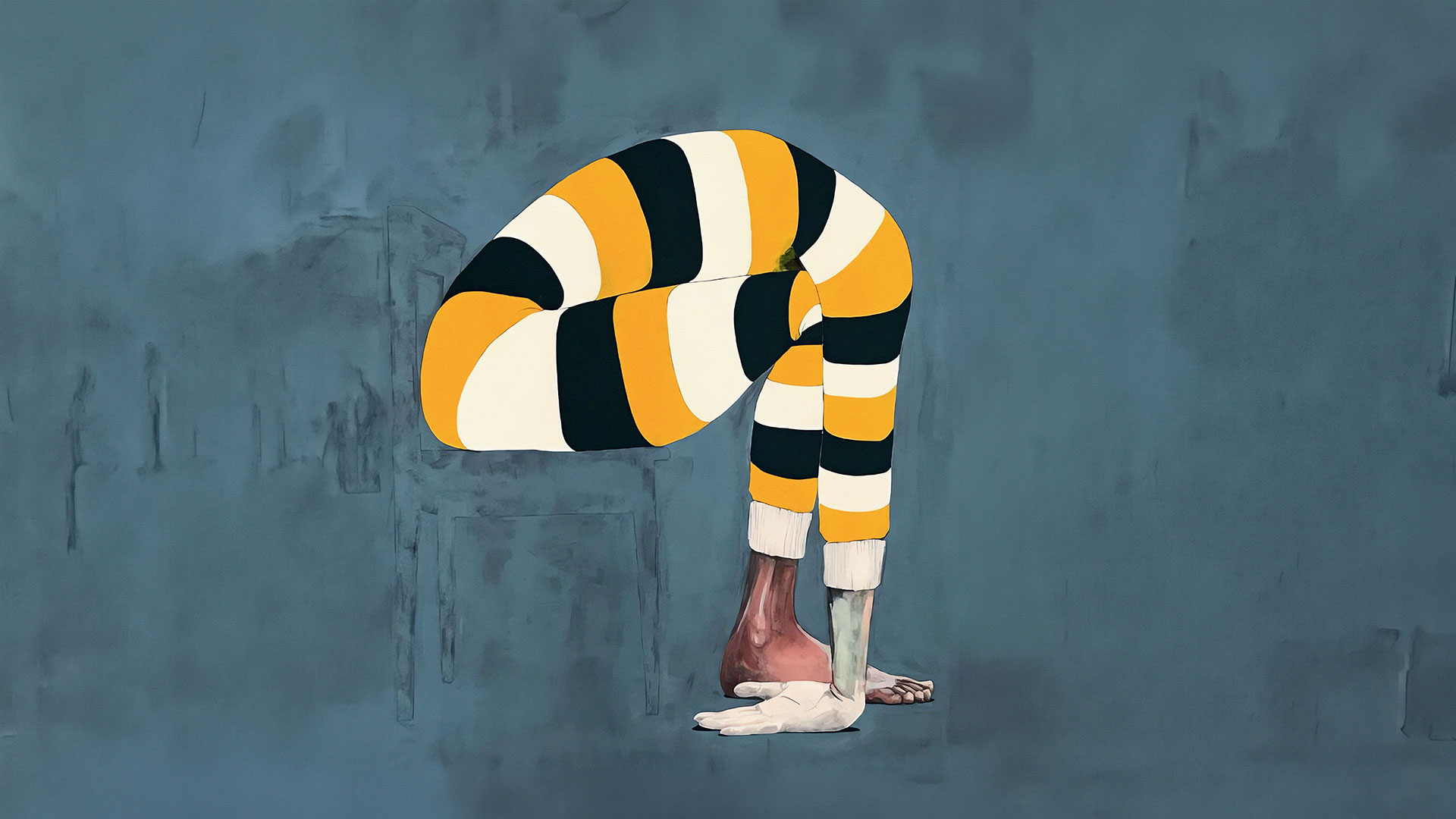
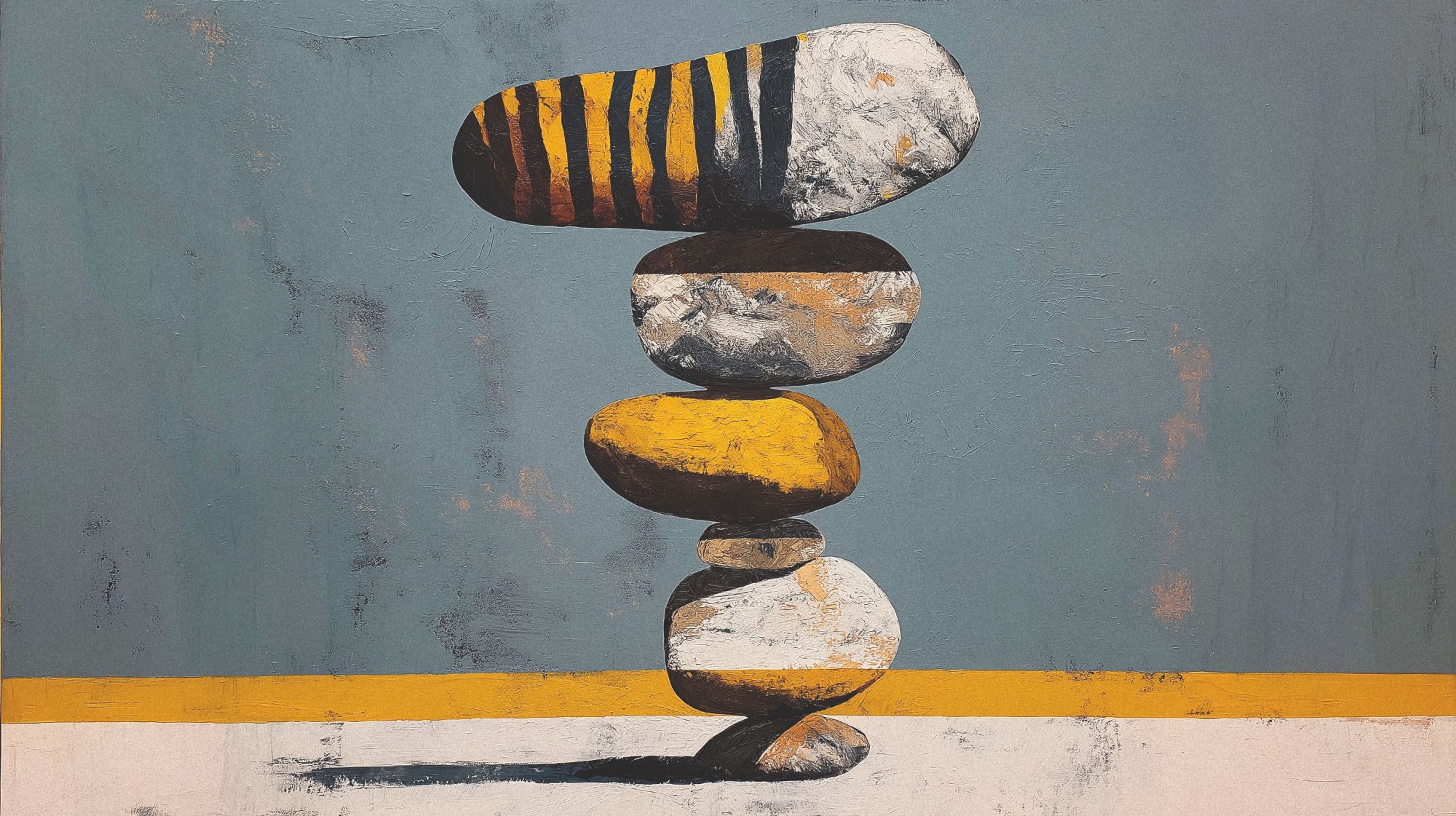
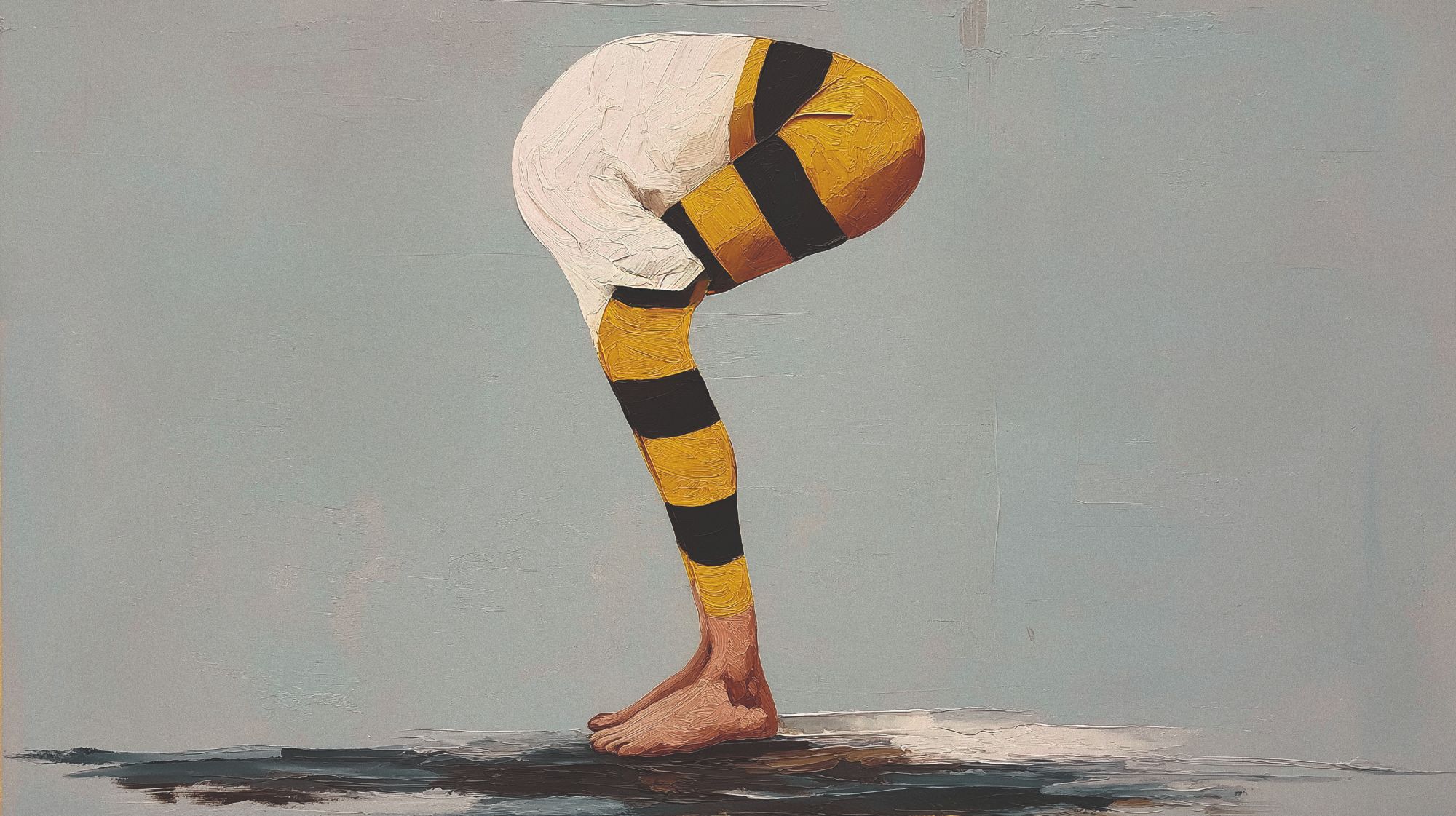
In the quiet halls of modern art museums, Alexander Calder’s mobiles hang in a state that looks like perfect rest. Thin rods and painted metal shapes offset one another so precisely that the whole construction seems to have found its center of gravity and decided to stay there. A breath of air from an open door, a visitor walking too close, and every element shifts. The balance was never fixed. It was a temporary arrangement of forces waiting for the next interruption. The cover painting for Vinyl Floor’s new record shows a related contortion: a body folded forward, hands planted, striped fabric stretched across an extreme hold that cannot last.
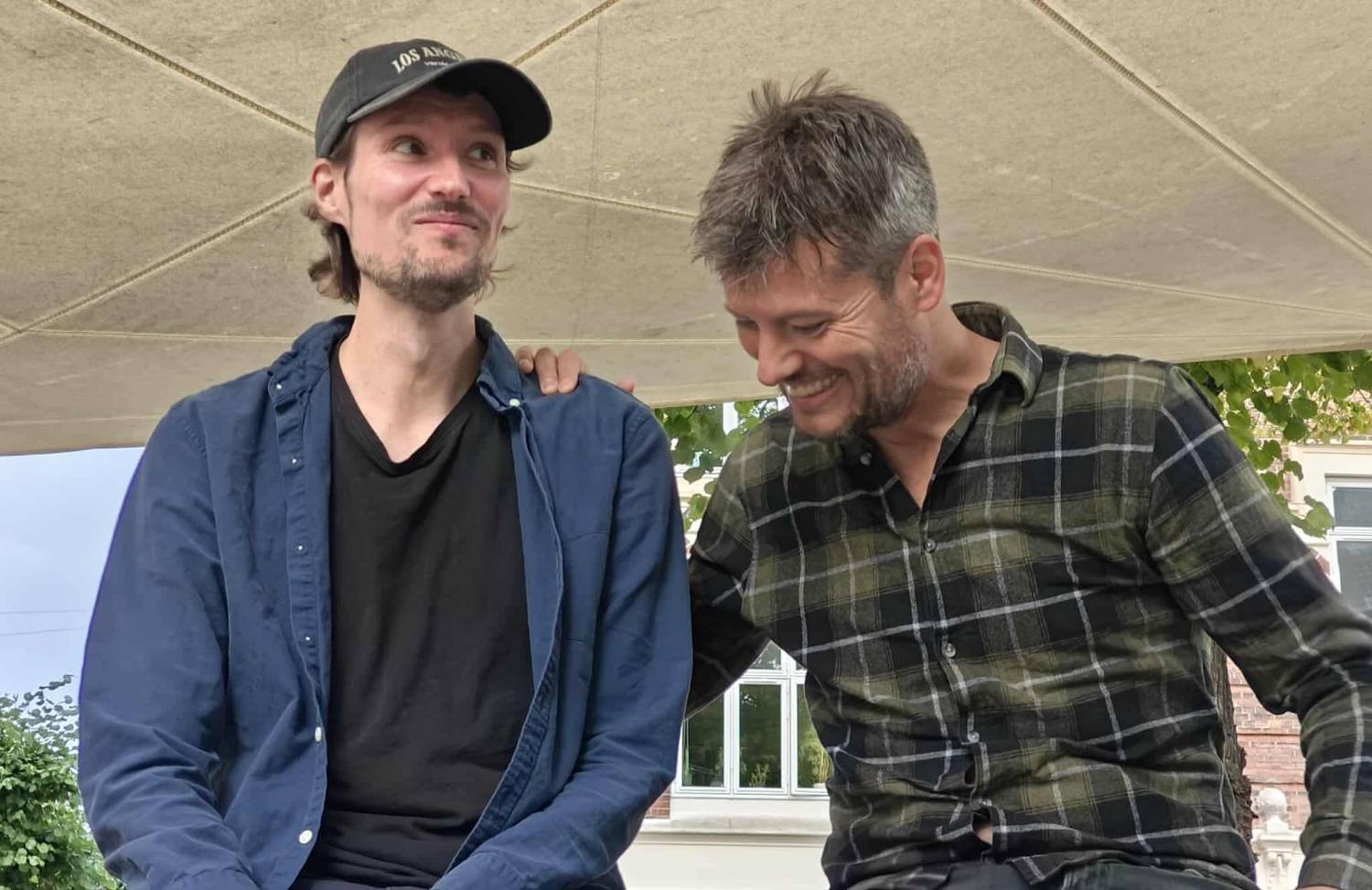
That image stays with me while listening to Balancing Act. Brothers Daniel Pedersen and Thomas Charlie Pedersen formed the band in Copenhagen in 2007. Across nearly two decades and more than two hundred shows they have released five albums before this one, from Do You Still Dream through Funhouse Mirror in 2022, touring the UK, Germany and Japan while expanding a foundation of 1960s and 1970s British rock and pop with horns, strings and electronics on their own Karmanian Records. The new album, recorded live at Studio Möllan in Malmö with Emil Isaksson and finished in Copenhagen, refuses the consoling story that life can be managed through careful adjustment. It names the collapse of that illusion. The lyrics track how individuals are pushed by forces that claim the right to shape their minds, their art and their fate. Those forces appear in two concrete places: the bureaucratic machinery of the music industry, with its contracts, NDAs and hollow promises of fame, and the brutal certainty of ideological or religious fanaticism that turns streets into sites of blood where peace treaties fail.
The album opens with “All This and More,” a march that places the listener inside the collective voice of the indoctrinated. “Completing our God’s will / Causing a landslide,” they sing, and “We’ll tear through the masses / Tear through the classes.” Wide guitar chords and organ give the opening a liturgical weight before bass and drums lock into a propulsive pace. The delivery stays firm and preacher-like, widening into stacked harmonies that sound like a mass without doubt. From there the perspective flips to the vulnerable individual. “I’m on the Upside” catches the vertigo of someone who has lost the ground. “Baby, will I ever land? … I’m on the upside / Baby, I’m in Neverland.” Sharp electric guitars and a tight rhythm section push forward, then drop out for a moment before the wall of sound returns. Long stacked vocalizations on “High” stretch the sense of elevation into something precarious.
“The Helping Hand” turns the industry itself into the antagonist. “I wonder why we’re all part of this industry, it’s a crazy constitution,” and “greedy monsters everywhere taking part in the confusion.” Piano and a dry electronic pulse keep the early verses close and watched, then the full band opens into melodic indie rock that makes the promises sound bright even as the words cut them down. The vocal line moves from quiet resignation toward urgency on the plea to “fight them all with all your might.” “Mr. Rubinstein” stages a direct confrontation with an oppressive mentor or critic. “Mr. Rubinstein / Give back what is mine.” Dense piano chords and strings hold the verses in a formal, almost academic space, the kind of room where every note is judged. When the frustration breaks, horns and a syncopated groove arrive, the arrangement itself rejecting the restraint. The repeated name becomes a choral demand before the instrumental release.
“Tell the World it Happened” slows for memory and duty. “Before we make amends / Tell the world” and the stacked “For us” that multiplies until the single voice becomes a collective prayer. Piano arpeggios and measured drums carry the plea, then the second half dissolves into strings and keyboards that feel like a secular procession. “Land of the Desert” maps an intimate desert of incommunicability. “In a state of confusion and a walled up mind.” Crystalline guitar arpeggios and strings create space, then a saturated guitar solo in the coda turns resignation into release. “Back of My Hand” sits in the sequence as another turn toward what is known too well and still fails. The title alone carries the double weight of familiarity and rejection, fitting the album’s pattern of bonds that look stable until the next force arrives.
“Puppet Laureate” returns to creative inadequacy under the master’s hand. “Just trying to compose my little self” while Haydn quartets fade in the street. Bright major-key guitars and driving rhythm give the anxiety a power-pop surface, then theatrical horns and rhythmic syllables in the coda let the mechanism wind down. “The Swan of Eileen Lake” addresses a magnetic, destructive figure. “All the sins in the world / All in the dress that you wear / Like a miracle” and “This time you’ve gone too far / You reek of grief and heartache.” Soft electric piano and measured drums hold the opening letter-like tone, then distorted guitars swell the radiance and the cost at once. The sudden retreat on “A delicate swan you are” leaves the fragility exposed.
“Adelaide” returns the lost love in a dream and the guilt that follows. “Seal my fate, baptize me / Or drown me, my sweet Adelaide.” Solo piano opens the confession, rhythm section and then heavy electric guitars build a tide, the repeated “I dreamed of you” answered by the full band before a long guitar coda. “Less Dystopian Book” names the industry myth directly. “All rock and roll has become / Is a myth of a man walking in / To be greeted by a company” and “the strictures of the NDA.” Compact rock energy and horns suggest another narrative, then the arrangement strips back to organ and reverb guitars for the collective surrender: “Maybe we shall not prevail / ’Cause it’s over.”
“Jacaranda Blossoms” expands to seven minutes and holds the private dream against historical violence. “A jacaranda blossoms where the streets were paved with blood / A jacaranda blossoms where a peace treaty could not.” Crystalline piano and clean guitars open the domestic vision, then heavy chords and strings shift the frame. The long instrumental suite, with its piercing guitar solo, lets the music carry the weight the words have already named. The title track “Balancing Act” closes in under three minutes and states the thesis without decoration. “They say life’s a balancing act / They’re all full of shit” and the Blake lines “Some are born to sweet delight / Some are born to endless night.” A mechanical synth pulse and regular piano give way to saturated guitars that erase the initial composure. The stacked “Hear me out” becomes the urgent call before the final dissolution.
Across the forty-eight minutes the arrangements move from post-punk urgency and power-pop drive into chamber-like art rock, progressive expansions and the hazier edges of the closer. Strings from Christian Ellegaard of the Danish Symphony Orchestra and horns and upright bass from Bebe Risenfors (whose work appears on Tom Waits albums including Alice, Blood Money and Orphans) color the textures without ever turning the songs into showcases. The brothers share lead vocal duties, moving between confessional closeness and wider harmonic layers that sound like more than one person trying to hold a line. What gives Balancing Act its force is the precision with which the music answers the lyrics. When the words name the NDA, the fanatic’s landslide, the failed treaty or the arbitrary birth into delight or night, the arrangements open space for the feeling to land. The album does not offer a new equilibrium. It records the moment the mobile shifts and keeps recording until the last note fades.