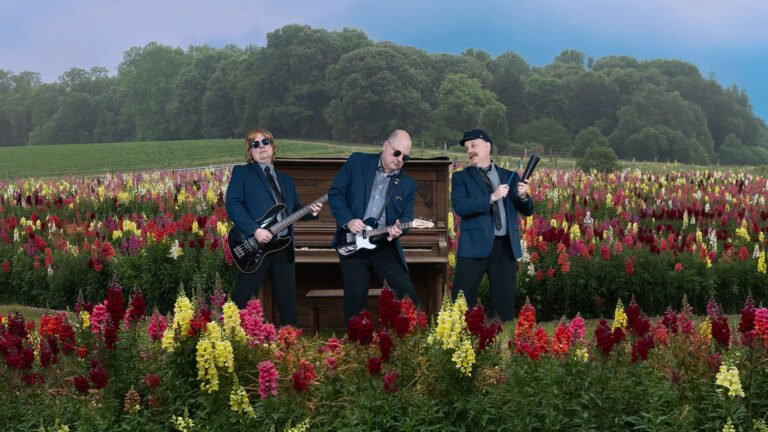
The Atlanta-rooted trio keep an electric tenor ukulele at the centre and let the wear of connection show without losing the signal.
Winchester 7 & the Runners have spent years working from three points on a map. Winchester 7 handles vocals and electric tenor ukulele out of Sanctuary Studio in Atlanta. Phil Voorhees plays bass from Amsterdam. Jack Kane keeps the drums somewhere itinerant in the United Kingdom. The arrangement began almost as a joke in the band’s own telling: two players decided to pull a runner and the one who caught them brought a ukulele instead of a conventional guitar. Since the 2019 debut Beyond the Dome they have kept the same core, moving through Argos Holiday, Catacomb Songs, Heart of the Golden Mystics, and the 2024 concept record The Waking Giant, which imagined an AI-run immersive retirement world. Winchester 7 also stepped out for the 2025 solo EP Postcards. The geography never settled into one room. The sound did.
In the Japanese practice of kintsugi, a broken ceramic vessel is repaired with lacquer mixed with powdered gold. The crack is not hidden or sanded away. It becomes the brightest line on the object, the part that draws the eye and proves the vessel survived use. No Worse For Wear works from a similar logic. The EP does not pretend the contemporary world leaves no marks. It records the marks, then traces them with melody, rough electric texture, and a warm baritone voice that can drop into a conversational register or open into doubled harmonies. The wear shows. The record remains usable, and the gold is in the grain.
Waitin’ Here For You opens with a compact drum groove and a round bass line that never hurries. The electric tone carries blues and garage grit without tipping into saturation. Winchester 7’s voice stays slightly rough and present, then thickens with doubles on the chorus. The verses name the modern transaction directly: “This one’s for our advertisers,” then subscribers, patrons, tip jars. The chorus answers with a simple reciprocal claim: “Well, if you believe in me / And I believe in you.” The instrumental stretches let the riff and the rhythm section take the weight. The song does not resolve the contradiction. It places the two lines next to each other and lets the groove hold both.
I’m Goin’ Down shifts the temperature. Synths and dark arpeggios set a controlled nocturnal pace. The vocal sits lower, more reflective, until the chorus opens on “I’m goin’ down, there’s nothing I can do” and then counters it with “this time I made it through.” The production stays clean and spare. Pads and synthetic percussion create space rather than density. The bridge turns toward light and return: “And every star I wish upon will be to return to you.” The track keeps its tension without forcing a climax.
The World From My Bed, with Airinna Namara, brightens the palette. Clean guitars, a melodic bass, and light synth touches give the song a dream-pop lift while the drums stay linear. The lyric moves from remembered newspapers and phone calls to the present fact of seeing the world from bed: “All of its beauty / All that I dread.” The push and pull between “Maybe we should go out” and the final “I don’t think I’ll go out” stays unresolved. Namara’s presence fills the harmonic space without crowding the lead. The song captures the small, precise alienation of screens as both window and wall.
Ballad of the Bishop of Eastwood stretches longer, built on a straight drum pattern and electric lines that alternate between incisive riffs and wider, atmospheric figures. The vocal stays conversational in the verses, describing a hotel-bar conversation with a bishop about the human condition. The chorus gathers force around a clear resilience claim: “We all get knocked down sometimes / But how you get up defines.” The arrangement leaves room for the instruments to breathe between the narrative stretches. It is the most open-handed track on the EP, the one that treats endurance as a shared fact rather than a private struggle.
The Talk tightens everything again. Short, stop-start, and dry, it runs on nervous guitars, a pulsing bass, and a drum kit that keeps the room sound. The chorus hammers a simple observation: “Yeah, talk, talk, talk ’til the algorithm is full.” The verses place the narrator on the interstate, at the local, at a net café, always missing or receiving a call that has already said everything. The track ends almost as soon as it states its point. That brevity is part of the effect. Saturation does not require length.
10 Easy Steps returns to a classic rock-band frame. The electric riff is immediate, the drums and bass lock into a propulsive pattern, and the vocal phrases the verses with rhythmic precision before opening in the chorus. The lyric is concrete: “Panic attack in the bathroom, well the walls, they are closing in,” “Plaster on my plastic smile,” “I’ll try them ten easy steps.” The instrumental break is brief and guitar-led. The final chorus doubles without adding ornament. The song turns a private moment of physical constriction into something that can be sung along with, which is its own form of control.
The Way You Moved closes the sequence with piano, a measured rhythm section, and a warmer, more spacious mix. Jenny Conlee of The Decemberists contributes keys. Guy Page of Coach Party handled mixing and drums. The vocal is round and direct, supported by soft harmonies. The lyric moves from a table for one to the invitation “Come on, dance like you were young” and the reassurance “your race, it ain’t run.” The long instrumental coda lets the piano and sustained guitars settle. After the tighter, more agitated tracks, the closer does not erase the earlier tension. It simply offers a different temperature in which the same concerns can rest.
Across the seven tracks the electric tenor ukulele remains the constant centre, sometimes carrying the riff work, sometimes sitting inside a wider arrangement of guitars, bass, drums, and occasional keys or synths. The production keeps an organic grain even when the palette shifts from garage pulse to darker synth textures to cleaner indie-pop lift. The writing stays specific about the present: advertisers and algorithms, the world visible from bed, the plastic smile held in place while counting tiles. The hope that appears is practical rather than abstract. It shows up as reciprocal belief, as the knowledge that getting up again defines the next step, as the invitation to move the way one used to move.
No Worse For Wear does not claim that the contemporary marks can be removed. It records them with enough clarity and enough melodic precision that the record itself becomes the gold line along the fracture. The signal stays readable. The vessel still holds.
Follow Winchester 7 & the Runners
No Worse For Wear is out now.
Listen: Spotify · Bandcamp · SoundCloud
Follow: Instagram · YouTube · Facebook · X · Official Site
Join the Club
Like this story? You’ll love our monthly newsletter.
Thank you for subscribing to the newsletter.
Oops. Something went wrong. Please try again later.

ROMBO Editorial Staff
The collective voice behind ROMBO Magazine’s news, reviews, features, and cultural coverage.